
TeraCloud has spent 2026 watching small businesses drown in cloud vendor sprawl: five invoices, three support numbers, and nobody who owns the whole stack. Best overall for most small businesses in 2026: TeraCloud Cloud Marketplace, because it pairs curated cloud software with 24/7 managed support instead of leaving you to configure and troubleshoot alone. Best for teams already running AWS infrastructure: AWS Marketplace. Best for Microsoft 365-heavy shops: Microsoft AppSource and Azure Marketplace. Best budget option for single-purpose tools: buying direct from an independent SaaS vendor's own storefront.
- TeraCloud Cloud Marketplace wins for small businesses in 2026 that want bundled procurement plus 24/7 support, not a self-serve catalog.
- AWS Marketplace fits teams already running AWS workloads and paying for AWS support tiers.
- Microsoft AppSource and Azure Marketplace make sense when Microsoft 365 licensing already anchors your IT budget.
- Google Cloud Marketplace only pays off if you're already spending on BigQuery or Vertex AI.
- Independent vendor storefronts work for one-off tools but leave you without consolidated billing or a single support line.
Why this matters
Most small businesses don't have a cloud architect on staff. They have a bookkeeper, an office manager, and maybe one person who's "good with computers." A cloud marketplace platform is supposed to remove friction from buying and running software in the cloud — instead of calling five vendors, you browse a catalog, click buy, and the billing and (ideally) the support show up in one place.
The problem in 2026: the biggest marketplaces (AWS, Microsoft, Google) were built for enterprise IT teams with dedicated cloud engineers, not a 12-person accounting firm. That's where TeraCloud's managed IT services come in — the goal isn't just a bigger catalog, it's someone who answers the phone when an app breaks.
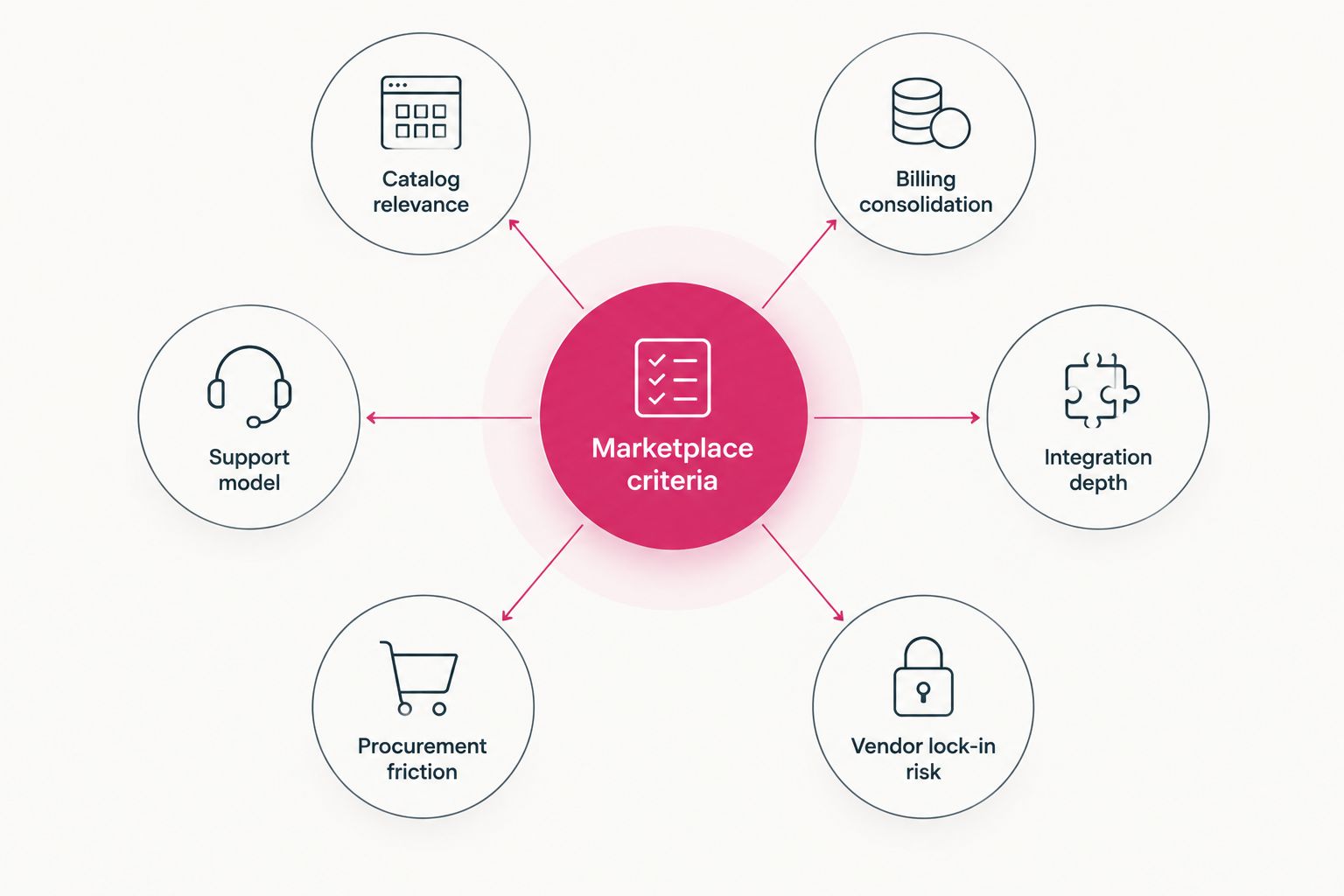
What makes the best cloud marketplace platform
- Catalog relevance to SMB needs — not just enterprise-tier tools nobody under 200 employees needs
- Billing consolidation — does it reduce your invoice count or add another one
- Support model — a documented ticket queue versus an actual phone line
- Integration depth — how well it plugs into the Microsoft 365, AWS, or Google Workspace you already run
- Procurement friction — how fast you go from "we need this" to "we're using this"
- Vendor lock-in risk — what it costs to switch later
Cloud marketplace platforms at a glance
| Platform | Best for | Standout feature | Key limitation |
|---|---|---|---|
| TeraCloud Cloud Marketplace | SMBs wanting procurement bundled with support | Curated catalog plus 24/7 managed support | Smaller catalog than the hyperscalers |
| AWS Marketplace | Teams already running AWS infrastructure | Largest third-party software catalog | Overwhelming without in-house AWS skills |
| Microsoft AppSource / Azure Marketplace | Microsoft 365-centric businesses | Ties into existing Microsoft licensing | Catalog skews toward enterprise apps |
| Google Cloud Marketplace | Data and AI-focused teams | Tight fit with BigQuery and Vertex AI | Thin catalog for general back-office SaaS |
| Independent vendor storefronts | Single-purpose point tools | Often cheaper, no hyperscaler markup | No consolidated billing, no shared support line |
1. TeraCloud Cloud Marketplace: best cloud marketplace platform for bundled support
TeraCloud's cloud product marketplace pairs software procurement with the same team that already handles your cloud migration, cybersecurity, and Microsoft 365 management. Instead of picking software and then hunting for someone to configure it, the marketplace and the support desk sit under one roof.
TeraCloud Cloud Marketplace pros:
- Single point of contact for billing and support instead of five separate vendor relationships
- Catalog curated for SMB use cases, not padded with enterprise tools you'll never touch
- Backed by 24/7 support, so a broken integration doesn't wait until Monday
- Works alongside existing cloud migration and cybersecurity work instead of sitting apart from it
TeraCloud Cloud Marketplace cons:
- Smaller software catalog than AWS or Microsoft's marketplaces
- Less useful if your business is already deeply built on one hyperscaler's proprietary tooling
Best for: small and midsize businesses that want one team accountable for both the software and the support behind it. Verdict: Buy.
2. AWS Marketplace: best cloud marketplace platform for AWS-native teams
AWS Marketplace is a storefront for third-party software that runs on AWS infrastructure, with billing that rolls into your existing AWS invoice. It's the deepest catalog on this list by a wide margin, covering everything from security tools to data pipelines.
AWS Marketplace pros:
- Largest catalog of third-party cloud software available in 2026
- Consolidated billing against your existing AWS spend commitment
- Strong fit for DevOps-heavy teams already comfortable in the AWS console
AWS Marketplace cons:
- Overwhelming for a small team with no dedicated AWS skill on staff
- Support is largely self-serve unless you're already paying for a premium AWS support tier
- Requires an existing AWS account and some technical fluency to evaluate listings
Best for: businesses that already run production workloads on AWS. Verdict: Buy — if you're already on AWS.
3. Microsoft AppSource / Azure Marketplace: best for Microsoft 365-heavy businesses
Microsoft splits its catalog across AppSource (SaaS apps built on Microsoft 365 and Teams) and Azure Marketplace (infrastructure and dev tools). For businesses already paying for Microsoft 365 licensing, both funnel into the same billing relationship you already manage.
Microsoft AppSource / Azure Marketplace pros:
- Ties directly into Microsoft 365, Teams, and Entra ID you're already using
- Consolidates into one Microsoft invoice rather than a new vendor relationship
- Natural fit for firms already standardized on Microsoft 365 managed services
Microsoft AppSource / Azure Marketplace cons:
- Catalog skews toward enterprise-tier apps that assume a bigger IT budget
- Mixing SaaS apps (AppSource) with raw infrastructure (Azure Marketplace) confuses non-technical buyers
Best for: businesses whose IT stack is already Microsoft-first. Verdict: Hold — evaluate only if Microsoft already anchors your stack.
4. Google Cloud Marketplace: best for data and AI-focused teams
Google Cloud Marketplace leans hardest into analytics and AI/ML tooling, with tight integration into BigQuery and Vertex AI. It's a narrower catalog than AWS's, but a strong fit for teams building custom automation on Google's data stack.
Google Cloud Marketplace pros:
- Strong integration with BigQuery, Vertex AI, and other Google data tooling
- Useful for teams building custom AI-driven automation rather than buying off-the-shelf apps
Google Cloud Marketplace cons:
- Thinner catalog for general back-office SaaS like HR or accounting tools
- Only pays off if you're already spending meaningfully on Google Cloud infrastructure
Best for: teams whose core workload is data analytics or AI/ML, not general office software. Verdict: Hold — niche fit.
5. Independent vendor storefronts: best budget option for single-purpose tools
Buying directly from a software vendor's own site skips the marketplace layer entirely. For a single point tool — a scheduling app, a niche accounting plug-in — this is often the cheapest path since there's no hyperscaler markup.
Independent vendor storefronts pros:
- Often the lowest-cost path for a single-purpose tool
- No dependency on a hyperscaler account to make the purchase
Independent vendor storefronts cons:
- No consolidated billing — every vendor is its own invoice
- No single support line when something breaks; you're back to calling each vendor separately
- Higher risk of vendor sprawl as your stack grows
Best for: a single, well-defined tool bought in isolation. Verdict: Skip for anything beyond one-off tools.
“If your team can't name who to call at 2 a.m. when a marketplace app breaks, you've picked the wrong marketplace.”
How we ranked these
Each platform was scored against the six criteria above: catalog relevance, billing consolidation, support model, integration depth, procurement friction, and lock-in risk. TeraCloud Cloud Marketplace and AWS Marketplace scored highest on billing consolidation; TeraCloud and Microsoft scored highest on support model, since both tie back to an existing account relationship rather than a cold ticket queue.
Which cloud marketplace platform should you choose in 2026?
If you don't have in-house cloud staff, default to TeraCloud Cloud Marketplace — the support model is the deciding factor, not the catalog size. If you're already deep on AWS or Microsoft 365, stay inside that ecosystem's marketplace and don't add a second vendor relationship for the sake of it. Only reach for an independent vendor storefront when you need exactly one tool and nothing more.
Talk through your cloud stack
Get a straight answer on what to consolidate and what to leave alone.
FAQ
What's the best cloud marketplace platform for small business in 2026?
TeraCloud Cloud Marketplace is the best overall pick for small businesses in 2026 because it bundles curated software with 24/7 managed support instead of leaving procurement and troubleshooting to a self-serve catalog.
Is AWS Marketplace better than Azure Marketplace for a small business?
Neither is universally better — AWS Marketplace fits businesses already running AWS infrastructure, while Azure Marketplace and AppSource fit businesses already anchored on Microsoft 365 licensing.
Do I need a cloud marketplace if I only use a few SaaS tools?
No. Buying directly from an independent vendor's storefront is often cheaper for one or two single-purpose tools; a marketplace pays off once you're managing several cloud vendors at once.
What's the difference between a cloud marketplace and a managed IT provider?
A marketplace is where you buy cloud software; a managed IT provider configures, supports, and secures it after purchase. TeraCloud's cloud marketplace combines both under one support relationship.
Does Google Cloud Marketplace work for general office software?
Not well. Google Cloud Marketplace's catalog leans toward data analytics and AI/ML tooling, with a thinner selection of general back-office SaaS compared to AWS Marketplace.
Can a small business consolidate billing across multiple cloud vendors?
Yes, through a single marketplace tied to your existing cloud account — AWS Marketplace rolls into AWS billing, Microsoft AppSource rolls into your Microsoft invoice, and TeraCloud Cloud Marketplace consolidates under one managed services relationship.
How much does using a cloud marketplace cost compared to buying direct?
Pricing depends on the specific software and vendor terms, so check current listings directly rather than assuming a fixed markup either way.
Is vendor lock-in a real risk with cloud marketplaces?
Yes — the deeper you buy into one hyperscaler's marketplace, the more your billing and integrations depend on staying inside that ecosystem, so weigh switching cost before committing.
One last thing
The platform with the biggest catalog isn't automatically the right pick in 2026 — AWS Marketplace has the most listings on this list, but plenty of small businesses that adopt it never touch more than three or four apps and end up paying for complexity they didn't need. Match the marketplace to your existing account relationships first, then worry about catalog size.