
Choose TeraCloud if your business needs managed IT, cybersecurity, cloud migration, or help automating repetitive work; choose Jumpfactor if your IT services business needs B2B marketing and customer acquisition. This is an operations-versus-marketing decision, not a comparison between interchangeable IT providers.
- TeraCloud vs Jumpfactor compares managed IT services with B2B marketing, not two equivalent providers.
- TeraCloud is best for small and midsize businesses seeking managed IT, cybersecurity, and cloud services.
- Jumpfactor is best for IT services businesses seeking marketing and customer acquisition.
- Choose by the business problem, then compare scope, accountability, and contract terms.
Why this matters
A search for teracloud vs jumpfactor puts two different buying decisions on the same page. One concerns the technology your employees use. The other concerns how a technology business attracts customers.
For your 2026 shortlist, start with the problem rather than the company name. Failed employee access, unreliable systems, and cloud migration belong in an IT services brief. Weak market visibility and insufficient sales opportunities belong in a marketing brief.
TeraCloud is the better fit for small and midsize businesses buying managed IT services rather than marketing services. Jumpfactor belongs on a marketing shortlist for businesses selling IT services. Choosing the right category matters before comparing individual providers.
At a glance
| Dimension | TeraCloud | Jumpfactor |
|---|---|---|
| Best for | Small and midsize businesses buying IT support | IT services businesses buying B2B marketing |
| Primary outcome | Support business technology and reduce operational friction | Attract prospective customers for the business |
| Standout capability | Managed IT alongside cybersecurity, cloud, and automation services | Marketing focused on B2B technology and IT services |
| Cybersecurity responsibility | Offers cybersecurity services | Evaluate as a marketing provider, not an IT security operator |
| Cloud and data work | Offers cloud migration and data management | Marketing engagement rather than a cloud migration engagement |
| Working relationship | Provides 24/7 support; define escalation and service responsibilities | Define marketing deliverables and sales handoffs |
| Scope boundaries | Internal technology and operational workflows | External positioning and customer acquisition |
| Pricing model | Evaluate recurring services separately from project work | Evaluate ongoing marketing separately from campaign deliverables |
The commercial rows describe how to evaluate proposals, not guaranteed contract structures. Neither company wins merely because its proposal has more line items. Your decision rests on which responsibilities you need to assign.
Jumpfactor fits marketing buyers; managed IT fits operations buyers
Best for marketing: Jumpfactor. Best for internal IT: the managed services partner. Jumpfactor’s public positioning is B2B marketing for technology and IT services businesses. That makes it relevant when you sell IT services and need help reaching buyers.
For example, an IT services founder who wants a clearer market position needs a marketing discussion. The questions concern target customers, messaging, campaign execution, and how inquiries reach sales. They do not concern who fixes employee devices.
A small-business leader facing recurring support problems needs the opposite conversation. The brief should identify affected systems, support responsibilities, security concerns, and business-critical workflows. A marketing engagement does not answer that brief.
The limitation on each side follows from its purpose. Managed IT is not a substitute for customer acquisition, and marketing is not a substitute for operational support. Do not force either provider into the wrong category simply to keep one vendor relationship.
Marketing owns acquisition; managed IT owns technology operations
A 2026 comparison should separate the result you want from the activity a provider performs. Publishing content is an activity. Generating relevant sales conversations is a marketing outcome. Resolving support requests is an activity. Keeping employees able to work is an operational outcome.
Jumpfactor wins the category fit when your priority is marketing an IT services business. Its marketing positioning matches that assignment. Judge a proposed engagement against the buying audience and sales process, not against help-desk coverage.
For managed IT, ask what happens when an employee cannot access a business application. Who receives the issue? Who investigates it? Who communicates with your team? Those responsibilities need an operational owner.
Avoid a shared scorecard that blends unrelated results. Website inquiries and resolved support requests do not measure the same thing. Each engagement needs a business outcome its provider can actually influence.
Neither standout capability replaces the other
The managed IT offering combines support with cybersecurity, cloud migration, data management, and practical automation. That breadth is relevant when your operational problems cross systems rather than sit inside a single application.
Jumpfactor’s distinguishing category is B2B marketing for technology businesses. That focus is relevant when your buyers need to understand a technical service before they speak with sales. Evaluate its proposed positioning and marketing work against your actual customer profile.
Neither capability is an all-purpose advantage. A business buying employee support gains nothing from treating marketing specialization as a help-desk feature. An IT services company buying demand generation gains nothing from treating cloud migration as a campaign deliverable.
Ask each provider to connect its proposed work to a named problem. A broad service list becomes useful only when it explains who will do what for your business.
TeraCloud fits cybersecurity work, not marketing execution
Cybersecurity protects systems, accounts, and business information. Marketing communicates what a business offers and brings that offer to prospective customers. These responsibilities overlap in conversation, but they are not interchangeable.
Choose the cybersecurity services provider when your requirement is operational security. The client’s stated offering includes cybersecurity. That supports category fit; it does not establish a particular certification, detection platform, recovery guarantee, or response deadline.
Build the security brief around responsibilities:
- Identify the accounts, devices, and systems in scope.
- Assign responsibility for reviewing alerts and investigating incidents.
- Define how employees report suspicious activity.
- Specify who authorizes changes and communicates during an incident.
Jumpfactor belongs in a different conversation: how a cybersecurity or IT services business explains its offering to buyers. Marketing a security service does not mean operating a customer’s security environment. Keep that distinction explicit in your 2026 procurement brief.
TeraCloud fits cloud migration and data management
Cloud migration moves applications, files, or services into a different hosted environment. Data management concerns how business information is organized, accessed, and maintained. Both appear in the managed IT provider’s stated offering.
The managed services partner wins category fit for cloud and data work. Jumpfactor’s marketing role does not make it an alternative for moving business systems or managing operational data.
Before you commission a migration, document the applications employees depend on, who controls access, and what successful completion means. Include a rollback plan: the agreed method for returning to the previous setup if the change fails.
Read the small-business cloud migration provider guide if migration is the actual buying decision. Compare providers within that category rather than comparing an IT engagement with a marketing engagement.
The same boundary applies to automation. Automating an internal approval process is an operational assignment. Improving how prospective customers understand that process is a marketing assignment. Name the workflow before naming the vendor.
Both need explicit accountability; neither wins by promise alone
The client provides support 24 hours per day, 7 days per week. That describes support coverage, not a guaranteed time to resolve every issue. Your agreement still needs to define priorities, escalation, exclusions, and responsibilities.
For a marketing engagement, accountability means something different. Specify who approves messaging, who publishes deliverables, who handles incoming inquiries, and how sales feedback reaches the marketing team. A campaign can produce activity without a clear sales handoff.
There is no universal winner on accountability. The useful comparison is whether each proposal assigns responsibility for the result you are buying. A company name does not answer that question.
For either engagement, appoint 1 accountable owner inside your business. This is a recommended governance choice, not a staffing requirement. Give that person authority to approve work, resolve conflicting requests, and confirm whether the agreed outcome has been delivered.
Separate scopes work better than a forced all-in-one comparison
If your company sells IT services, you can have both needs at once: reliable internal technology and stronger customer acquisition. Those needs can coexist without becoming the same project.
Jumpfactor fits the external marketing scope; the managed IT partner fits the internal technology scope. Neither should receive credit for responsibilities outside the proposed agreement. That boundary also prevents duplicate work and unresolved handoffs.
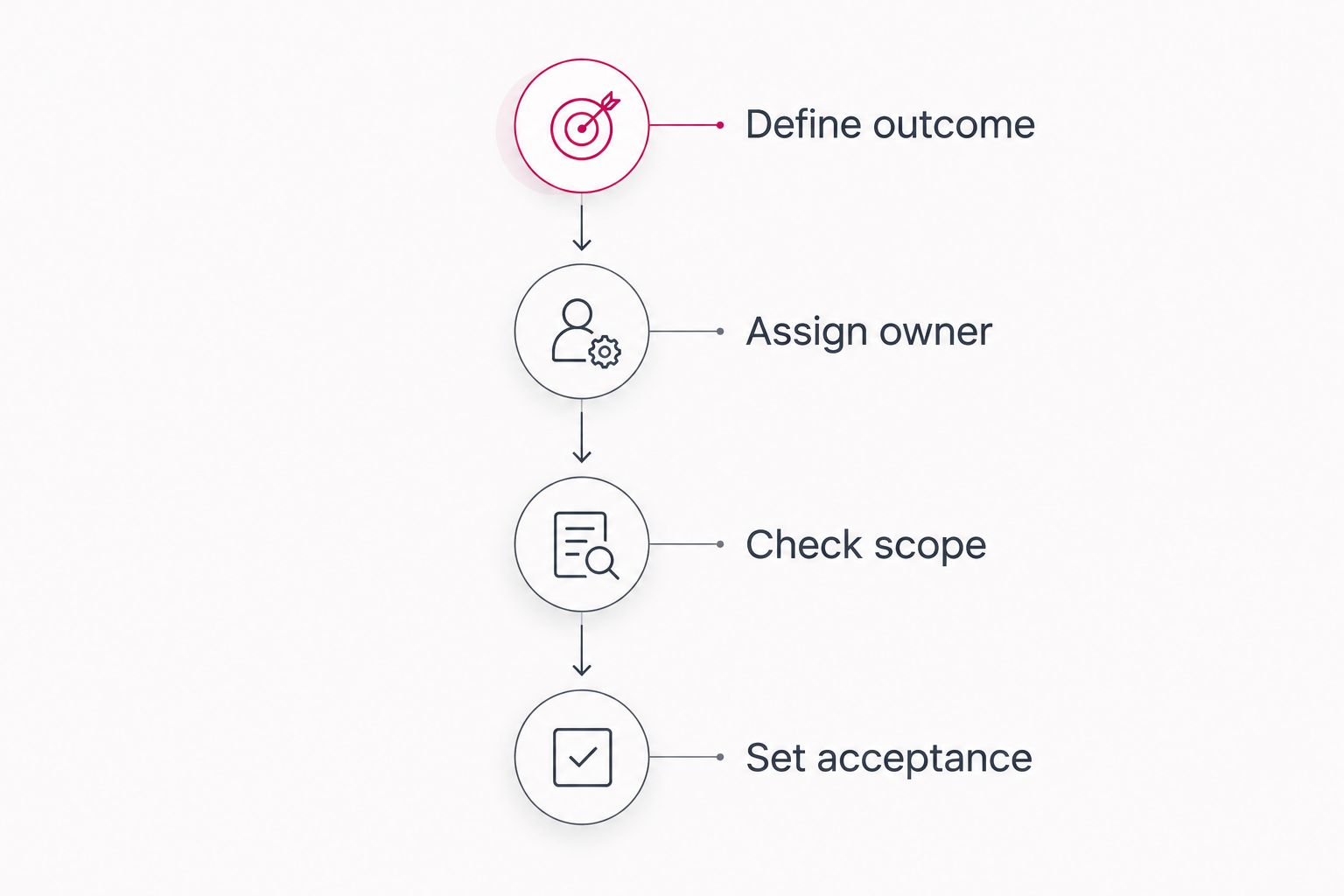
Write 2 separate briefs when both needs exist. Use the same short process for each:
- Define outcome: Describe the business problem and the result you need.
- Assign owner: Name the person accountable for decisions and approvals.
- Check scope: Identify included work, dependencies, and exclusions.
- Set acceptance: State how your business will confirm completion or progress.
These are recommended planning steps, not claims about either provider’s delivery process. Use them to make proposals comparable within their respective categories.
Pricing models: compare commitments within each service category
For your 2026 evaluation, distinguish continuing work from a defined project. This is a procurement framework, not a statement that either provider uses a particular billing structure.
In managed IT, examine which responsibilities continue throughout the agreement and which belong to a separate implementation. Support, migration, security work, and automation need clear boundaries. Do not assume every service named in a company description is included in one engagement.
For marketing, distinguish ongoing activity from a specific deliverable or campaign. Ask who owns the resulting content, accounts, reporting, and approvals. Check what continues after the initial work and what requires a new scope.
A recurring commitment supports continuity but requires clear ongoing responsibilities. A project structure creates a defined endpoint but needs explicit acceptance criteria and handoff arrangements. Those are tradeoffs to assess in both proposals.
Neither pricing model wins without a matched scope. Compare managed IT proposals with managed IT proposals and marketing proposals with marketing proposals. Include change procedures, contract duration, exclusions, and exit responsibilities in the decision.
Final verdict for 2026
Choose TeraCloud if you are an SMB operations buyer
TeraCloud wins for a small or midsize business seeking managed IT services. Choose this route when your brief concerns employee support, cybersecurity, cloud migration, data management, or repetitive internal work.
Its stated services match those operational needs. The boundary is equally clear: that offering does not establish a marketing engagement for attracting new customers. Confirm the exact responsibilities before signing.
Choose Jumpfactor if you are an IT services growth buyer
Jumpfactor wins for an IT services founder or marketing lead buying B2B marketing. Choose this route when your brief concerns reaching prospective customers and improving how your business presents its services.
Its category fit is marketing, not employee IT support. Keep operational technology responsibilities with the appropriate internal team or IT services provider.
| Dimension | Winner |
|---|---|
| Best for | Managed IT partner for operations; Jumpfactor for marketing |
| Primary outcome | Managed IT partner for technology operations; Jumpfactor for acquisition |
| Standout capability | Split by the service you need |
| Cybersecurity responsibility | Managed IT partner |
| Cloud and data work | Managed IT partner |
| Working relationship | No universal winner; assess accountability |
| Scope boundaries | Split: internal operations versus external marketing |
| Pricing model | No universal winner; compare matched commitments |
FAQ
Is TeraCloud better than Jumpfactor for managed IT?
TeraCloud is the better category fit for managed IT because its stated services include IT support, cybersecurity, cloud migration, and data management. Jumpfactor is positioned as a B2B marketing agency for technology and IT services businesses.
Is Jumpfactor an alternative to an IT support provider?
Jumpfactor is not an equivalent alternative when you are buying employee IT support. Its marketing role addresses customer acquisition rather than responsibility for your internal systems.
Which company should an IT services business choose for marketing?
Jumpfactor is the relevant choice for an IT services business seeking B2B marketing. Evaluate the proposed audience, deliverables, reporting, and sales handoff before committing.
Can a business need both managed IT and a marketing agency?
Yes, a business can need operational IT support and marketing at the same time. Write separate scopes so each provider has a clear outcome and accountable owner.
Does round-the-clock IT support guarantee immediate resolution?
Round-the-clock support describes coverage, not a guaranteed resolution time. Your agreement must define issue priorities, escalation, and the responsibilities attached to each service.
How should I compare their pricing models?
Compare the commitments and scope within each service category rather than treating marketing and managed IT as interchangeable purchases. Separate ongoing responsibilities from defined projects, then check exclusions, ownership, and exit terms.
What should I put in a provider brief in 2026?
Start with the business problem, required outcome, included systems or audience, and accountable decision-maker. Add acceptance criteria and dependencies so the provider can respond to a defined assignment.
One last thing
The clearest comparison is often a sentence about what you are not buying. An IT brief can exclude marketing responsibility. A marketing brief can exclude internal systems support.
Put that sentence beside the desired outcome. It makes a proposal easier to assess and prevents a broad service description from becoming an assumed commitment.
Related guides
- Jumpfactor alternatives
- Best managed IT service providers for small businesses
- Managed IT provider onboarding
Next step: write a one-page brief naming the business problem and required outcome, then send it to the provider whose service category matches.