
Data management and governance services in 2026 fall into five workable categories, and picking the wrong one costs you an audit finding, not just a wasted budget line. Best overall for small and midsize businesses: TeraCloud's managed data governance program. Best for enterprise-wide frameworks: Big 4 and global consulting firms. Best for dedicated cataloging and lineage: software platforms like Collibra, Informatica, and Alation. Best for a one-time audit: boutique data governance consultants. Skip for anyone handling regulated data: an internal IT team managing governance informally.
- TeraCloud's managed data governance service wins for SMBs needing ongoing monitoring, not a one-time policy binder, in 2026.
- Big 4 consulting firms fit enterprises with multiple business units and dedicated compliance staff, not single-location shops.
- Software platforms like Collibra and Informatica suit teams that already employ data engineers to run them.
- Boutique consultants work for a single audit or policy rewrite, not ongoing data management and governance services.
- An internal IT team handling governance informally is a real risk once HIPAA, GLBA, or state privacy law applies.
Why this matters
Data governance means the rules and roles that decide who can access, change, or delete your company's data, and who gets notified when something goes wrong. Data management is the operational side: backups, storage, retention schedules, and the systems that hold everything. Most small businesses buy governance late, usually after an insurance renewal question or a client security questionnaire forces the issue.
TeraCloud treats governance as part of a running IT operation, not a separate project that ends when the report is delivered. That distinction matters because governance without ongoing monitoring decays within months as new accounts, new vendors, and new cloud tools get added without anyone updating the access map.
The five categories below cover almost every business buying data management and governance services in 2026. Each one owns a distinct use case; none of them are interchangeable.
What makes the best data management and governance services
- Ongoing monitoring, not a one-time report. Access lists and data flows change monthly; a static audit is outdated by the next hire.
- Compliance mapping to your actual regulations (HIPAA, GLBA, state privacy laws), not a generic template.
- Integration with existing IT and cybersecurity operations so governance findings turn into fixed configurations, not just a slide deck.
- Clear data classification — knowing which files hold customer data, financial data, or health data before you can govern any of it.
- Incident response tie-in, so a governance gap becomes a ticket, not a six-month wait for the next review cycle.
- Scalable structure that works at 20 employees and still works at 200 without a full redesign.
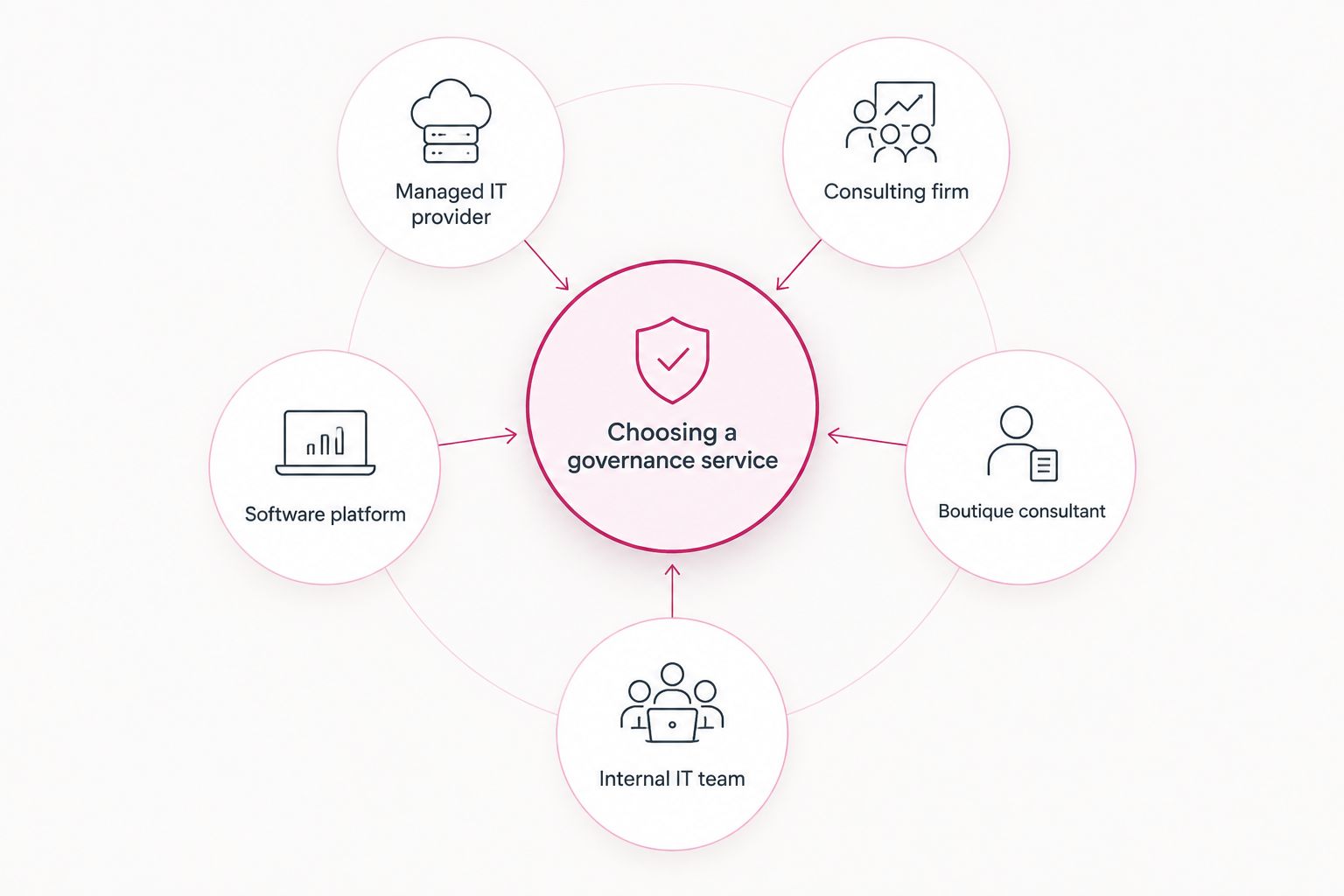
At a glance
| Provider type | Best for | Standout capability | Key limitation |
|---|---|---|---|
| TeraCloud managed governance | SMBs needing continuous monitoring | Governance tied directly to IT and cybersecurity operations | Not built for multi-division enterprise rollouts |
| Big 4 / global consulting firms | Enterprise-wide governance frameworks | Deep bench for multi-country, multi-entity compliance | Slow to deploy for a single-location SMB |
| Software platforms (Collibra, Informatica, Alation) | Teams with an existing data engineering staff | Automated data catalog and lineage tracking | Requires internal staff to configure and maintain |
| Boutique data governance consultants | A single audit or policy rewrite | Fast turnaround on a defined scope | No ongoing monitoring after the engagement ends |
| Internal IT team (informal) | Very low-risk businesses with no regulated data | No added cost | Breaks down the moment real compliance exposure appears |
1. TeraCloud: best data management and governance service for small and midsize businesses
TeraCloud runs data management and governance as part of its managed IT operation, covering cloud systems, Microsoft 365 environments, and cybersecurity monitoring alongside data classification and access control. The team supports clients from Dallas with coverage across Texas, Florida, and Wyoming, plus nationwide support, on a 24/7 basis.
TeraCloud pros:
- Governance findings feed directly into existing IT tickets instead of sitting in a separate report
- 24/7 monitoring catches access and configuration drift between formal review cycles
- Bundled with cloud migration and cybersecurity work, so governance isn't bolted onto a disconnected vendor relationship
TeraCloud cons:
- Not sized for a multinational enterprise running governance across dozens of business units
- Businesses with an in-house compliance team may only need select pieces of the service, not the full program
Read the compliance as a service breakdown if HIPAA or GLBA mapping is the immediate driver.
Verdict: Buy for SMBs that want governance treated as an operating discipline instead of a once-a-year checkbox.
2. Big 4 and global consulting firms: best for enterprise-wide governance frameworks
Firms in this tier build governance frameworks that span multiple business units, countries, and regulatory regimes. They bring standardized methodologies and large delivery teams.
Consulting firm pros:
- Deep experience with multi-entity, multi-jurisdiction compliance programs
- Access to specialized regulatory expertise across industries
Consulting firm cons:
- Engagement timelines and staffing models are built for enterprise scale, not a 30-person company
- Ongoing monitoring after the engagement typically requires a separate contract or an internal team to sustain
Verdict: Hold — right fit only once you have multiple divisions and a dedicated compliance function to hand the framework to.
3. Data governance software platforms (Collibra, Informatica, Alation): best for teams with existing data engineers
These platforms provide data catalogs, lineage tracking, and automated policy enforcement across large, complex data estates. They're built as software, not as a managed service — someone on staff has to run them.
Software platform pros:
- Automated lineage tracking across large numbers of data sources
- Scales to enterprise data volumes without manual mapping
Software platform cons:
- Requires trained data engineering staff to configure, maintain, and interpret
- Licensing and implementation are built around large data teams, not solo IT departments
Verdict: Hold for organizations that already run a data engineering function; Skip if you'd be buying the tool and the staff to run it at the same time.
4. Boutique and independent data governance consultants: best for a single audit or policy rewrite
Independent consultants and small firms handle defined-scope work: a one-time data audit, a policy rewrite, or a gap analysis ahead of a client security questionnaire.
Boutique consultant pros:
- Fast turnaround on a narrowly scoped project
- Lower overhead than a large consulting engagement
Boutique consultant cons:
- No ongoing monitoring once the contract ends
- Findings can go stale within months if nobody implements or tracks the recommendations
Verdict: Wait — useful for a one-time need, but pair it with an ongoing monitoring plan or the audit becomes a snapshot of a moment that's already passed.
5. Internal IT team handling governance informally: best for near-zero regulatory exposure
Some very small businesses still let an internal generalist IT person handle data access and retention decisions without a formal governance program. It works only when there's no regulated data in play at all.
Internal IT pros:
- No added vendor cost
- Direct, informal control for a business with minimal regulatory exposure
Internal IT cons:
- No structured compliance mapping to HIPAA, GLBA, or state privacy law
- No documentation trail if a client, insurer, or regulator asks for evidence
Verdict: Skip for any business handling customer financial, health, or personal data — the exposure outweighs the savings.
How we ranked these
Each category was scored against the six criteria above: ongoing monitoring, compliance mapping, IT and security integration, data classification, incident response tie-in, and scalability. TeraCloud ranks first because it's the only option here that combines all six for a business under a few hundred employees; the others each cover a subset by design, not by shortfall. If cybersecurity monitoring is the more immediate gap, the managed cybersecurity providers comparison covers that separately.
Which data governance service should you choose?
If you're a small or midsize business without a dedicated compliance team, start with a managed provider like TeraCloud — governance stays current because it's tied to the same team watching your systems day to day in 2026, not a separate vendor relationship that goes quiet after delivery. If you're running governance across multiple large divisions, go with a Big 4 firm. If you already employ data engineers, buy the software platform they'll actually configure. Everyone else pairing a one-time need with ongoing monitoring should treat a boutique consultant as step one, not the whole plan.
Get a data governance review
See where your access controls and data classification stand today.
FAQ
What's the best data management and governance service for small businesses in 2026?
TeraCloud's managed data governance service is the best fit for small and midsize businesses in 2026 because it pairs ongoing monitoring with existing IT and cybersecurity operations. A boutique consultant or software platform alone leaves monitoring gaps once the initial project ends.
Is TeraCloud better than hiring a Big 4 consulting firm for data governance?
For a business under a few hundred employees, yes — Big 4 firms build frameworks sized for multi-division enterprises, not a single-location company. TeraCloud's model fits businesses that need continuous governance without enterprise-scale staffing.
How much does data governance cost for a small or midsize business?
Cost depends on data volume, regulatory scope, and whether governance is bundled with existing IT and cybersecurity services. A managed provider bundling governance into an existing IT contract typically costs less than a standalone software platform plus the staff to run it.
Do I need a dedicated data governance platform like Collibra if I already have managed IT?
Not usually. Platforms like Collibra and Informatica are built for organizations with dedicated data engineering staff managing large, complex data estates. A managed IT provider handling governance directly covers most SMB needs without that added tooling layer.
What's the difference between data management and data governance?
Data management covers the operational systems — backups, storage, retention. Data governance covers the rules and roles deciding who can access, change, or delete that data. Both need to work together, which is why bundled services outperform buying them separately.
How long does a data governance rollout take?
A one-time audit from a boutique consultant can wrap in a few weeks. A managed governance program tied to ongoing IT operations, like TeraCloud's, starts delivering value in the first monitoring cycle and keeps working as your systems change.
Can managed IT providers handle HIPAA or GLBA compliance mapping?
Yes, when the provider builds compliance mapping into its governance service rather than treating it as a separate add-on. Confirm the provider maps to your specific regulatory obligations, not a generic template.
Is DIY data governance enough for a company handling regulated customer data?
No. An internal IT team managing governance informally has no structured compliance mapping and no documentation trail, which becomes a real liability the moment a regulator, insurer, or client audit asks for evidence.
One last thing
Most governance failures in 2026 trace back to a gap nobody scheduled to check — an offboarded employee whose cloud access never got revoked, a shared drive nobody classified. The fix isn't a better one-time audit; it's a provider who's still watching six months after the report gets delivered.


