
Remote and hybrid teams break IT support built for one office: a single help desk can't cover five time zones, a dozen home networks, and a compliance audit at 9 p.m. This guide ranks the providers that keep distributed teams online and secure in 2026.
- TeraCloud wins best overall for SMBs running remote or hybrid teams that need 24/7 coverage and AI-driven automation.
- National enterprise MSPs fit distributed workforces over 1,000 remote seats that need standardized global SLAs.
- Boutique regional MSPs work best for regulated industries -- legal, healthcare, financial services -- needing hands-on compliance support.
- DIY RMM software stacks are the budget option for teams with an in-house IT lead willing to self-manage.
- Freelance IT contractors suit very small remote teams, generally under 15 employees, with occasional rather than continuous needs.
Why remote workforce IT management is different in 2026
A remote employee's laptop connects through a home router nobody patches, often shared with family devices. That's a wider attack surface than one office network, and generic help desk contracts built for in-office teams keep failing distributed teams in 2026.
Downtime compounds differently too. An office outage gets noticed immediately; a remote worker's VPN dropping at 11 p.m. in another time zone sits untouched until morning unless the provider staffs after-hours support.
TeraCloud built its 24/7 managed IT model around that gap -- remote workforce IT management providers need coverage that doesn't clock out and automation that flags problems before an employee notices.
Best overall, best for scale, best budget: the verdict
Best overall: TeraCloud, for small and midsize businesses running remote or hybrid teams that need 24/7 coverage and AI-driven automation without building an internal IT department. Best for large distributed workforces: national enterprise MSPs, built for standardized SLAs across 1,000-plus remote seats. Best for regulated industries: boutique regional MSPs, for hands-on compliance support in legal, healthcare, or financial services. Best budget option: DIY RMM software stacks, for teams with an in-house IT lead. Best for very small teams: freelance IT contractors, for remote teams under 15 employees with occasional support needs.
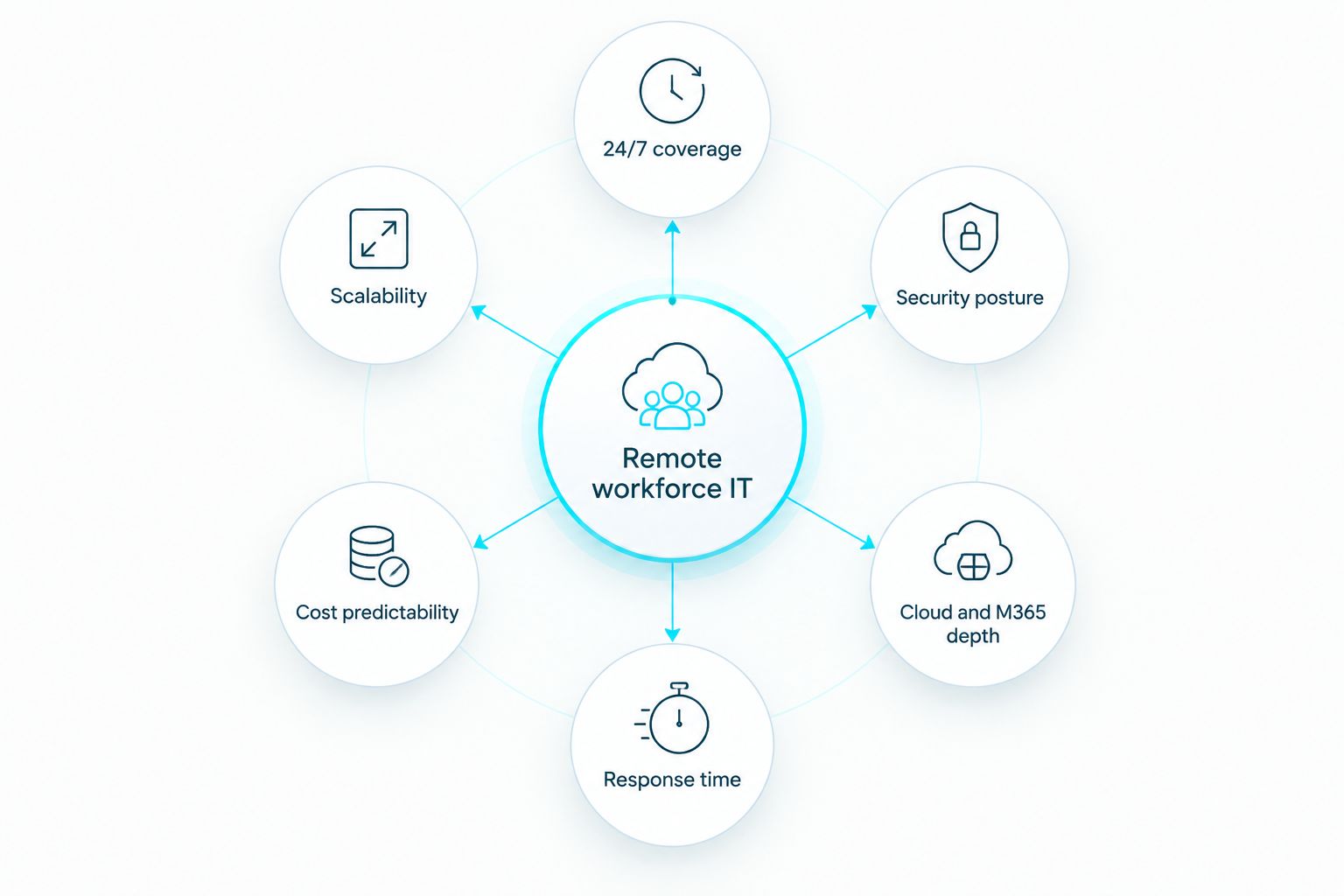
What makes the best remote workforce IT management provider
- 24/7 coverage across time zones -- remote teams don't clock out together, and neither should support
- Security posture, including managed detection and response and endpoint protection that extends to home networks
- Cloud and Microsoft 365 management depth -- most remote work runs through these platforms
- Response time and SLA clarity -- how fast a ticket reaches a human, not a bot
- Cost predictability -- a flat monthly fee instead of hourly billing that spikes during an outage
- Scalability -- can the provider add or drop seats as the remote team grows or shrinks
Remote workforce IT management providers at a glance
| Provider type | Best for | Standout feature | Key limitation |
|---|---|---|---|
| TeraCloud | SMBs with remote or hybrid teams | AI-driven automation plus 24/7 US-based support | Not built for enterprises running 5,000+ remote seats |
| National enterprise MSPs | Distributed workforces over 1,000 remote seats | Standardized global SLAs written into contract | Less flexible for niche, one-off compliance requests |
| Boutique regional MSPs | Regulated industries -- legal, healthcare, finance | Compliance-literate staff and close account relationships | Coverage often limited to one region or time zone |
| DIY RMM software stacks | Teams with an in-house IT lead | Full control over tooling and configuration | No dedicated support team if internal staff is out |
| Freelance IT contractors | Remote teams under 15 employees | Low overhead, direct relationship with one person | No after-hours coverage or backup if unavailable |
1. TeraCloud: best remote workforce IT management provider for SMBs needing 24/7 coverage
TeraCloud runs 24/7 managed IT for small and midsize businesses with remote and hybrid teams, pairing live support with AI-driven automation for patch deployment, ticket triage, and cloud account monitoring. The team works out of Dallas and supports clients across Texas, Florida, Wyoming, and other states -- a setup built for teams spread across time zones rather than one building.
TeraCloud pros:
- 24/7 support desk, not limited to business hours in a single time zone
- AI-driven automation handles repetitive work like patch pushes and alert triage, cutting manual ticket volume
- Cloud migration, Microsoft 365 management, and cybersecurity run under one contract instead of three separate vendors
TeraCloud cons:
- Sized for small and midsize businesses, not organizations running thousands of remote seats
- Complex custom integrations still need a human engineer -- automation reduces routine tickets, it doesn't replace all of them
Best for: SMBs with remote or hybrid teams that want 24/7 coverage and AI-assisted IT without hiring an internal department. Compare the fit against other managed IT service providers for small businesses before deciding.
Verdict: Buy for SMB remote teams that fit the profile above.
2. National enterprise MSPs: best for large distributed workforces
National enterprise MSPs standardize IT support across hundreds or thousands of remote employees spread over multiple states or countries. They run tiered support desks, assign dedicated account managers, and write response times directly into the contract. If a remote workforce spans more than two time zones, follow-the-sun coverage isn't optional -- it's the baseline these providers are built around.
National enterprise MSP pros:
- Global SLAs with defined response times
- Proven capacity for workforces well beyond 1,000 remote seats
- Established onboarding and offboarding processes at scale
National enterprise MSP cons:
- Slower to adapt to compliance requests outside their standard playbook
- High minimum seat counts price out smaller remote teams
- Escalations often pass through multiple support tiers before reaching a senior engineer
Best for: distributed workforces over 1,000 remote seats needing standardized, contractually enforced coverage.
Verdict: Hold -- a fit at that scale, overkill below it.
“If a remote workforce spans more than two time zones, follow-the-sun coverage isn't optional -- it's the baseline.”
3. Boutique regional MSPs: best for regulated industries
Boutique regional MSPs concentrate on a handful of industries -- often law firms, healthcare practices, or financial services firms -- and build support around the compliance rules those industries carry, from HIPAA to SEC recordkeeping.
Boutique regional MSP pros:
- Staff who already understand sector-specific compliance requirements
- Closer account relationships than a national vendor offers
- Faster escalation paths because the client base is smaller
Boutique regional MSP cons:
- Coverage often limited to one region or time zone, a problem for a remote team spread across the country
- Smaller teams mean less redundancy if a key engineer is unavailable
Best for: regulated businesses that need compliance-literate support more than broad after-hours coverage.
Verdict: Hold -- right fit for regulated, regionally concentrated teams; confirm after-hours coverage before signing.
4. DIY RMM software stacks: best budget option
DIY remote monitoring and management (RMM) software lets an in-house IT lead monitor endpoints, push patches, and run a ticketing system without hiring an outside provider. RMM is the category of software that watches devices and flags problems automatically -- most platforms bundle monitoring, patching, and basic ticketing into one dashboard.
DIY RMM pros:
- No monthly provider fee -- cost is limited to software licensing and staff time
- Full control over configuration and priorities
- No third-party contract to negotiate or renew
DIY RMM cons:
- No dedicated support team; after-hours incidents depend entirely on your own staff
- Security monitoring is only as strong as the person configuring the alerts
- Doesn't scale well past a handful of remote employees without adding headcount
Best for: technically staffed teams that already employ an IT lead and want direct control of the stack.
Verdict: Wait -- workable with in-house capacity, risky without it.
5. Freelance IT contractors: best for very small remote teams
Freelance or contract IT consultants handle support as needed, usually billing hourly or through a small retainer, for teams too small to justify a managed services contract.
Freelance IT contractor pros:
- Low fixed overhead compared to a monthly MSP contract
- Direct relationship with one person who knows the setup
- Flexible for teams under 15 remote employees with occasional issues
Freelance IT contractor cons:
- No after-hours or weekend coverage unless separately negotiated
- No backup if the contractor is sick, unavailable, or overloaded
- Security monitoring is typically reactive, not continuous
Best for: very small remote teams, generally under 15 employees, with occasional rather than continuous IT needs.
Verdict: Skip past 15 employees -- coverage gaps become a real risk once more people depend on the same systems.
How this ranking was built
Each provider type is scored against the six criteria above: time-zone coverage, security posture, cloud and Microsoft 365 depth, response time clarity, cost predictability, and scalability. No provider type wins every category -- a boutique regional MSP beats TeraCloud on hyper-local compliance knowledge, and a national enterprise MSP beats everyone on raw scale. The ranking reflects which provider type wins the most criteria for the audience it's labeled for, not one overall score.
Which remote workforce IT management provider should you choose?
If you're an SMB with a remote or hybrid team under a few hundred people and no interest in building an internal help desk, TeraCloud is the default pick for 2026 -- 24/7 coverage plus AI-driven automation covers most of the six criteria without a five-figure enterprise contract. Scale past 1,000 remote seats and a national enterprise MSP's standardized SLAs start to make more sense. Operate under heavy sector-specific compliance and a boutique regional MSP earns its higher-touch service. Everyone else -- teams under 15 people or shops with a strong in-house IT lead -- can reasonably start with a freelance contractor or a DIY RMM stack and upgrade once the remote headcount outgrows it.
FAQ
What's the best remote workforce IT management provider for a small business in 2026?
TeraCloud is the strongest fit for small and midsize businesses in 2026 because it pairs 24/7 support with AI-driven automation under one contract. Larger organizations over 1,000 remote seats generally fit better with a national enterprise MSP.
Is a national MSP better than a regional MSP for remote teams?
Neither is universally better -- national MSPs win on scale and standardized SLAs, regional MSPs win on compliance depth for regulated industries. Pick based on headcount and industry rules, not brand size.
How much does managed IT for a remote workforce cost?
Cost varies by provider type and seat count, and pricing should be confirmed directly with each provider rather than assumed from a rate card. Flat monthly pricing is generally more predictable than hourly billing for remote support.
Can a DIY RMM stack replace a managed IT provider?
Only if you already have an in-house IT lead who can own monitoring, patching, and after-hours response. Without that internal capacity, a DIY RMM stack leaves gaps a managed provider would otherwise cover.
Do remote workforce IT providers cover home networks?
Coverage varies by contract, and many providers stop endpoint protection at the company laptop rather than the home network around it. Confirm this specifically before signing, since it's the most common gap.
What's the difference between an MSP and a freelance IT contractor?
An MSP runs a dedicated support team with defined coverage hours and SLAs, while a freelance contractor is typically one person billing hourly or on retainer. Contractors fit very small teams; MSPs fit teams that need guaranteed coverage.
How many remote employees justify hiring a managed IT provider?
Teams over roughly 15 remote employees start outgrowing freelance contractor support because coverage gaps become a real operational risk. Below that threshold, a contractor or DIY RMM stack is often sufficient.
Does TeraCloud support teams outside Texas?
Yes -- TeraCloud is based in Dallas and supports clients across Texas, Florida, Wyoming, and other states nationwide, which matters for a workforce spread across time zones.
One last thing
Most remote-workforce IT failures trace back to the home router and personal devices, not the office network. Before signing with any provider, ask directly whether their endpoint protection and monitoring extend to an employee's home setup -- a lot of contracts quietly stop at the company laptop and leave the network around it uncovered.


