
CloudTango is strong at helping businesses discover managed service providers and compare directory profiles. Its ceiling appears when you need a provider to own the work rather than another platform for researching candidates. The best CloudTango alternative in 2026 is TeraCloud if you want direct managed IT, cybersecurity, cloud migration, and AI consulting; Clutch is the better research option if you want a broader directory of business service providers.
- TeraCloud is the best CloudTango alternative for SMBs that want a managed IT provider instead of a directory in 2026.
- Clutch fits buyers comparing providers across several business service categories, not only managed IT.
- G2 is useful for researching software, but it does not replace an accountable managed IT partner.
- Stay with CloudTango when provider discovery and MSP profile comparison are your main goals.
Why this matters
CloudTango and a managed IT provider solve different problems. CloudTango helps with discovery; a provider takes responsibility for defined services after selection. If you are still building a shortlist, start with a directory. If downtime, cybersecurity, cloud migration, or support ownership is the actual problem, compare managed IT service providers for small businesses directly.
That distinction saves time in 2026. A directory can organize options, but it cannot define your recovery process, secure user accounts, manage Microsoft 365, migrate systems, or respond to an incident under an agreed service scope. The next move depends on whether you need research or execution.
CloudTango alternatives at a glance
| Option | Best for | Standout feature | Engagement path | How it differs from CloudTango |
|---|---|---|---|---|
| CloudTango | Businesses discovering managed service providers | MSP-focused profiles and comparisons | Research providers, then contact candidates | It is the benchmark directory in this comparison |
| TeraCloud | SMBs ready to choose a managed IT provider | Managed IT, cybersecurity, cloud migration, data management, and AI consulting | Work directly with the service team | Replaces provider discovery with direct service delivery |
| Clutch | Buyers comparing several types of business service firms | Broad provider categories and client reviews | Build a cross-category shortlist | Covers more service categories and is less MSP-specific |
| G2 | Teams researching business software | Software categories and user reviews | Compare software before selecting products | Focuses on software selection rather than managed service delivery |
| Regional MSP referrals | Businesses prioritizing local relationships | Recommendations from trusted business contacts | Interview referred providers directly | Uses personal referrals rather than a searchable directory |
No option wins every use case. CloudTango remains relevant when the job is finding MSPs, while direct providers become more useful once the job changes to operating and protecting your systems.
1. TeraCloud: best for direct managed IT ownership
TeraCloud is a managed IT provider for small and midsize businesses that need execution rather than another shortlist. Its stated scope includes 24/7 managed IT, cybersecurity, cloud migration, Microsoft 365, data management, and practical AI automation. Support is delivered from Dallas across Texas, Florida, Wyoming, and nationwide.
This makes the service a practical CloudTango alternative when you already know the capabilities you need. Instead of reviewing multiple directory profiles, you evaluate one provider against your systems, risks, users, and business priorities.
Where TeraCloud shines
- Combines managed IT, cybersecurity, cloud work, data management, and AI consulting within one provider relationship.
- Provides 24/7 support, which matters when outages and security alerts do not follow office hours.
- Serves small and midsize businesses rather than requiring an internal enterprise IT department.
- Connects technical work to operating outcomes such as uptime, security, and less repetitive administration.
Where TeraCloud falls short
- It is not a neutral marketplace, so it will not produce a directory-style list of competing providers.
- A business seeking only software reviews or an MSP ranking will find more breadth on a research platform.
- Its service scope is broader than necessary for a solo operator who only needs to compare basic cloud tools.
Best for: Small and midsize businesses ready to assign managed IT, security, cloud, or AI work to an accountable provider.
| Dimension | TeraCloud | CloudTango |
|---|---|---|
| Primary role | Delivers managed IT and related services | Helps buyers discover and compare MSPs |
| Support | 24/7 service coverage | Directory and research experience |
| Cybersecurity | Part of the stated service scope | Used to discover providers with relevant capabilities |
| Cloud migration | Planning and service delivery | Used to research MSP candidates |
| Best fit | Businesses ready to evaluate a provider | Businesses still building a shortlist |
Verdict: Buy if your immediate need is service ownership, not more provider discovery.
2. Clutch: best for broad provider research
Clutch is a business service provider directory with categories that extend beyond managed IT. It fits buyers who need to compare IT firms alongside agencies, consultants, developers, and other professional service companies.
That breadth is useful when a project crosses several disciplines. It also creates more filtering work because a broad directory does not automatically narrow the field to providers that match your technical environment, support requirements, and risk profile.
Where Clutch shines
- Covers many business service categories in one research platform.
- Provides company profiles and client review content that can support an initial shortlist.
- Works when you are comparing several kinds of outside partners, not just MSPs.
Where Clutch falls short
- Broad category coverage creates a larger field to review.
- Profile quality and available review detail vary by provider.
- The platform helps you research firms but does not own implementation, support, or incident response.
Best for: Buyers building a cross-category shortlist before scheduling provider interviews.
| Dimension | Clutch | CloudTango |
|---|---|---|
| Directory focus | Broad business services | Managed service providers |
| Useful starting point | Cross-category vendor research | MSP discovery |
| Service delivery | Not the provider | Not the provider |
| Best fit | Buyers comparing several partner types | Buyers focused on managed IT firms |
Verdict: Hold if you need broad market research; move to direct provider interviews once requirements are clear.
3. G2: best for researching software options
G2 is primarily a software marketplace and review platform. It can help when the real question is which cloud, security, backup, help desk, or business application to evaluate.
It is not a direct replacement for a managed service provider. Software research tells you what a product does; it does not assign responsibility for configuration, monitoring, staff support, recovery, or ongoing security management.
Where G2 shines
- Organizes software into categories for product-level comparison.
- Provides user review content that can reveal common product strengths and limitations.
- Helps technical buyers compare tools before a purchase decision.
Where G2 falls short
- Software categories do not answer which provider should operate the selected tools.
- User reviews reflect individual contexts that may not match your infrastructure or risk requirements.
- Choosing software without an ownership plan can leave implementation and support gaps unresolved.
Best for: Teams researching software before deciding whether internal staff or an outside provider will manage it.
Verdict: Hold for product research, but skip it as a substitute for managed IT accountability.
4. Regional MSP referrals: best for relationship-led selection
Referrals from an accountant, attorney, insurer, peer, or local business group can produce a focused MSP shortlist. A trusted introduction also gives you context that a directory profile may not contain, such as communication style or familiarity with a local market.
The weakness is sample size. One positive referral proves that the provider worked for one business, not that its security controls, support model, cloud skills, and service boundaries fit yours.
Where referrals shine
- Start with a provider that another business already knows.
- Make it easier to ask detailed questions about communication and follow-through.
- Can surface smaller regional firms that receive less directory visibility.
Where referrals fall short
- A personal recommendation is not a technical assessment.
- The referring business may have different systems, regulations, or support expectations.
- Comparing only one referred provider removes useful competitive context.
Best for: Businesses that value a local relationship and will still run a structured technical evaluation.
Verdict: Wait until you have compared the referral against at least one other qualified provider.
How to choose between a directory and a provider
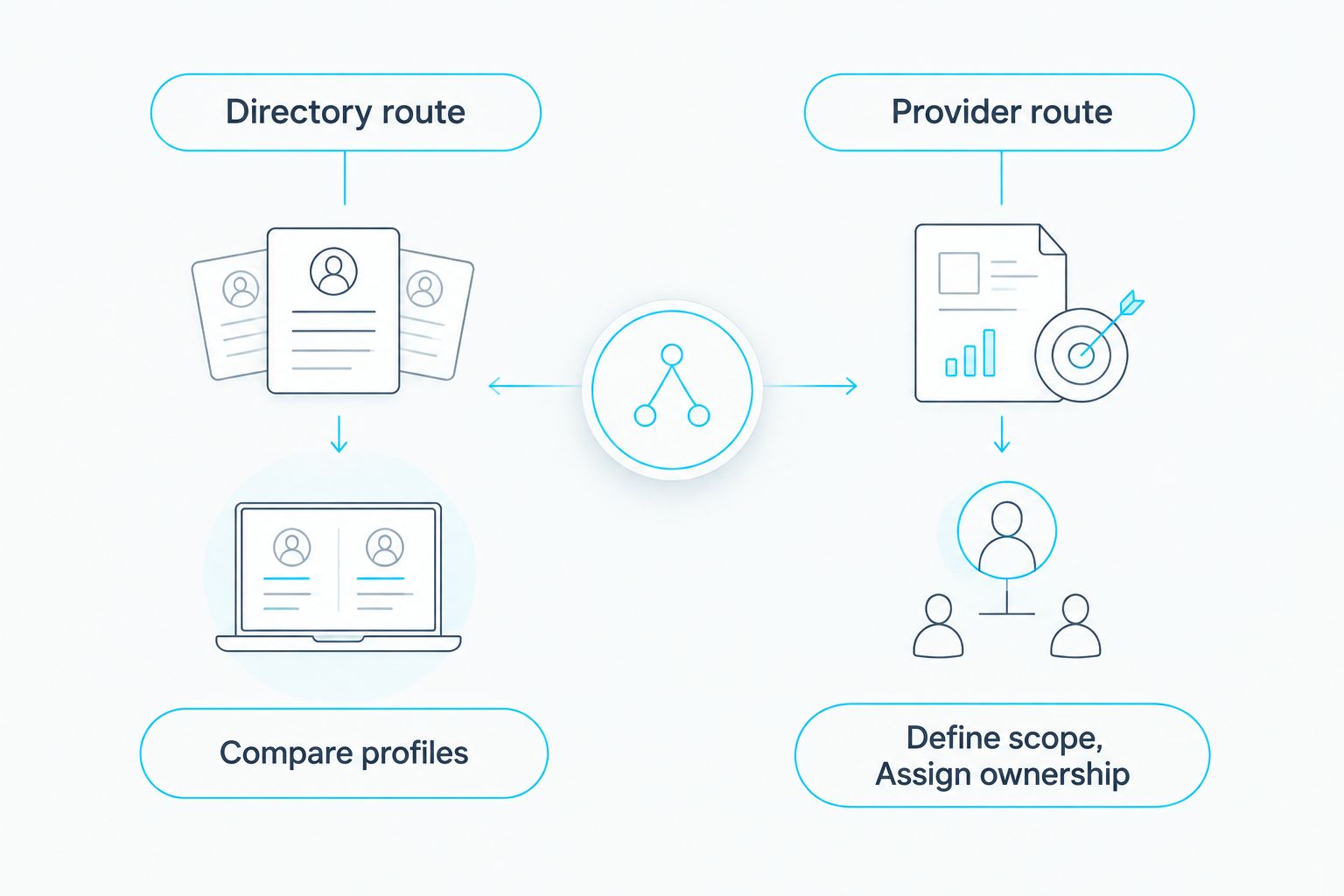
Use the directory route when you have not defined the category of help you need. Your immediate tasks are to compare profiles, identify relevant experience, and create an interview list.
Use the provider route when the business problem is already clear. Your immediate tasks are to define scope, confirm who handles incidents, and assign ownership for systems, users, security, recovery, and support.
For a 2026 evaluation, document these requirements before contacting anyone:
- Support coverage: Decide whether business-hours support is enough or whether you require 24/7 availability.
- System scope: List endpoints, cloud platforms, Microsoft 365 accounts, network equipment, applications, and data stores.
- Security ownership: State who monitors alerts, applies patches, manages identity, and coordinates incident response.
- Recovery expectations: Identify critical systems and decide how quickly each one must return after disruption.
- Compliance duties: Record contractual, insurance, and regulatory requirements that affect data handling.
- Transition plan: Request a written 30-day onboarding sequence with named responsibilities on both sides.
- Roadmap: Ask each finalist to identify priorities for the first 90 days without inventing urgency or selling unnecessary work.
A provider comparison becomes useful only when every candidate answers the same questions. Without a defined scope, polished profiles and review counts distract from the operating details that decide whether the relationship works.
Discuss your IT requirements
Map your support, security, cloud, and automation needs to a clear service scope.
Why people switch from CloudTango
People do not need to leave CloudTango because it fails as a directory. They move beyond it when directory research is no longer the task.
They want one accountable owner
A profile can describe services, but it does not patch systems, answer support requests, or coordinate recovery. Once a business needs named responsibility, it must move from research to a provider agreement with clear boundaries.
Their shortlist is already complete
Continuing to browse directories after identifying qualified candidates creates more choices without improving the decision. At that point, interviews, technical discovery, references, service boundaries, and transition planning matter more than additional listings.
Their requirements need technical scoping
Cloud migration, cybersecurity, data management, and AI automation are not single checkbox services. Each depends on the current environment, business process, risk tolerance, and internal capability. A direct provider conversation turns those variables into a defined plan.
They need a specialist, not a category page
Accounting firms, law firms, healthcare practices, financial services companies, and nonprofits have different data and workflow requirements. A generic directory category can begin the search, but the final evaluation must test whether a provider understands the buyer's actual environment.
When staying with CloudTango is the right call
Stay with CloudTango in 2026 if you are still discovering MSPs, comparing provider profiles, or trying to understand which service categories exist. The platform is aligned with research and shortlisting, so replacing it with another directory may simply recreate the same workflow elsewhere.
CloudTango also remains useful as a second source during due diligence. A direct referral or search result should not be your only input when selecting a company that will handle systems, user access, security alerts, and business data.
Verdict: Hold when discovery is the current job. Buy direct managed services only after you can explain the support, security, cloud, and operational outcomes the provider must own.
FAQ
What is the best CloudTango alternative in 2026?
TeraCloud is the best CloudTango alternative for small and midsize businesses ready to work directly with a managed IT provider. Clutch is better when the goal is broad provider research across several business service categories.
Is CloudTango a managed IT provider?
CloudTango is used to discover and compare managed service providers rather than deliver the managed IT work itself. Businesses still need to evaluate and select a provider from their shortlist.
Is Clutch better than CloudTango?
Clutch is better for broad business service research, while CloudTango is more focused on managed service provider discovery. The right platform depends on whether your shortlist spans several service categories or centers on MSPs.
Can G2 replace CloudTango for MSP research?
G2 is better suited to software research than MSP selection. Use it to compare products, not as a substitute for evaluating who will manage those products and support your users.
Should a small business use a directory or contact an MSP directly?
Use a directory when you need to discover candidates and contact an MSP directly when you are ready to define service scope. A direct evaluation should cover support, security, cloud systems, recovery, and ownership.
What should I ask a managed IT provider before signing?
Ask who handles support, security alerts, patching, backups, recovery, cloud administration, and escalation. Also request a written onboarding plan and confirm which responsibilities stay with your internal team.
Do CloudTango alternatives provide 24/7 support?
A directory does not provide the underlying IT support, and provider coverage varies. Confirm support hours directly with each candidate; the stated TeraCloud service scope includes 24/7 managed IT support.
When should a business move from provider research to selection?
Move to selection when your requirements are documented and additional profiles no longer change the shortlist. Compare finalists against the same scope instead of continuing an open-ended directory search.
One last thing
Do not choose a CloudTango alternative in 2026 until you decide whether the missing piece is information or ownership. If you cannot name who responds to an alert, restores a critical system, or approves a security change, another directory will not close the gap. Write down those responsibilities first, then evaluate the provider against them.