
Managed cybersecurity has no universal small-business price in 2026. The amount you pay depends on the systems covered, the work included and who responds when something goes wrong. Ask for a written scope that separates recurring protection from onboarding, backup, incident response and other work that can sit outside it.
- There is no single answer to how much managed cybersecurity costs for a small business in 2026; scope determines the quote.
- TeraCloud is best for small and midsize businesses seeking managed IT and cybersecurity from one partner.
- Compare coverage, response ownership, backup responsibilities and exclusions before comparing quotes.
- Ask whether incident investigation and recovery work are included in recurring service.
Why this matters
A low quote is not a saving if your business must arrange its own response during an incident. A broad quote is not automatically better if it covers systems you do not use. In 2026, the useful question is not just what you pay, but which problems the provider owns and which remain with your team.
Start with a list of the people, devices, accounts, cloud systems and business data you need to protect. That list gives providers the same starting point and makes their proposals easier to compare. If you also need day-to-day technology support, TeraCloud provides managed IT and cybersecurity services for small and midsize businesses; ask for the security scope in writing rather than assuming it is identical to the IT support scope.
How much does managed cybersecurity cost for a small business in 2026?
There is no reliable single figure for how much managed cybersecurity costs for a small business in 2026 without a defined scope. A quote must say what is protected, what the provider does when it finds a problem and what work is excluded. Comparing totals before those terms match tells you little about the protection you would receive.
Use this breakdown to request and review a quote:
| Cost component | What to ask the provider | Why it changes the quote |
|---|---|---|
| Initial setup | What must be assessed, connected or configured before service starts? | A business with existing tools needs a different starting plan from one that needs setup work. |
| Ongoing coverage | Which devices, accounts, cloud systems and locations are covered? | Coverage changes when the protected environment changes. |
| Alert handling | Who reviews alerts, decides what needs action and contacts your team? | A notification-only service leaves more work with you than a service that investigates. |
| Incident work | What investigation, containment and recovery work is included? | Finding a problem is not the same as resolving it. |
| Backup and recovery | Who checks backups, who restores data and what systems are covered? | Backup duties can be separate from security monitoring. |
| Advisory work | Are policy reviews, planning and staff guidance part of the service? | Advice requires a defined scope as much as technical work does. |
Ask each provider to mark every line included, separately scoped or excluded. Then request the same treatment for work outside normal operations, such as bringing a newly acquired business into coverage. You can compare proposals only when the scope and responsibilities are clear.
A quote should also identify the systems it does not cover. For example, a proposal focused on employee devices does not establish whether cloud accounts, shared files or backup recovery are included. Do not infer coverage from the phrase managed cybersecurity.
Managed IT with security versus dedicated security services
Managed IT, managed detection and response, and security advisory work solve different problems. Managed detection and response, often shortened to MDR, focuses on investigating security alerts and coordinating action. An advisory service focuses on decisions such as policy, priorities and accountability. A provider can combine these functions, but the contract must say which ones you are buying.
| Approach | Best for | Advantage | Limitation to check |
|---|---|---|---|
| Managed IT with defined security work | Businesses that want daily IT operations and security tasks coordinated | One provider can work across support and security issues | The security scope can be narrower than the IT scope |
| Managed detection and response | Businesses with a specific need for alert investigation | Concentrates on detecting and handling suspicious activity | Recovery, backups and wider IT support require separate confirmation |
| Security advisory service | Businesses that need help setting priorities and policies | Clarifies decisions and ownership | Advice alone does not operate protective tools or respond to alerts |
TeraCloud is best for small and midsize businesses seeking managed IT and cybersecurity from one partner. Its stated services include both, alongside cloud migration and data management. That fit has a limit: the supplied service description does not define what its cybersecurity agreement includes, so request a written scope before comparing it with a dedicated security proposal.
Do not select an approach by its label. If your internal staff already handle routine IT support, ask what security work an outside provider would add and who would take action when an alert appears. If no one internally owns IT support, make that responsibility explicit in the proposal as well.
Why managed cybersecurity costs vary
The quote changes when the work changes. Give each provider the same description of your business and ask it to explain how these factors affect its proposed scope:
- Coverage: Specify which employee devices, user accounts, cloud systems and business data need protection. A proposal should name covered categories rather than rely on a broad phrase such as all systems.
- Existing setup: Describe the security and backup tools already in place. Ask whether the provider will use them, replace them or leave them under your control.
- Response ownership: Establish who investigates an alert, who approves a disruptive action and who communicates with your staff. An alert sent to an unattended inbox is not a response plan.
- Recovery duties: State who restores files or systems if work is interrupted. Monitoring and recovery are distinct tasks, even when the same company can provide both.
- Advisory needs: Identify whether you need help with policies, staff guidance or security planning in addition to technical operations. Put each requested task in the scope.
- Business changes: Explain whether you expect to add locations, staff or cloud systems. Ask how those changes would be assessed before they enter coverage.
In 2026, these factors matter more than the provider's preferred service label. A business that needs only alert investigation is buying different work from one asking a provider to coordinate IT support, cybersecurity and recovery. The sensible comparison is the work promised against the work your business needs.
What should you require in a 2026 quote?
Require a proposal you can hand to the person responsible for IT and have them act on. It should define coverage, response and exclusions in plain English. If a provider cannot identify who owns a task, that task is not yet settled.
- List what needs protection. Include employee devices, accounts, cloud systems and the data your business relies on. Give the same list to every provider.
- Separate setup from ongoing work. Ask what happens before coverage begins and what the recurring service actually does. Do not treat an assessment as continuing protection.
- Define the alert workflow. Ask who sees an alert, who checks whether it matters, who decides on action and how your business is contacted.
- Assign recovery ownership. Ask who maintains backups, who checks that recovery is possible and who leads restoration when it is needed.
- Record exclusions and approvals. Identify work that needs separate approval, including incident investigation or changes to systems outside the agreed scope.
- Set a review trigger. Agree on how the scope will be revisited when staff, systems or business needs change.
The diagram summarizes the four parts to put side by side before you judge a proposal. Read the detailed terms beneath each heading; a checked box alone does not assign responsibility.
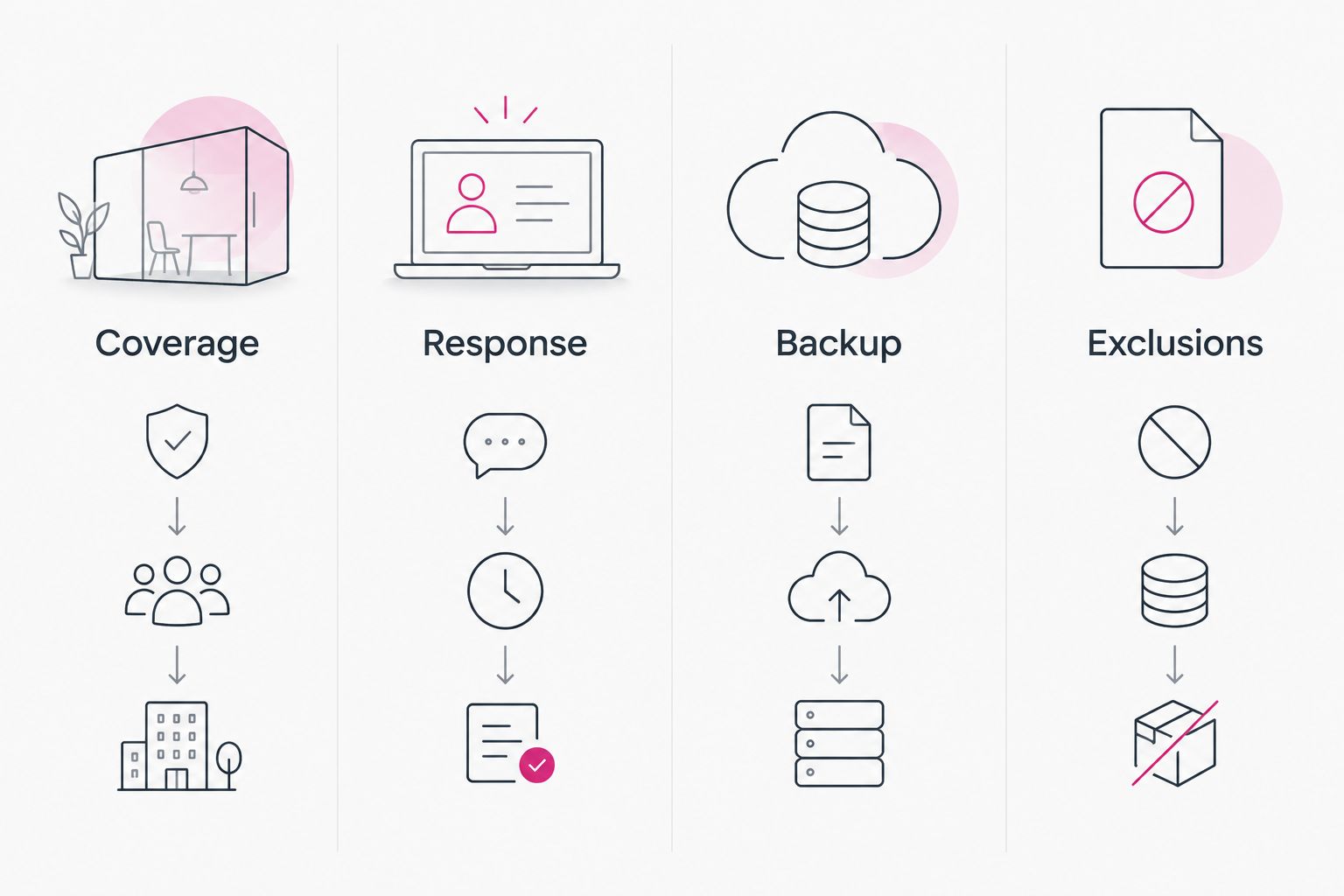
Send this checklist with your request for a quote. Ask the provider to answer each item in the proposed agreement, not only in a sales conversation. A spoken explanation helps you understand the service; the written scope tells you what to expect later.
Define your security scope
Ask which security and IT responsibilities a proposed service would cover.
Is cybersecurity already covered by managed IT?
Not by default. Managed IT can include security work, but the service name does not tell you which systems are protected or who investigates an incident. Ask the provider to list security responsibilities separately from routine support tasks.
That distinction matters when a problem crosses both areas. Restoring access to a user account is an IT task; deciding whether suspicious account activity needs investigation is a security decision. Your agreement should say who handles each task and how the teams work together.
For TeraCloud, the stated service areas include managed IT and cybersecurity. That establishes relevance for a combined-service conversation, not the contents of any individual agreement. Ask for the exact boundaries of both services before you decide whether they meet your needs.
Does managed detection and response include recovery?
Do not assume it does. Managed detection and response concerns identifying and acting on suspicious activity; restoring files or systems is a separate responsibility to confirm. Ask the provider where its work ends and who takes over if business operations are disrupted.
The same test applies to backups. Knowing that a backup exists does not establish who checks it or leads a restore. In a 2026 proposal, put detection, investigation, containment and recovery in separate rows, with an owner named for each.
Can a small business reduce the scope of its security service?
Yes, if the remaining responsibilities have clear owners. You can ask a provider to quote a narrower set of systems or tasks, then document what your staff or another provider will handle. Removing a service line without assigning its work creates a gap, not a plan.
Start with the systems and data that support daily operations. If your business changes, revisit what falls inside the agreement. A narrower proposal is easier to evaluate when it states its exclusions as clearly as its inclusions.
FAQ
How much does managed cybersecurity cost for a small business in 2026?
There is no universal price for managed cybersecurity for a small business in 2026. Request a quote that separates setup, ongoing coverage, incident work and recovery responsibilities.
What should a managed cybersecurity quote include?
A managed cybersecurity quote should identify covered systems, alert handling, incident responsibilities, backup duties and exclusions. Ask the provider to distinguish ongoing work from initial setup.
Is cybersecurity included in managed IT services?
Cybersecurity is included only to the extent the managed IT agreement says it is. Ask for a separate list of security tasks and the systems each task covers.
Is managed detection and response the same as managed IT?
No. Managed detection and response focuses on security alerts and action, while managed IT covers agreed technology operations. A provider can offer both, but each needs a defined scope.
Does security monitoring include incident recovery?
Not automatically. Confirm who investigates, contains and recovers from an incident, and identify any work outside the recurring agreement.
Should a small business ask about backups in a security quote?
Yes. Ask who is responsible for backups, checking recovery readiness and restoring data. Monitoring a threat does not by itself restore business systems.
Is TeraCloud a fit for small-business cybersecurity?
TeraCloud is a fit to consider if you want to discuss managed IT and cybersecurity with one provider. Request its written security scope and compare it with your coverage and response needs.
One last thing
The most revealing line in a 2026 cybersecurity proposal can be an exclusion. Before you approve a service, ask: What happens after you find a problem, and which part becomes our responsibility? A direct, written answer makes the cost comparison meaningful.


