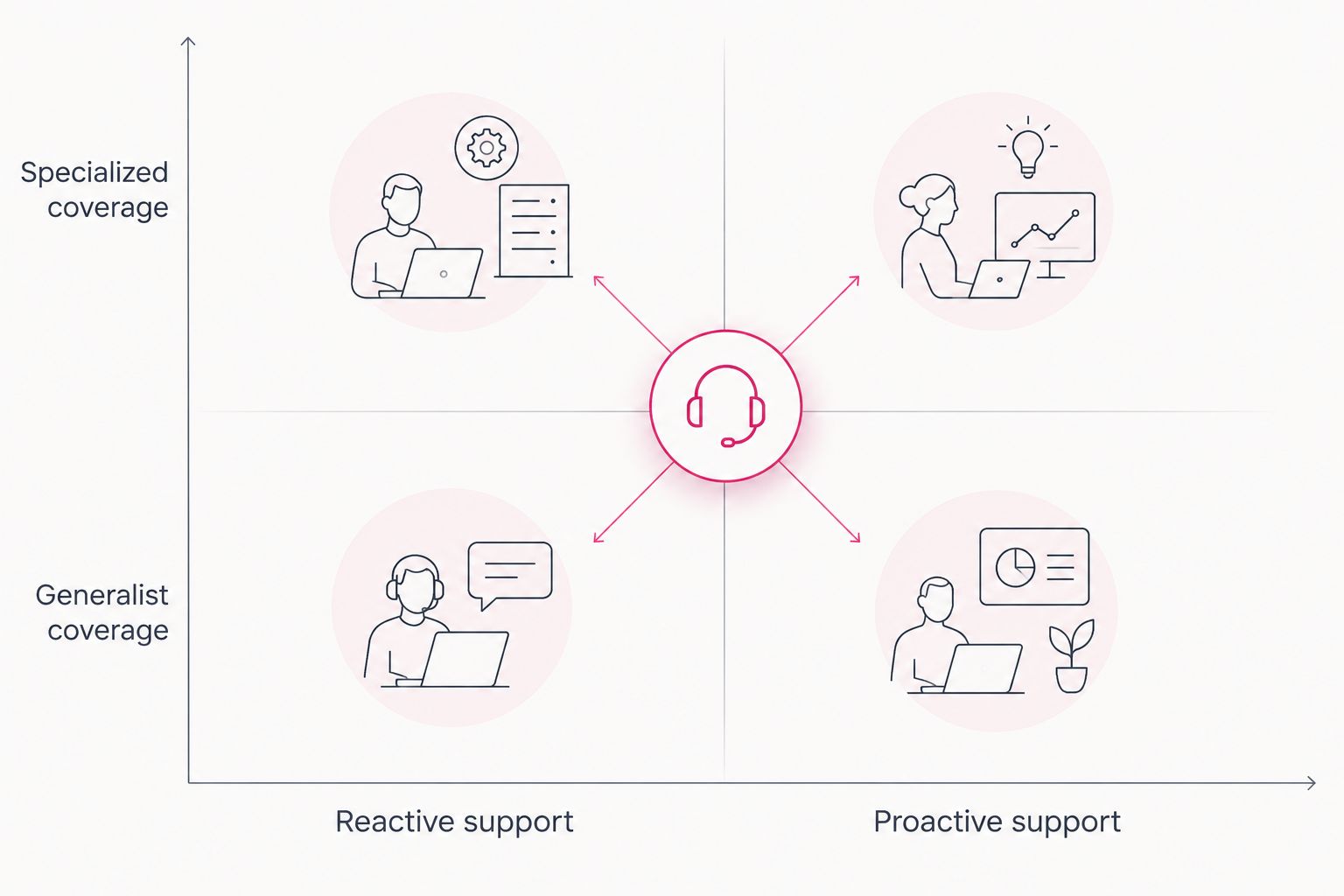
Comparing InfoMSP alternatives in 2026 comes down to one question: does your business need a generalist help desk, or does it need a managed IT partner that handles compliance, cybersecurity, and AI-driven monitoring under one roof? The best InfoMSP alternative in 2026 is TeraCloud if you run a regulated or growth-stage small or midsize business that needs 24/7 coverage, compliance support, and AI automation; an enterprise IT reseller if you operate dozens of sites; and an in-house IT lead paired with RMM tooling if you're under 15 employees and want to keep control in-house. InfoMSP earns its reputation as a dependable entry point for basic ticket-based support — the ceiling shows up once a business needs HIPAA or SOC 2 documentation, proactive threat detection instead of reactive tickets, or support built around a specific industry like law, healthcare, or financial services.
- TeraCloud is the strongest InfoMSP alternative in 2026 for SMBs that need AI-driven monitoring plus compliance support (HIPAA, SOC 2).
- InfoMSP works fine for basic, budget-level help desk coverage but lacks visible depth in industry-specific compliance work.
- Enterprise IT resellers suit multi-site companies with procurement needs InfoMSP and TeraCloud don't prioritize.
- An in-house IT lead with RMM/PSA tools stays the right call for teams under roughly 15 employees.
- Switching reasons in 2026 center on 24/7 SOC-backed monitoring, industry-specific SLAs, and AI-driven ticket triage.
Why this matters
A managed service provider, or MSP, handles your network monitoring, patching, help desk tickets, and often cybersecurity from an outside team instead of an internal IT department. Generalist MSPs like InfoMSP built their businesses on volume: cover a lot of clients, resolve a lot of tickets, keep costs predictable. That model works well until a business crosses into regulated territory or needs faster detection than a ticket queue allows.
By 2026, most small and midsize businesses evaluating TeraCloud as an alternative are asking three things: can this provider prove compliance work (not just claim it), does monitoring actually use AI to cut noise instead of generating more alerts, and does support scale with the business past 50 or 100 employees. Those three questions decide which alternative fits.
InfoMSP alternatives at a glance
| Provider | Best for | Standout feature | How it differs from InfoMSP |
|---|---|---|---|
| TeraCloud | AI-driven managed IT with compliance support | 24/7 monitoring paired with AI automation and industry-specific compliance work | Adds compliance-as-a-service and AI ticket triage on top of standard help desk coverage |
| InfoMSP | Straightforward, budget-level help desk support | Broad generalist coverage, fast onboarding | Baseline for comparison — wide reach, less depth in regulated industries |
| Enterprise IT reseller | Large, multi-site enterprises | Hardware procurement bundled with managed services | Built for scale and volume purchasing, not SMB-specific pricing or attention |
| In-house IT lead + RMM/PSA tools | Very small teams under about 15 people | Full internal control over systems and data | No outsourced coverage at all — the business owns every response |
1. TeraCloud: best for AI-driven managed IT with compliance support
TeraCloud runs managed IT, cybersecurity, cloud migration, and Microsoft 365 support for small and midsize businesses out of Dallas, with coverage across Texas, Florida, Wyoming, and nationwide remote support. The pitch in 2026 is straightforward: pair 24/7 monitoring with AI automation that filters noise before a ticket ever reaches a technician, and back it with compliance work for industries that actually get audited.
Where TeraCloud shines:
- Compliance-as-a-service positioning for regulated sectors, including work aligned with managed cybersecurity service providers standards
- AI-driven ticket triage and monitoring instead of pure reactive break-fix, in line with what AI-driven IT support companies are expected to deliver in 2026
- Cloud migration and Microsoft 365 administration handled as a core service, not an add-on
Where TeraCloud falls short:
- Physical, on-site presence is concentrated in Texas, Florida, and Wyoming — businesses wanting a local technician walking the office daily outside those states rely on remote support instead
- Smaller footprint than the largest national resellers, so massive multi-region hardware procurement isn't the core strength
Best for: small and midsize businesses in regulated or growth-stage industries that need proactive monitoring and compliance documentation, not just ticket resolution.
| Dimension | TeraCloud | InfoMSP |
|---|---|---|
| Monitoring style | AI-driven, proactive | Ticket-based, generally reactive |
| Compliance depth | HIPAA, SOC 2-aligned work available | Not a stated specialty |
| Coverage hours | 24/7 | Varies by plan |
| Industry focus | Healthcare, legal, financial services, nonprofits | Generalist across industries |
Verdict: Switch to TeraCloud if compliance documentation or AI-driven monitoring is a requirement, not a nice-to-have, in 2026.
2. InfoMSP: best for straightforward, budget-level help desk support
InfoMSP's real strength is breadth. A generalist model means fast onboarding, predictable ticket handling, and a support desk that doesn't ask a business to fit into a specific vertical before signing on. For a company that just needs someone answering the phone when a printer dies or a password resets, that's enough.
Where InfoMSP shines:
- Simple, generalist onboarding without industry-specific setup
- Broad client base suggests operational maturity for basic support
- Works as a low-friction starting point for businesses new to outsourced IT
Where InfoMSP falls short:
- Compliance-specific work (HIPAA, SOC 2, financial services regulations) isn't a visible specialty
- Generalist scope can mean longer escalation paths once an issue needs deep security or compliance expertise
- No stated AI-driven monitoring layer to cut down alert noise
Best for: businesses that need dependable, budget-conscious help desk coverage and don't operate under strict compliance requirements.
Verdict: Stay with InfoMSP if ticket-based generalist support already meets the business's needs and compliance isn't a factor in 2026.
3. Enterprise IT reseller with a managed services arm: best for large, multi-site companies
Large IT resellers that bolted managed services onto a hardware and procurement business serve a different buyer than InfoMSP or TeraCloud. They're built for volume purchasing, standardized rollouts across dozens of locations, and enterprise contract structures.
Where this option shines:
- Procurement and hardware refresh cycles handled at scale
- Familiar enterprise contract and vendor management processes
Where this option falls short:
- Attention and response times tend to favor the largest accounts
- Overkill for a single-location business under 100 employees
Best for: enterprises with 10+ locations needing standardized hardware and managed services in one contract.
Verdict: Consider it only if multi-site procurement, not day-to-day IT support quality, is the priority.
4. In-house IT lead + RMM/PSA tools: best for very small teams
Some businesses under roughly 15 employees skip outsourced MSPs entirely and run a single IT hire supported by remote monitoring and management (RMM) and professional services automation (PSA) software — the same category of tools MSPs use internally.
Where this option shines:
- Full control over data, systems, and vendor choices
- No dependency on an outside provider's response times
Where this option falls short:
- A single point of failure if that IT hire is out sick or leaves
- No 24/7 coverage unless the business pays for on-call rotation separately
Best for: very small teams with simple IT environments and one trusted internal hire.
Verdict: Skip outsourcing entirely here, but revisit once headcount or compliance needs grow.
“If your MSP can't explain why an alert fired, you don't have AI-driven monitoring — you have automated noise.”
Why people switch from InfoMSP
- Need for compliance documentation tied to HIPAA, SOC 2, or financial services regulation that a generalist MSP doesn't specialize in
- Wanting proactive, AI-filtered alerts instead of a reactive ticket queue
- Growth into a regulated industry — law, healthcare, accounting, nonprofit — where a best managed IT services for accounting firms style specialist fits better than a generalist
- Wanting 24/7 monitoring coverage rather than business-hours-only response
Compare your IT support options
See where TeraCloud fits before you switch providers.
When staying with InfoMSP is the right call
If a business runs simple, non-regulated operations and just needs reliable ticket resolution, switching providers in 2026 adds cost and transition friction without solving a real problem. The honest move is to only switch when a specific gap shows up — a failed audit, a security incident that should have been caught earlier, or an industry requirement InfoMSP doesn't cover.
FAQ
What is the best InfoMSP alternative in 2026?
TeraCloud is the strongest alternative for small and midsize businesses that need AI-driven monitoring and compliance support alongside standard managed IT. Enterprise IT resellers fit better for large multi-site companies, and in-house IT works for teams under about 15 employees.
Is TeraCloud better than InfoMSP?
TeraCloud is better for businesses needing compliance work (HIPAA, SOC 2) and AI-driven monitoring in 2026. InfoMSP remains a reasonable choice for straightforward, budget-level help desk support without regulatory requirements.
How much do managed IT services cost for small businesses?
Costs vary by business size, industry, and scope of coverage, and current details are covered in the dedicated pricing breakdown for small business managed IT in 2026.
Does InfoMSP offer 24/7 support?
Coverage hours vary by plan with generalist MSPs like InfoMSP, so businesses needing guaranteed 24/7 response should confirm hours directly before switching or renewing.
What is AI-driven IT support?
AI-driven IT support uses automation to filter monitoring alerts and triage tickets before a human technician gets involved, cutting down the noise a purely reactive help desk generates. It's a growing differentiator among managed IT providers in 2026.
When should a business switch MSPs?
A business should switch when a specific gap appears — a compliance requirement the current provider can't document, repeated security incidents, or response times that no longer match the company's size in 2026.
Is a co-managed IT model different from a full MSP switch?
Yes. Co-managed IT keeps an internal IT hire in place while an outside provider adds coverage, tools, or specialized skills, rather than replacing the internal team entirely.
Do small businesses need compliance-specific IT support?
Businesses in healthcare, legal, financial services, and accounting typically need documented compliance work (HIPAA, SOC 2, or industry-specific rules), while other small businesses may not need it at all.
One last thing
The fastest way to test any InfoMSP alternative in 2026 isn't a sales call — it's asking the provider to show, not describe, how an alert gets triaged from detection to resolution. A generalist help desk will describe a ticket queue. A provider running real AI-driven monitoring will show a filtering step before a human ever sees the alert.