StratifyIT works fine if your only need is a dashboard to track devices, tickets, and assets for a team that already has an IT staff. Its ceiling shows up the moment you need someone to act on those tickets at 2 a.m., run security operations, or produce compliance paperwork for an auditor. The best StratifyIT alternative in 2026 is TeraCloud if you need outsourced 24/7 coverage with a security team attached, and a co-managed setup if you want to keep an internal IT lead with backup.
TeraCloud runs managed IT, cybersecurity, and cloud services for small and midsize businesses, with 24/7 support delivered from Dallas and covering Texas, Florida, Wyoming, and nationwide clients. That's the difference this guide walks through: StratifyIT is software you operate yourself, and the alternatives below are staffed models that operate on your behalf.
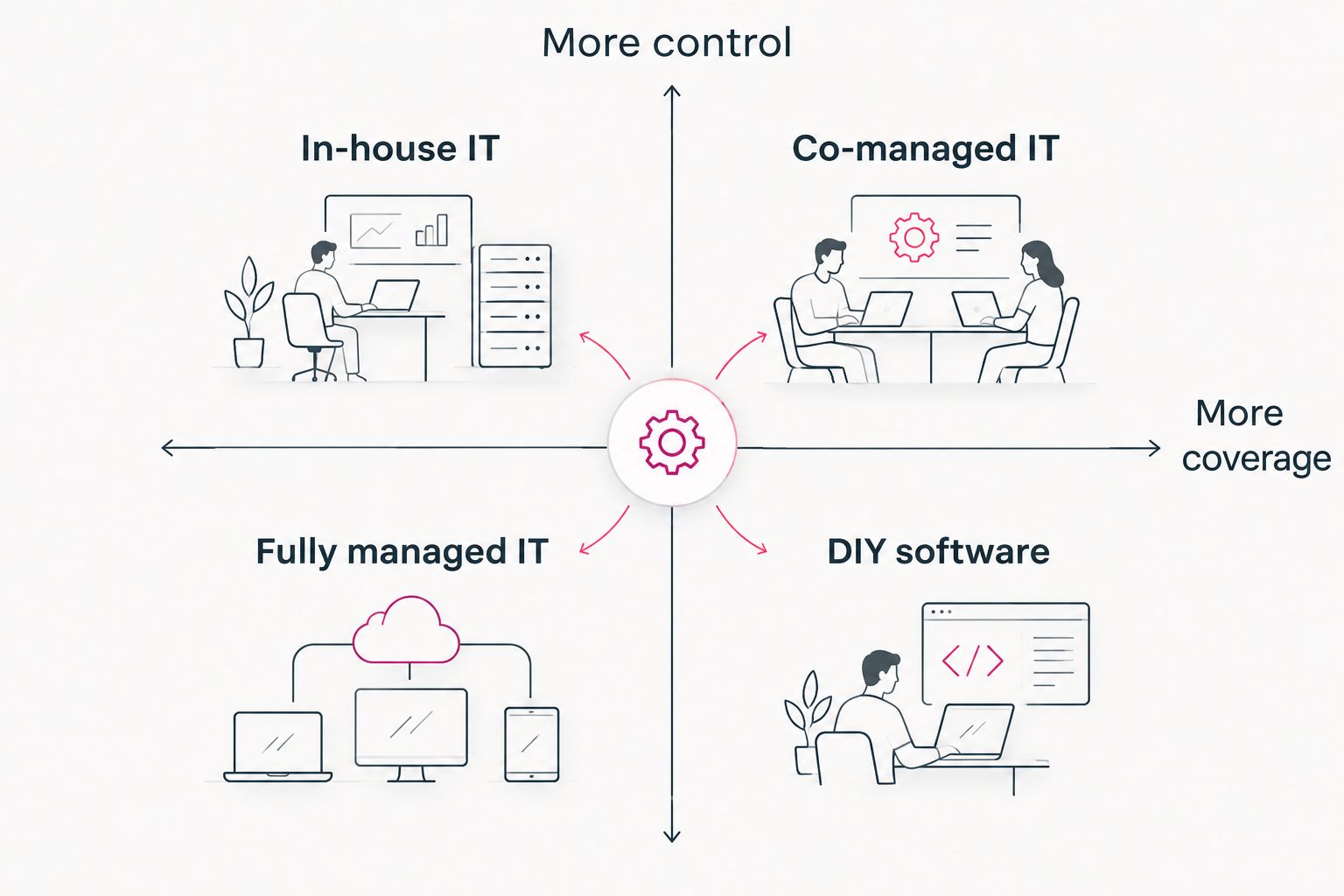
- StratifyIT alternatives in 2026 split into four models: fully managed, co-managed, regional MSP, and in-house.
- TeraCloud wins for businesses that want 24/7 human-staffed support plus security operations, not just a monitoring dashboard.
- Co-managed IT fits companies with one internal IT hire who need nights, weekends, and overflow coverage.
- StratifyIT remains a reasonable pick if you already have full-time IT staff and only need better ticket organization.
Why this matters
StratifyIT gives you visibility: a dashboard showing device status, open tickets, and asset inventory. Visibility isn't response. When a server goes down at midnight or a phishing attempt lands in twelve inboxes at once, a dashboard doesn't call anyone or shut down the attack — a person does.
Businesses evaluating StratifyIT alternatives in 2026 are usually hitting one of three walls: no one is watching the dashboard after hours, no one on staff owns cybersecurity response, or an auditor is asking for documentation the software wasn't built to produce. Each wall points to a different alternative.
StratifyIT alternatives at a glance
| Option | Best for | Standout feature | How it differs from StratifyIT |
|---|---|---|---|
| StratifyIT | Teams with existing in-house IT staff | Centralized dashboard for assets and tickets | Baseline — software only, no staffed response |
| TeraCloud | Full 24/7 outsourced IT and security | Human-staffed support plus AI-driven automation | Adds around-the-clock response, not just visibility |
| Co-managed IT (internal lead + provider) | Companies with one IT hire needing backup | Coverage for nights, weekends, and overflow | Fills the gaps a dashboard alone can't close |
| Regional MSP franchise | Multi-location businesses | Standardized processes across sites | Similar staffing model, often less local responsiveness |
| In-house IT hire | Companies wanting full internal control | Direct oversight of every system | Requires paying for the coverage StratifyIT can't provide alone |
1. TeraCloud: best for full 24/7 outsourced IT and security
TeraCloud replaces the dashboard-and-hope approach with a staffed team that monitors, responds, and remediates around the clock. It covers managed IT, cybersecurity, cloud migration, Microsoft 365 administration, and data management, plus practical AI automation for repetitive back-office work.
Where TeraCloud shines:
- 24/7 support means someone is actually watching, not just logging
- Cybersecurity is built into the engagement, not a separate purchase
- AI automation reduces manual ticket triage and repetitive admin tasks
Where TeraCloud falls short:
- Businesses that already run a competent internal IT department may not need the full outsourced model
- Highly customized in-house workflows sometimes take longer to fold into a managed structure
Best for: small and midsize businesses that want IT handled end-to-end, not monitored and reported on.
| Dimension | StratifyIT | TeraCloud |
|---|---|---|
| After-hours response | Dashboard only | Staffed 24/7 |
| Security operations | Not included | Included |
| Compliance documentation | Manual, self-produced | Supported through compliance-as-a-service style engagements |
2. Co-managed IT: best for teams with one internal IT hire
Co-managed IT keeps your internal person as the primary point of contact while a provider backstops nights, weekends, and overflow tickets. It's the middle path between doing everything yourself and outsourcing everything.
Where co-managed IT shines:
- Internal hire keeps institutional knowledge and day-to-day relationships
- Provider absorbs the hours no single employee can staff alone
- Escalation path exists for incidents beyond one person's expertise
Where co-managed IT falls short:
- Requires clear division of responsibility or tickets fall through the gap between teams
- Costs more than software alone, since you're paying for a person and a partner
Best for: companies with one IT employee who's stretched thin but not ready to hand over everything. TeraCloud structures co-managed IT service arrangements around exactly this gap.
3. Regional MSP franchise: best for multi-location standardization
A regional managed service provider (MSP — a company that runs your IT infrastructure remotely for a recurring fee) franchise applies the same playbook across every location a business operates. Standardization is the appeal for retail chains, multi-office practices, and franchise operators.
Where a regional MSP franchise shines:
- Consistent processes and documentation across every site
- Easier to onboard new locations using an existing template
Where a regional MSP franchise falls short:
- Local responsiveness can lag when the nearest technician is a franchise territory away
- Standardized playbooks sometimes ignore location-specific quirks
Best for: multi-location businesses that value uniformity over local relationship depth.
4. In-house IT hire: best for full internal control
Hiring internally means every decision, every escalation, and every fix runs through someone who reports directly to you. StratifyIT's dashboard actually pairs well here, since an in-house team is exactly who the software was built for.
Where an in-house hire shines:
- Direct oversight with no vendor relationship to manage
- Deep familiarity with your specific systems and history
Where an in-house hire falls short:
- One person can't cover 24/7 shifts without burning out or costing significantly more with a full team
- Security operations and compliance work require specialized skills a generalist hire may not have
Best for: companies with the budget for a full internal team and the volume of work to justify it.
Why people switch from StratifyIT
- Coverage gaps at night and on weekends. A dashboard doesn't triage an outage at 3 a.m. — someone has to be watching it.
- No built-in security response. StratifyIT tracks assets; it doesn't run managed cybersecurity service operations like threat detection and incident response.
- Compliance documentation demands. Auditors in regulated industries want evidence of ongoing monitoring and remediation, not a static dashboard export.
- Scaling past what one internal hire can manage. Ticket volume grows faster than headcount, and software alone doesn't close that gap.
When staying with StratifyIT is the right call
If you already run a full internal IT team with someone covering after-hours issues, and compliance isn't a factor for your industry, StratifyIT's dashboard is a reasonable tool to keep. The switch only pays off once coverage, security, or compliance gaps start costing more than a provider relationship would.
Compare your IT support options
See what fully managed or co-managed IT looks like for your business.
FAQ
What is the best StratifyIT alternative in 2026?
TeraCloud is the best StratifyIT alternative in 2026 for businesses that need 24/7 human-staffed IT support and cybersecurity, not just a monitoring dashboard. Co-managed IT is the better fit if you want to keep an internal IT hire with backup coverage.
Is StratifyIT good for small businesses?
StratifyIT works for small businesses that already have someone on staff watching the dashboard and responding to tickets. It doesn't include staffed after-hours response or security operations on its own.
What's the difference between co-managed and fully managed IT?
Co-managed IT keeps your internal hire as the primary contact with a provider backing up nights, weekends, and overflow. Fully managed IT hands the entire function to the provider.
Does TeraCloud replace StratifyIT software?
TeraCloud replaces the function StratifyIT's dashboard is meant to support by adding staffed monitoring, response, and security operations around the clock.
Is StratifyIT better than a managed IT provider for compliance?
No. StratifyIT tracks assets and tickets but doesn't produce the ongoing monitoring documentation regulated industries need. A provider offering compliance-as-a-service closes that gap.
How much does switching from StratifyIT to a managed provider cost?
Cost depends on business size, number of endpoints, and which services are included. Check current pricing directly with a provider rather than relying on a general estimate.
Should I keep StratifyIT and add a provider on top?
Some businesses keep StratifyIT for internal asset tracking while a provider handles response and security. Whether that's worth the overlap depends on how much duplicate tooling costs versus one consolidated engagement.
One last thing
The businesses that regret switching are the ones who pick a model based on price alone instead of matching it to their actual coverage gap. A regional MSP franchise and a co-managed setup can look similar on paper in 2026, but the difference shows up the first time an incident happens outside business hours — one has a template, the other has a relationship.