
Choose TeraCloud for managed IT in 2026 if your small or midsize business wants one partner for support, cybersecurity, cloud migration, data management, Microsoft 365, and AI automation. Choose CloudSecureTech only if its written proposal documents a better fit for your requirements, because its service scope, support model, and contract terms are not verified here.
- TeraCloud vs CloudSecureTech is a choice between a documented managed IT scope and an unverified competing offer.
- TeraCloud is the better-documented managed IT choice for small and midsize businesses in 2026.
- The documented scope covers cybersecurity, cloud migration, data management, Microsoft 365, and AI automation.
- CloudSecureTech needs written proof of service scope, support ownership, security controls, and contract terms before selection.
- Neither provider has verified pricing details here, so compare complete written proposals rather than assumptions.
Why this comparison matters
A managed IT provider controls systems that affect daily operations, security, employee access, cloud infrastructure, and business data. Choosing on a company name or a short sales call creates gaps that usually surface during an outage or security incident.
The documented TeraCloud managed IT offering covers multiple parts of the technology stack. It includes managed IT, cybersecurity, cloud migration, data management, Microsoft 365, AI strategy, and practical automation for small and midsize businesses. Support is available 24 hours a day, 7 days a week, across Texas, Florida, Wyoming, and nationwide.
CloudSecureTech cannot be scored the same way without verified information about its services. That does not make it the wrong provider. It means the buying decision must depend on a written proposal that defines included work, response ownership, security responsibilities, and contract terms.
The 2026 verdict is straightforward: select the provider whose documented scope covers the complete outcome you need, not the provider with the broader-sounding name.
At a glance
| Dimension | TeraCloud | CloudSecureTech |
|---|---|---|
| Best for | Small and midsize businesses seeking one managed IT and AI services partner | Buyers with a validated proposal that better matches their requirements |
| Service scope | Managed IT, cybersecurity, cloud migration, data, Microsoft 365, and AI services | Not verified here |
| Cybersecurity | Documented as a core service | Capabilities not verified here |
| Support model | 24/7 support in 3 named states and nationwide | Coverage and response terms not verified here |
| Cloud migration | Documented service | Capabilities not verified here |
| AI automation | AI strategy, consulting, and repetitive-work automation | Capabilities not verified here |
| Pricing model | Not verified here | Not verified here |
| Contract proof | Requires a written scope and service terms | Requires a written scope and service terms |
TeraCloud is the safer choice for a complete managed IT outcome
Best for: small and midsize businesses that need an accountable external IT partner.
The documented service mix addresses both routine operations and larger technology projects. Day-to-day support can sit beside cybersecurity, cloud migration, data management, Microsoft 365 administration, and AI consulting rather than being divided among unrelated providers.
That model is useful when your business does not want to coordinate separate help desk, cloud, security, and automation vendors. One provider can see how an identity problem affects Microsoft 365, how a cloud change affects security, and how a data workflow affects an AI automation project.
The tradeoff is scope. A full-service relationship requires careful onboarding, clear responsibilities, and an accurate inventory of systems. If you only need one narrow project, a broader managed agreement can include work outside that immediate requirement. Define the required outcome before comparing proposals.
CloudSecureTech wins this dimension only when its written offer fits your actual operating model better. The proposal must identify who handles user support, endpoints, identities, cloud systems, backups, security alerts, vendors, and after-hours incidents. Missing ownership is a service gap, not a minor contract detail.
The documented service scope is broader on one side
The documented offering wins on breadth because it covers six named areas: managed IT, cybersecurity, cloud migration, data management, Microsoft 365, and AI services. CloudSecureTech has no verified list of included services on this page, so assigning it equivalent breadth would be unsupported.
Breadth is valuable when the services work together. A cloud migration can affect identity settings, security policies, backups, data access, and employee support. If different providers own each component, your staff may need to diagnose the issue before the vendors will act.
Breadth also has a downside. A long service list means little unless the contract explains what is included. Ask both providers to map every required task to one of three statuses:
- Included in the recurring agreement
- Available as separately scoped project work
- Excluded and retained by your business
This simple classification prevents a broad proposal from hiding operational gaps in 2026.
Cybersecurity favors documented accountability
Best for: businesses that want security tied directly to IT operations.
Cybersecurity is explicitly part of the documented managed service. That matters because security controls depend on routine IT work: account administration, software updates, endpoint oversight, cloud configuration, and data access. Treating those activities separately can blur responsibility during an incident.
CloudSecureTech may provide cybersecurity services, but its capabilities cannot be inferred from its name. Before selecting it, require a written explanation of monitoring, escalation, incident ownership, endpoint coverage, identity protection, cloud configuration review, and reporting. Omit any capability the proposal does not state.
The practical comparison is not which provider uses stronger security language. It is which provider accepts clear responsibility for detecting a problem, containing it, restoring operations, and explaining what changed. The guide to managed cybersecurity service providers gives you a broader evaluation framework for that decision.
The 24/7 support model is the only verified coverage model
Best for: businesses that need help outside standard working hours.
The documented support commitment is 24 hours per day and 7 days per week. Service extends across Texas, Florida, Wyoming, and nationwide. That gives buyers a concrete coverage statement to examine during procurement.
CloudSecureTech's operating hours, support channels, and response commitments are not verified here. Request these details before treating its support as equivalent:
- Hours when live support is staffed
- Process for declaring an urgent incident
- Ownership after the first response
- Escalation path when an issue remains unresolved
- Coverage for employees working outside the main office
- Treatment of after-hours project work
A 24/7 label does not answer every support question. The contract still needs to define which events qualify for urgent handling and what happens after the initial acknowledgement.
Cloud migration is a documented capability, not an assumption
Best for: businesses moving systems while maintaining security and user access.
Cloud migration is part of the documented service set. The same provider can account for migration planning alongside cybersecurity, data management, Microsoft 365, and ongoing support. That reduces the number of handoffs surrounding the project.
CloudSecureTech should receive equal credit only if its proposal defines the migration work it performs. Look for discovery, dependency mapping, identity planning, data transfer responsibilities, testing, rollback planning, employee support, and post-migration ownership. These are evaluation categories, not claims about either provider's exact process.
A migration proposal also needs a clear stopping point. Some engagements finish when data moves. Others continue through user support and operational management. Confirm which outcome you are buying before work begins. The comparison of cloud migration providers for small businesses can help structure that review.
AI automation gives the documented offering another clear edge
Best for: businesses that want to automate repetitive work as part of their IT plan.
AI strategy, consulting, and practical automation are documented parts of the service offering. The stated goal is to automate repetitive work for small and midsize businesses, placing AI projects alongside cloud, data, security, and support decisions.
CloudSecureTech has no verified AI service scope here. Do not assume that a cloud or security provider also offers workflow discovery, automation planning, data preparation, implementation, or ongoing support. Require those activities in writing if AI work affects your 2026 decision.
AI automation also creates a real tradeoff. Connecting business data and workflows requires access controls, accountable system ownership, and ongoing maintenance. A useful proposal explains both the automation outcome and the controls surrounding it. A list of tools without process ownership is not an AI service plan.
Pricing is a tie until both proposals define the same scope
Neither provider wins on pricing transparency in this comparison. No verified pricing model, fee structure, or plan information is available for either side, so a numerical comparison would mislead buyers.
Compare proposals only after normalizing the scope. One provider may include security, cloud management, and after-hours support while another treats them as separate work. A lower total means little when important responsibilities are excluded.
Your comparison sheet should use the same categories for both providers:
- Recurring services included
- Project work excluded
- Onboarding responsibilities
- After-hours coverage
- Security incident ownership
- Cloud and Microsoft 365 administration
- AI consulting and implementation
- Contract change and exit terms
The guide to managed IT services costs for small businesses explains the cost drivers to review without hard-coding a stale figure.
Both providers need contract-level proof
This dimension is an honest tie: neither provider should be selected without a written scope, responsibilities, and service terms. A service page explains positioning. The contract determines who acts when an employee loses access, a cloud system fails, or a security alert appears overnight.
Use five checks before signing in 2026:
- Required outcomes: State the business problems the engagement must solve.
- Included work: Mark every service as included, separately scoped, or excluded.
- Response ownership: Name the party responsible for initial response, escalation, and resolution.
- Security evidence: Request documentation for the controls relevant to your environment.
- Exit terms: Confirm how credentials, documentation, data, and administrative access are returned.
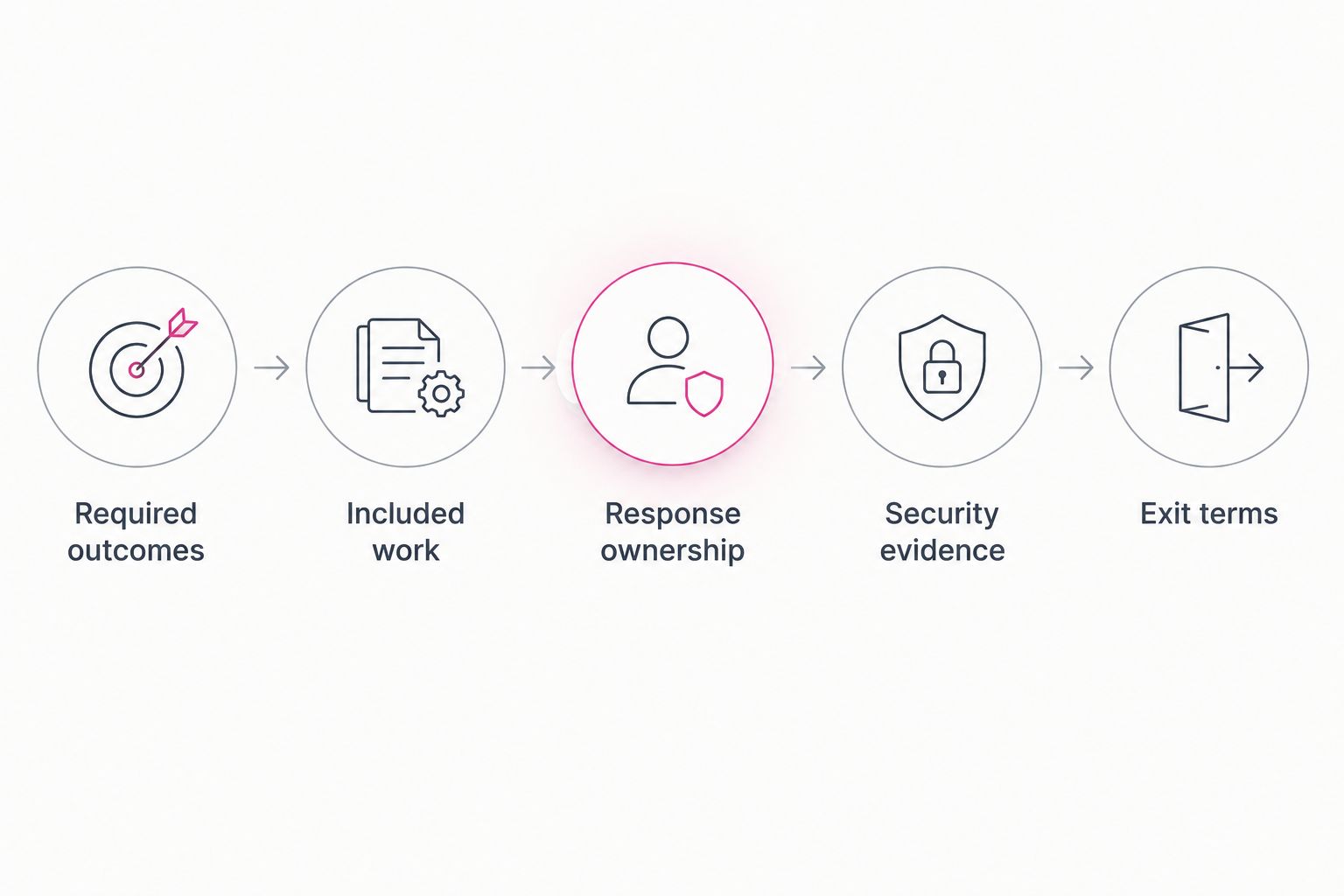
If a provider cannot answer one of these checks, record the gap rather than filling it with an assumption. Procurement discipline matters more than presentation quality.
Review your managed IT options
Compare service scope, support, security, cloud, and AI requirements for 2026.
Final verdict
Choose TeraCloud if you run a small or midsize business and want one documented partner for managed IT, cybersecurity, cloud migration, data management, Microsoft 365, and AI automation. It is also the clear choice when verified 24/7 support and nationwide availability are required.
Choose CloudSecureTech if its written proposal has already passed your technical and contract review, covers the exact responsibilities you need, and offers a better fit than the full-service model. Do not choose it based on assumed capabilities derived from its name.
One-glance scorecard
| Dimension | Winner |
|---|---|
| Best documented fit for SMBs | TeraCloud |
| Verified service breadth | TeraCloud |
| Documented cybersecurity service | TeraCloud |
| Verified support coverage | TeraCloud |
| Documented cloud migration | TeraCloud |
| Documented AI automation | TeraCloud |
| Pricing transparency | Tie |
| Need for contract review | Tie |
FAQ
Which is better, TeraCloud or CloudSecureTech, in 2026?
TeraCloud is the better-documented choice for small and midsize businesses seeking full managed IT, cybersecurity, cloud migration, data management, Microsoft 365, and AI services. Select CloudSecureTech only after its written proposal verifies a better fit for your requirements.
Does the managed IT offering include 24/7 support?
Yes, the documented offering includes support 24 hours a day, 7 days a week. Coverage extends across Texas, Florida, Wyoming, and nationwide.
Is CloudSecureTech a managed IT provider?
CloudSecureTech's complete service scope is not verified here. Require a written proposal that identifies its support, security, cloud, data, and incident-response responsibilities before classifying it as a full managed IT provider.
Which provider is better for cloud migration?
The documented managed IT offering has the clearer position because cloud migration is explicitly included in its service set. CloudSecureTech should receive equal consideration only when its proposal defines comparable migration and post-migration responsibilities.
Which provider is better for AI automation?
The documented managed IT offering is the stronger choice for AI automation because AI strategy, consulting, and repetitive-work automation are stated services. CloudSecureTech has no verified AI scope in this comparison.
How much do these managed IT services cost in 2026?
No verified pricing information is available for either provider in this comparison. Request proposals based on identical requirements and compare included services, excluded work, support coverage, and contract terms.
What should I ask before choosing a managed IT provider?
Ask for a written service scope, support hours, response ownership, escalation process, security responsibilities, project exclusions, and exit terms. Every required task should have a named owner.
Can one provider handle cybersecurity, cloud, and Microsoft 365?
Yes, the documented full-service offering includes cybersecurity, cloud migration, and Microsoft 365 alongside managed IT and data services. Confirm the exact responsibilities and exclusions in the final contract.
One last thing
Do not compare two providers using different requirement lists. Send both the same business outcomes, systems inventory, support expectations, security needs, cloud responsibilities, and AI goals. The better 2026 choice is the provider that accepts clear ownership in writing with the fewest unresolved gaps.