TeraCloud and InfoMSP both sell managed IT services to small and midsize businesses, but they solve different problems. Choose TeraCloud if you want a Dallas-based, AI-driven managed IT partner that automates security monitoring, migrates you to modern cloud systems, and gives you 24/7 coverage across Texas, Florida, Wyoming, and nationwide. Choose InfoMSP if your business runs a simple, mostly on-premises environment and you want a traditional regional MSP for basic help desk, network monitoring, and on-site desktop support. The real difference in 2026 isn't price or friendliness — it's whether your IT partner uses AI to cut down on manual work and threat noise, or still runs the same ticket-and-technician model MSPs used a decade ago.
- TeraCloud vs InfoMSP comes down to AI-driven automation versus traditional generalist support.
- TeraCloud wins on cybersecurity, cloud migration, and Microsoft 365 modernization for growing SMBs in 2026.
- InfoMSP suits businesses that want a familiar, hands-on local MSP without a cloud or AI roadmap.
- Neither model is wrong — the right pick depends on how modern your stack already is.
Why this matters
Managed IT contracts run 12 to 36 months. Picking wrong means re-migrating systems, retraining staff, and paying twice for the same fix.
The MSP market split hard by 2026: AI-driven IT support companies now automate patching, alert triage, and compliance reporting, while traditional MSPs still bill for manual technician hours on the same tasks. That gap shows up directly in your monthly invoice and in how fast your team gets unblocked after an incident.
At a glance
| Dimension | TeraCloud | InfoMSP |
|---|---|---|
| Best for | SMBs modernizing cloud and security | Businesses wanting a familiar local generalist |
| Pricing model | Managed service tiers, scoped to environment | Typically per-device or per-user billing |
| AI & automation | Built into monitoring and alert triage | Limited to standard RMM tooling |
| Cybersecurity & compliance | vCISO, MDR, compliance-as-a-service available | Standard antivirus and firewall management |
| Cloud migration | Dedicated Azure and Microsoft 365 migration paths | Ad hoc, project-based migrations |
| On-site / hands-on support | Remote-first with nationwide reach | Local, in-person technician visits |
| Industry specialization | Dedicated stacks for law, healthcare, accounting, finance, nonprofits | Generalist across industries |
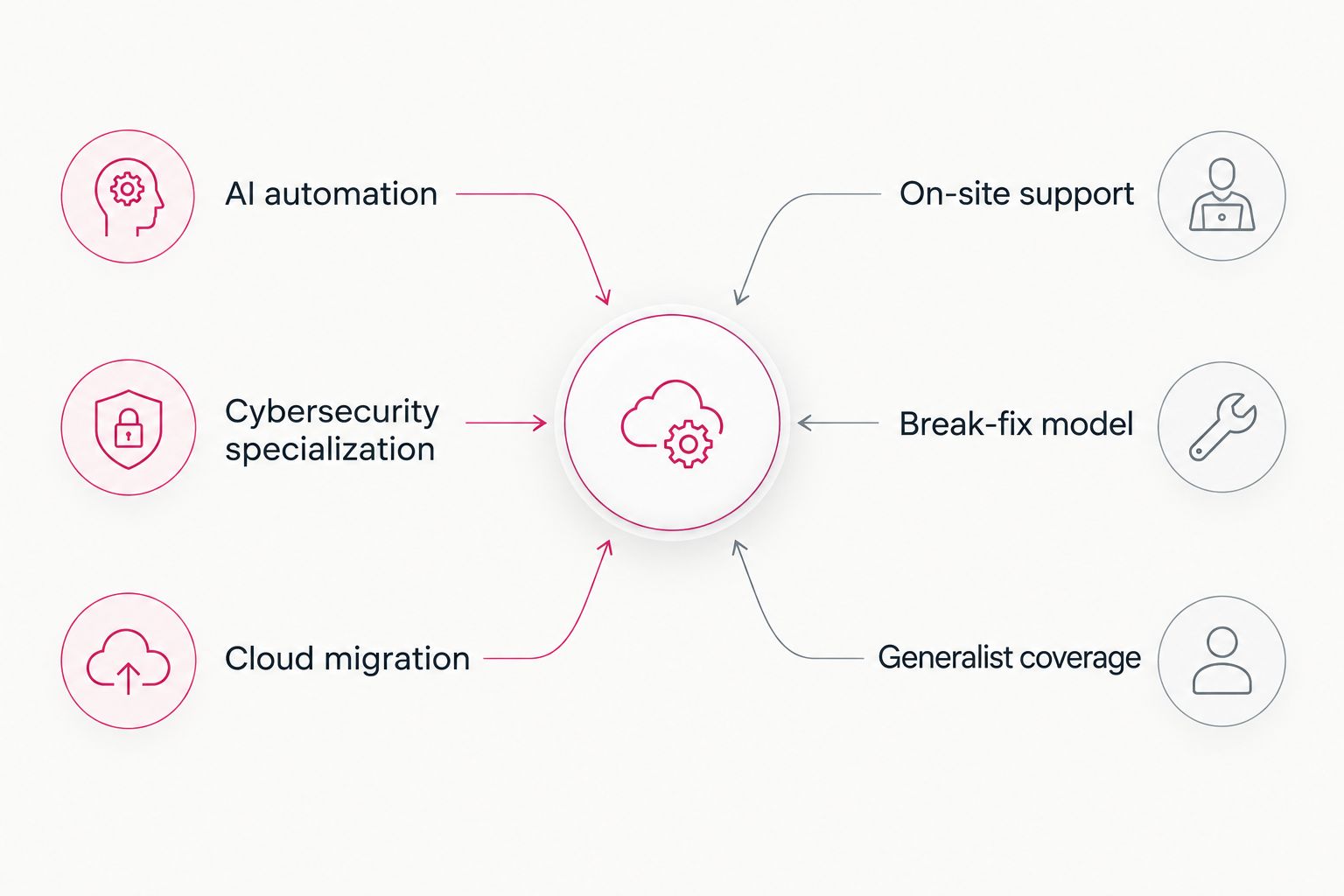
| Standout feature | AI-driven automation across security and IT ops | Local relationship and on-site presence |
TeraCloud is the stronger fit for AI-driven automation
TeraCloud builds AI into the day-to-day work: automated alert triage, patch management, and repetitive ticket resolution. That matters in 2026 because alert fatigue is the number one reason real threats get missed at understaffed IT desks.
InfoMSP-style traditional MSPs generally run standard remote monitoring and management (RMM) tools without an AI layer on top. That's not a knock — it's just a different operating model, one built around human technicians doing the triage instead of software doing the first pass.
“If your MSP can not tell you which alerts are noise and which are real threats, you are paying for a spreadsheet, not a security team.”
TeraCloud wins on cybersecurity and compliance depth
Cybersecurity coverage varies more than any other line item between MSPs. TeraCloud's stack includes managed cybersecurity services, managed detection and response, vCISO advisory, and compliance-as-a-service for regulated industries like healthcare and financial services.
A traditional regional MSP like InfoMSP typically covers the basics — antivirus, firewall rules, backup verification — which is enough for a low-risk business but thin for anyone handling regulated data. If you need HIPAA, SOC 2, or PCI-adjacent compliance work, that gap is the deciding factor, not price.
TeraCloud is the better cloud migration partner
Cloud migration in 2026 usually means Microsoft 365 tenant consolidation, Azure workload moves, or data migration off legacy on-prem servers. TeraCloud runs dedicated migration paths for exactly this work, with Azure-specific managed services on top once you're live.
Traditional MSPs generally treat migration as a one-off project rather than an ongoing specialty, which means less experience with the edge cases that actually break a migration — legacy line-of-business apps, custom permissions, and hybrid identity setups.
Both handle day-to-day help desk support reasonably well
This is one of the honest ties. Both TeraCloud and a traditional regional MSP like InfoMSP can staff a help desk, resolve password resets, and manage routine hardware issues without much daylight between them on basic responsiveness.
Where they diverge is how that support scales. TeraCloud's automation reduces the volume of repetitive tickets in the first place; a traditional MSP still needs a technician on every one.
InfoMSP has the edge for hands-on, on-site support
If your team needs a technician physically in the building every week — cabling, hardware swaps, in-person training — a traditional regional MSP with local technicians on staff is often the more practical fit. TeraCloud is remote-first with nationwide reach across Texas, Florida, Wyoming, and beyond, which is an advantage for distributed teams but a disadvantage if your workflow depends on someone walking the office floor daily.
TeraCloud covers more specialized industries out of the box
TeraCloud maintains dedicated service approaches for co-managed IT arrangements, law firms, healthcare practices, accounting firms, financial services firms, and nonprofits — each with different compliance and data-handling needs.
A generalist regional MSP can serve any of these industries too, but usually without a pre-built playbook for the specific compliance rules each one carries. That means more discovery time before InfoMSP-style providers can actually start solving your industry's real problems.
Pricing: predictability versus flexibility
Neither provider's specific rates are published here, so compare the models, not numbers you'd have to guess at. TeraCloud typically scopes managed service tiers to your environment size and risk profile — you can check current managed IT service cost ranges for small businesses before requesting a quote.
Traditional MSPs like InfoMSP commonly bill per device or per user, which is simple to forecast for a stable headcount but can get expensive fast if you're adding endpoints or users mid-year. Tiered managed service pricing tends to absorb some of that growth without a mid-contract renegotiation — that's the tradeoff: predictability versus flat-rate flexibility.
Get a managed IT quote for 2026
Compare your current setup against an AI-driven managed IT model.
Final verdict
Choose TeraCloud if: you're a growing SMB in a regulated field — law, healthcare, accounting, or financial services — that needs cloud migration, compliance-as-a-service, and AI-driven threat monitoring without hiring an internal security team. TeraCloud is the stronger 2026 pick here.
Choose InfoMSP if: you run a small, mostly on-premises operation, want a local technician who shows up in person weekly, and don't have near-term plans to migrate to Azure or Microsoft 365 at scale. A traditional regional MSP fits that use case without paying for automation you won't use yet.
Scorecard recap
| Dimension | Winner |
|---|---|
| AI & automation | TeraCloud |
| Cybersecurity & compliance | TeraCloud |
| Cloud migration | TeraCloud |
| Help desk basics | Tie |
| On-site / hands-on support | InfoMSP |
| Industry specialization | TeraCloud |
| Pricing predictability | TeraCloud |
FAQ
Is TeraCloud better than InfoMSP for small businesses in 2026?
TeraCloud is the better fit for small businesses that need cloud migration, compliance support, and AI-driven security monitoring. InfoMSP-style traditional MSPs work better for simple, on-premises environments that want a local technician on-site regularly.
How much do managed IT services cost in 2026?
Costs vary by environment size, industry, and whether cybersecurity or compliance work is included. Check current ranges on the managed IT services cost guide before requesting quotes from either provider.
Does TeraCloud offer 24/7 support?
Yes, TeraCloud provides 24/7 support across Texas, Florida, Wyoming, and nationwide. Coverage hours for traditional regional MSPs like InfoMSP vary by contract terms.
Which provider is better for cybersecurity compliance?
TeraCloud offers managed detection and response, vCISO advisory, and compliance-as-a-service, which suits regulated industries like healthcare and financial services better than a generalist antivirus-and-firewall setup.
Can a traditional MSP handle cloud migration?
Most traditional MSPs can run a cloud migration as a one-off project, but they typically lack a dedicated, repeatable migration process the way an AI-driven provider like TeraCloud does.
Is a local MSP always better for on-site support?
A local MSP is generally faster for in-person hardware work and physical office visits. A remote-first provider like TeraCloud can still cover most day-to-day issues remotely, which works well for distributed teams.
What industries does TeraCloud specialize in?
TeraCloud maintains dedicated approaches for law firms, healthcare practices, accounting firms, financial services firms, and nonprofits, each shaped around that industry's compliance requirements.
Should I switch from InfoMSP to TeraCloud?
Switching makes sense if your business is adding cloud workloads, facing new compliance requirements, or outgrowing manual ticket-based support. If your environment is stable and mostly on-premises, switching may not be necessary yet.
One last thing
The question worth asking isn't "which MSP is cheaper in 2026" — it's "which one reduces the number of tickets my team has to open in the first place." AI-driven automation exists specifically to shrink that number; a traditional generalist model doesn't change it much no matter how friendly the technician is.