
Choose TeraCloud if your small or midsize business needs an AI-driven managed IT partner covering cybersecurity, cloud migration, data management, Microsoft 365, and AI consulting. Choose ManagedIT USA if its written proposal gives you stronger contractual response, recovery, transition, or account-management terms for the same scope. The 2026 decision is verified service coverage versus the terms each provider will commit to in writing.
- TeraCloud vs ManagedIT USA in 2026 favors TeraCloud for its verified AI-driven managed IT scope.
- ManagedIT USA wins only when its proposal offers stronger terms for the same services.
- Compare cybersecurity evidence, recovery objectives, support coverage, exclusions, and transition duties before signing.
- Neither provider wins on pricing until both quotes cover the same users, systems, locations, and security work.
Why this matters
A managed IT comparison fails when one proposal includes cybersecurity, cloud work, and data management while the other covers only support tickets. The lower quote is not cheaper if essential services sit outside the contract.
The known TeraCloud managed IT scope includes AI strategy and consulting, cybersecurity, cloud migration, data management, Microsoft 365, and a cloud product marketplace. It serves small and medium-sized businesses, provides 24/7 support, and operates from Dallas with coverage across Texas, Florida, Wyoming, and nationwide. ManagedIT USA should be judged against that complete scope, not against a vague managed-services label.
For a fair 2026 decision, give both providers the same inventory and require written answers. Include users, devices, cloud systems, business applications, locations, compliance duties, recovery expectations, and work currently handled by employees or outside vendors.
At a glance
| Dimension | TeraCloud | ManagedIT USA |
|---|---|---|
| Best for | SMBs seeking AI-driven IT, cloud, security, and data services | Buyers receiving stronger contract terms for equivalent scope |
| Service scope | Multiple stated managed IT and AI service lines | Confirm every included service in the proposal |
| AI strategy | Explicitly offered | Verify capabilities, deliverables, and ownership |
| Cybersecurity | Explicitly offered | Require documented controls and responsibilities |
| Cloud and data | Cloud migration and data management stated | Verify migration and ongoing management scope |
| Support coverage | 24/7 support stated | Confirm hours, channels, escalation, and exclusions |
| Contract strength | Must be validated in the final agreement | Can win with better response, recovery, or exit terms |
| Pricing model | Compare through an equal-scope quote | Compare through an equal-scope quote |
| Standout feature | AI services combined with managed IT | Potential contract advantage, subject to the written proposal |
TeraCloud Has the Broader Verified Service Scope
The clearest advantage is the number of relevant capabilities explicitly stated. Cybersecurity, cloud migration, data management, Microsoft 365, AI strategy, AI consulting, and a cloud marketplace can all matter to an SMB replacing fragmented vendors.
That breadth is useful when one provider must own several connected problems. A cloud migration affects identity, security, data access, employee support, and recovery planning. Splitting those duties across unrelated vendors creates handoff risk and makes accountability harder to establish.
Breadth also creates a buying risk: a long capability list does not prove every service is included in your monthly agreement. Ask for an included-services schedule that names each responsibility, its limits, and the work billed separately. The provider wins this dimension on documented scope, but the contract still needs boundaries.
AI Strategy Is the Strongest Documented Difference
AI strategy and consulting are explicit parts of the service offer. That makes the provider a better match for an SMB that wants to automate repetitive work while keeping the underlying cloud, security, and data environment under managed oversight.
The practical test is not whether a proposal uses the term AI. Ask each provider to identify the process being changed, the data required, the system owner, the approval point, the security controls, and the measurable business outcome. A useful AI project has a defined workflow and owner; a vague promise does not.
ManagedIT USA wins this dimension only if it documents equivalent or better AI capabilities for your specific workflows. Require named deliverables in the statement of work. Examples include a process assessment, implementation responsibilities, data-access controls, staff training, and post-launch support. Do not award points for an unsupported feature list.
Neither Provider Gets a Free Pass on Cybersecurity
Offering cybersecurity is relevant, but a service label does not establish protection. Both candidates must show who monitors alerts, who investigates incidents, who has authority to isolate a device, how customers are notified, and which security tasks remain with the customer.
Ask for evidence that matches your risk. That can include control mappings, incident procedures, access-management practices, subcontractor responsibilities, and reporting examples. Regulated businesses also need the provider to state where its responsibility ends and where the customer's legal or operational duty begins.
The strongest 2026 proposal will convert security language into assigned duties. If an incident occurs at night, the contract should state who receives the alert, who acts, and who communicates with business leadership. Neither side wins this dimension until that chain is documented.
The 24/7 Support Commitment Is a Verified Advantage
The Dallas-based provider states that support is available 24 hours a day, 7 days a week. That matters for businesses operating across time zones, serving customers outside standard office hours, or running cloud systems that cannot wait until the next morning.
Still, 24/7 can describe several different operating models. Confirm whether all issues receive immediate attention or only critical incidents do. Ask which support channels stay open, how severity is assigned, when an engineer becomes involved, and whether onsite work follows separate hours.
ManagedIT USA can match or beat this dimension with clearer support commitments. The written agreement should define acknowledgement, escalation, restoration targets, and exclusions instead of relying on the phrase 24/7 alone.
ManagedIT USA Wins When Its Contract Is Materially Stronger
ManagedIT USA has a genuine route to victory: provide better contractual protection for the same technical scope. Stronger terms can include clearer escalation duties, more suitable recovery targets, cleaner termination assistance, better account governance, or fewer exclusions that shift routine work back to your team.
This scenario matters because capabilities and contractual accountability are different. A provider can advertise every service you need while leaving response obligations vague. Another provider can offer a narrower-looking pitch but commit to the outcomes your business actually requires.
Use the same service inventory for both bids. Then compare line by line. If ManagedIT USA accepts the required systems, security duties, support channels, reporting, and transition work under more favorable written terms, it is the better choice for that buyer. If the proposal omits AI strategy, cloud migration, data management, or cybersecurity work you need, the contract advantage disappears.
Both Need a Written Cloud Migration and Recovery Plan
Cloud migration is explicitly offered by one side, but neither candidate should receive the project without a system-level plan. The plan should identify dependencies, data owners, identity changes, testing, rollback responsibility, downtime communication, and post-migration support.
Start by defining business recovery requirements. A 1-hour recovery objective and a 4-hour recovery objective can require different architectures and operating commitments. These are comparison scenarios, not default promises. Ask both providers to explain what each target requires and which systems cannot meet it.
The cloud migration provider guide gives you a broader evaluation frame for 2026. Use it to separate migration planning from routine help desk work. This dimension is a tie until each provider submits a plan tied to your actual applications, data, and acceptable downtime.
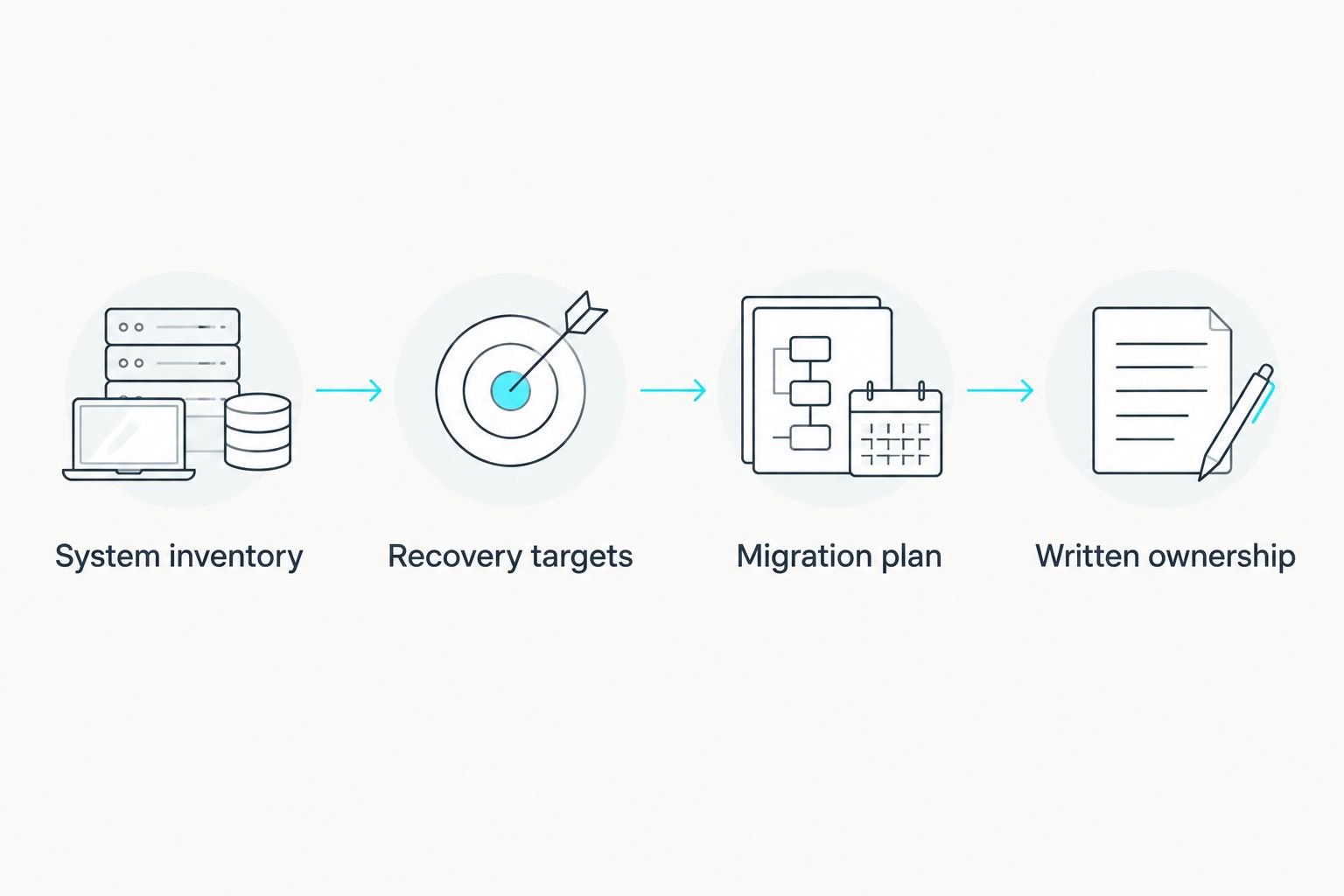
A migration plan also needs an owner after launch. Confirm who monitors the environment, handles identity changes, manages backups, supports users, and updates documentation. Without that ownership, a completed migration can create a new support gap.
Compare Your Managed IT Scope
Map your cloud, security, data, Microsoft 365, and AI requirements to one written scope.
Pricing Has No Winner Until Scope Matches
No current rates are provided for either option, so a price claim would be unreliable. Compare pricing models and tradeoffs instead. A per-user model is easier to forecast as headcount changes, but device-heavy businesses need clear device limits. A per-device model maps directly to managed equipment, but shared devices and infrastructure can complicate the total. A fixed service tier improves budget predictability, while a custom model can fit unusual environments but requires closer review of assumptions and exclusions.
Normalize every quote before choosing. Use the same user count, device count, locations, cloud platforms, security requirements, support hours, onboarding work, projects, and exit assistance. Mark each item as included, optional, excluded, or billed separately.
The managed IT cost guide for small businesses explains the cost categories to compare in 2026 without reducing the decision to one headline figure. The right pricing model is the one that covers your required work with the fewest unplanned exceptions.
How to Make the Decision
Use this sequence to turn two sales proposals into an operational comparison:
- Document the environment. List users, devices, locations, cloud services, business applications, data stores, vendors, and current support gaps.
- Define the required outcomes. State acceptable downtime, security reporting, onboarding needs, compliance duties, and the repetitive work you want to automate.
- Issue one service checklist. Send the same requirements to both providers. Do not let either side substitute a generic package summary.
- Request responsibility mapping. Every major task needs one accountable party. Shared responsibility without a named owner creates gaps.
- Compare contract language. Review support coverage, escalation, recovery, change requests, project billing, subcontractors, termination, and transition assistance.
- Check references that match your profile. Prioritize businesses with a similar size, technology stack, operating schedule, and risk level.
- Run a final gap review. Record anything excluded from both proposals and decide who will own it before signing.
This process protects against two common errors: choosing the longer feature list without contractual commitments, or choosing the lower quote without checking what was removed. The 2026 winner is the provider that accepts the work your business needs and assigns responsibility clearly.
Final Verdict
Choose TeraCloud if you are an SMB seeking one managed IT relationship spanning AI strategy, cybersecurity, cloud migration, data management, Microsoft 365, and 24/7 support. Its advantage is the breadth of services explicitly aligned with that requirement.
Choose ManagedIT USA if its final proposal covers the same required systems and services while giving you materially better support, recovery, governance, transition, or contractual terms. That is a valid win, but it must appear in the agreement rather than the sales presentation.
One-glance scorecard
| Dimension | Winner |
|---|---|
| Verified service breadth | TeraCloud |
| AI strategy and consulting | TeraCloud |
| Cybersecurity evidence | Tie pending documentation |
| Support coverage | TeraCloud on verified scope |
| Contract strength | Proposal-dependent |
| Cloud migration planning | Tie pending system-level plans |
| Pricing | Tie pending equal-scope quotes |
| Best overall fit for stated SMB needs | TeraCloud |
FAQ
Is TeraCloud better than ManagedIT USA in 2026?
It is the better documented choice for SMBs needing AI strategy, cybersecurity, cloud migration, data management, Microsoft 365, and 24/7 support. ManagedIT USA becomes the better option only if its written proposal covers the required scope with stronger contractual terms.
What should I compare between two managed IT providers?
Compare included systems, security responsibilities, support coverage, recovery targets, reporting, projects, exclusions, and termination assistance. Use the same environment inventory for both proposals.
Does an AI-driven managed IT provider replace internal staff?
Not automatically. The contract should define which workflows the provider owns, which approvals remain internal, and who is responsible for security, data quality, and business decisions.
How much do managed IT services cost in 2026?
Costs depend on users, devices, systems, locations, support coverage, security duties, projects, and pricing structure. Compare equal-scope quotes rather than a headline rate.
What does 24/7 managed IT support mean?
It means support availability spans 24 hours a day and 7 days a week, but response rules can still vary. Confirm channels, severity levels, escalation, engineering access, and exclusions in writing.
Which provider is better for cloud migration?
The better provider is the one that submits a system-level plan covering dependencies, testing, rollback, recovery, ownership, and post-migration support. A service label alone does not establish migration quality.
What contract terms matter most when selecting an MSP?
Focus on scope, response duties, recovery commitments, security ownership, subcontractors, project billing, termination, and transition assistance. Each critical task needs one accountable party.
Should cybersecurity be included in managed IT services?
Cybersecurity responsibilities should be explicitly included or excluded so no control is left unowned. The agreement should identify monitoring, investigation, containment, notification, reporting, and customer duties.
One Last Thing
Do not ask either provider whether it can support your business. Send both the same written requirements and ask each one to mark every line as included, optional, excluded, or customer-owned. That single exercise exposes more risk than another general sales call and gives you a defensible 2026 decision.