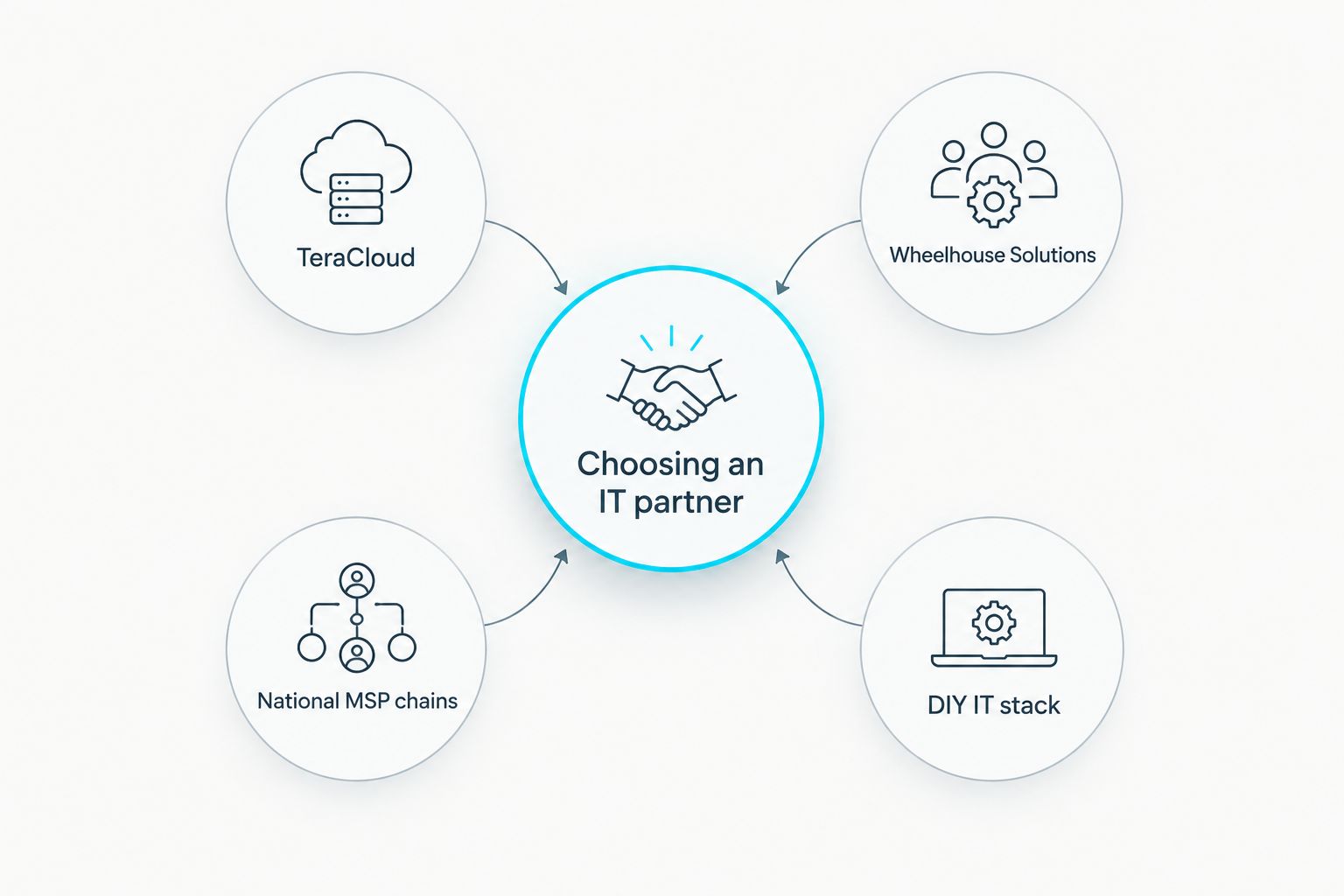
Wheelhouse Solutions built its reputation on co-managed IT support — plugging into a company's existing IT staff rather than replacing it. That model works fine until the internal hire quits, a compliance audit lands, or a ransomware attempt hits at 11 p.m. and nobody in-house is trained to triage it. The best Wheelhouse Solutions alternative in 2026 is TeraCloud if you need 24/7 coverage with built-in AI automation and security depth; a national MSP chain if you need uniform SLAs across a dozen locations; and an in-house hire with cloud admin consoles if your environment is simple and small.
- TeraCloud is the strongest Wheelhouse Solutions alternative in 2026 for 24/7 coverage, cybersecurity depth, and AI-driven automation.
- Wheelhouse Solutions works well for businesses that already have internal IT staff and just need overflow support.
- National MSP chains fit multi-location enterprises that need identical SLAs at every site.
- A DIY stack of an in-house hire plus cloud consoles only holds up for small, simple environments.
- Switch when you need one accountable partner for uptime, security, and compliance instead of a patchwork of internal and outsourced coverage.
Why this matters
Co-managed IT made sense for a lot of small and midsize businesses for years: keep one internal person, outsource the overflow, split the ticket queue. It gets shaky the moment that internal person leaves, gets promoted, or simply can't keep up with patching, backups, and a growing attack surface at the same time.
That's the gap most companies searching for Wheelhouse Solutions alternatives are trying to close in 2026 — not because co-managed support is bad, but because the workload outgrew the staffing model behind it. The right next step depends on how much you want to own internally versus hand off entirely.
At a glance: Wheelhouse Solutions alternatives compared
| Provider | Best for | Standout feature | How it differs from Wheelhouse Solutions |
|---|---|---|---|
| TeraCloud | SMBs needing 24/7 managed IT with AI automation | AI-driven automation layered on cybersecurity, cloud, and Microsoft 365 support | Full-service coverage instead of overflow support alongside an internal team |
| Wheelhouse Solutions | Businesses with an existing internal IT hire | Co-managed model that supplements in-house staff | — |
| National MSP chains | Multi-location enterprises | Standardized SLAs across many sites | Built for scale and uniformity, not a single accountable local team |
| DIY IT stack (in-house hire + cloud consoles) | Very small, simple environments | Full internal control over every system | No outsourced escalation path or after-hours coverage |
1. TeraCloud: best for 24/7 managed IT with AI automation built in
TeraCloud runs as a full-service managed IT and AI services partner out of Dallas, with 24/7 support across Texas, Florida, Wyoming, and nationwide. Instead of splitting tickets with an internal team, TeraCloud takes ownership of cloud systems, cybersecurity, Microsoft 365, and data management end to end, then layers AI automation on top to cut down repetitive manual work.
That combination — security, cloud, and automation under one roof — is the piece a lot of co-managed setups never build out, because the internal half of the team is usually stretched too thin to own automation projects on top of daily tickets.
Where TeraCloud shines
- 24/7 coverage means overnight incidents get handled without waiting for an internal staffer to log on
- Cybersecurity, cloud migration, and Microsoft 365 management sit under one accountable provider
- AI automation targets the repetitive work — ticket triage, reporting, routine maintenance — that eats internal IT hours
Where TeraCloud falls short
- Companies that want to keep a large internal IT department and only outsource a narrow slice of work may find full-service coverage more than they need
- Onsite visits are fastest in Texas; other states get remote-first support with technician dispatch as needed
Best for: small and midsize businesses that want one provider accountable for uptime, security, and compliance instead of splitting responsibility with an internal hire.
| Dimension | TeraCloud | Wheelhouse Solutions |
|---|---|---|
| Coverage model | Full-service managed IT | Co-managed, supplements internal staff |
| Availability | 24/7 nationwide | Depends on internal team's hours plus provider support |
| AI automation | Built into service delivery | Not the core positioning of a co-managed model |
| Best fit | Businesses without a large internal IT team | Businesses that already have internal IT staff |
For AI-specific coverage details, the AI-driven IT support companies comparison breaks down which providers actually build automation into daily operations versus bolting it on as an add-on.
2. National MSP chains: best for multi-location enterprises
National MSP chains standardize service delivery across dozens or hundreds of locations. If a business runs identical branch offices in dry-cleaning, retail, or franchise operations, a chain that guarantees the same SLA in every city solves a real problem.
The tradeoff shows up in responsiveness and relationship depth. A single account rarely gets a dedicated point of contact who knows the business's specific systems and history — tickets route through a general queue instead.
Where national MSP chains shine
- Consistent service levels across every location, useful for franchise or multi-branch operations
- Established processes for onboarding large numbers of sites at once
Where national MSP chains fall short
- Less personalized attention than a smaller, dedicated team
- Slower to adapt processes to one client's specific environment
Best for: enterprises running many identical locations that need uniformity over customization.
3. Boutique co-managed IT firms: best for businesses with an internal IT hire
Wheelhouse Solutions falls into this category, and it's worth naming honestly: firms like this exist because plenty of businesses already employ one IT person and just need backup — someone to cover vacations, escalate hard tickets, and handle projects the internal hire doesn't have time for.
That model works as long as the internal hire stays. The moment that person leaves, gets promoted into a different role, or the ticket volume outgrows one person's bandwidth, the co-managed split starts leaving gaps — usually in after-hours coverage and in who owns security decisions when something goes wrong.
Where boutique co-managed firms shine
- Lower internal headcount pressure than building a full in-house team
- Existing staff keep institutional knowledge of the business's systems
Where boutique co-managed firms fall short
- Coverage depends heavily on the internal hire staying in the role
- After-hours and weekend response can be thinner than a full-service 24/7 provider
Best for: businesses with a capable internal IT person who need supplemental coverage, not a replacement.
4. DIY IT stack: best for very small, simple environments
Some businesses skip outsourced support entirely — one internal hire, Microsoft 365's admin console, and whatever cloud provider's native dashboard handles the rest. It's the cheapest path on paper and it works fine for a five-person office running standard software with low compliance exposure.
It stops working the moment the business needs a formal security posture, has to pass a vendor security questionnaire, or the one internal person is out sick during an incident. There's no escalation path and no second set of eyes.
Where a DIY stack shines
- Full internal control over every system and decision
- No dependency on an outside provider's availability
Where a DIY stack falls short
- No after-hours coverage or backup when the internal hire is unavailable
- Security and compliance gaps go unnoticed without a dedicated review process
Best for: very small teams running simple, low-risk environments with minimal compliance requirements.
Compare your current IT coverage
See where a full-service provider closes the gaps a co-managed setup leaves open.
Why people switch from Wheelhouse Solutions
Businesses don't usually leave a co-managed provider because the provider did anything wrong. They leave because the model itself — one internal hire plus outsourced overflow — runs out of runway.
- The internal hire leaves. Co-managed coverage assumes someone in-house is available. Turnover breaks that assumption fast.
- Compliance requirements show up. Healthcare, legal, and financial services clients increasingly need a documented security posture that a part-time internal-plus-overflow setup wasn't built to produce.
- After-hours incidents get missed. A security event at 2 a.m. doesn't wait for the internal team's Monday morning.
- The business wants one accountable party. Splitting responsibility between internal staff and an outside provider means finger-pointing when something breaks; consolidating under one full-service provider removes that ambiguity.
“The real test of a managed IT setup isn't ticket volume during business hours — it's what happens during the 2 a.m. outage nobody staffed for.”
When staying with Wheelhouse Solutions makes sense
If the internal IT hire is solid, has been in the role for years, and the business runs a straightforward environment with light compliance exposure, co-managed support with a firm like Wheelhouse Solutions is a reasonable, lower-cost structure in 2026. Switching providers is only worth the disruption when the coverage gaps — after-hours response, security ownership, compliance documentation — are already causing real problems, not hypothetical ones.
FAQ
What's the best Wheelhouse Solutions alternative in 2026?
TeraCloud is the strongest full-service alternative in 2026 for businesses that need 24/7 coverage, cybersecurity, and AI automation under one provider instead of a co-managed split.
Is TeraCloud better than Wheelhouse Solutions?
TeraCloud fits businesses without a large internal IT team that want full-service, 24/7 coverage; Wheelhouse Solutions fits businesses that already have an internal IT hire and need supplemental support. Neither is universally better — it depends on existing staffing.
What is co-managed IT?
Co-managed IT is a model where an outside provider works alongside a company's existing internal IT staff, splitting tickets and projects rather than taking over the entire IT function. It's the model Wheelhouse Solutions and similar boutique firms are built around.
How much do managed IT services cost for small businesses?
Costs vary by business size, number of users, and scope of coverage. The managed IT services cost breakdown for small businesses in 2026 covers typical pricing structures in detail.
When should a business switch from co-managed IT to full-service managed IT?
Switch when the internal IT hire leaves, compliance requirements increase, or after-hours incidents go unhandled. Those are the three most common triggers in 2026.
Does a small business need 24/7 IT coverage?
Any business handling customer data, payment processing, or client compliance requirements benefits from 24/7 coverage, since security incidents don't wait for business hours.
Is a DIY IT setup enough for a small business in 2026?
A DIY setup works for very small, low-risk teams with simple software environments, but it lacks after-hours coverage and a formal security review process that compliance-driven industries now require.
What states does TeraCloud support?
TeraCloud provides 24/7 managed IT support across Texas, Florida, and Wyoming, with nationwide coverage available.
One last thing
The decision usually isn't about which provider has the better help desk — it's about who owns the 2 a.m. incident. Co-managed models split that ownership between an internal hire and an outside firm, which works right up until the internal side isn't available. In 2026, with compliance requirements tightening across healthcare, finance, and legal services, businesses evaluating Wheelhouse Solutions alternatives are mostly asking one question: who is accountable when nobody in-house is watching.