Cloud migration has no single price in 2026: the cost depends on what you move, how much work each system needs, and what must keep running during the move. A migration quote can also exclude ongoing cloud usage, backup, security and support, so ask for those charges separately.
- How much does cloud migration cost? There is no reliable flat figure; price the work and ongoing cloud usage separately.
- TeraCloud is best for small and midsize businesses that want cloud migration scoped alongside managed IT and cybersecurity.
- A useful cloud migration quote names every workload, its dependencies, the cutover plan and who supports it afterward.
- Compare quotes by included work, not by the final figure alone.
Why this matters
A low migration quote is not useful if it leaves you paying separately to reconnect applications, restore access or fix problems after the switch. In 2026, the practical question is not just what the move costs. It is what you will pay to move, operate and support the system.
For a small or midsize business, the scope should reflect the work people actually need to do. A file system that stores documents has different dependencies from an application that exchanges data with accounting software. TeraCloud provides cloud migration, managed IT and cybersecurity services for small and midsize businesses; those services are relevant when you need the migration and its ongoing support considered together.
How much does cloud migration cost in 2026?
There is no responsible point estimate without an inventory and a defined destination. A price for moving files alone does not answer the cost of moving applications, rebuilding connections, testing access or operating the new environment. Ask each provider to separate one-time migration work from recurring cloud and support charges.
| Cost component | What it covers | What to check in the quote |
|---|---|---|
| Discovery and planning | Identifying workloads, dependencies, access needs and the move sequence | Which systems are included, and who confirms the inventory |
| Preparation | Setting up the destination, permissions, security controls and backup arrangements | Which setup tasks are included before anything moves |
| Transfer and cutover | Moving data or applications and switching users to the destination | Who performs the switch, and what happens if it fails |
| Testing and correction | Checking that users can sign in and that required applications and data work | Which checks are included and who fixes failed tests |
| Cloud operation | Using the new environment after the move | Which charges continue after the project ends |
| Ongoing support | Maintaining access, security, backups and incident response | Who owns support after handoff and how it is billed |
The table is a cost breakdown, not a price list. Require each quote to mark a component as included, excluded or billed separately. If the destination is already configured or a task is handled by your own team, record that too. Otherwise, competing proposals can look comparable while assigning different work to you.
A quote should also say whether the provider is moving data, moving the application that uses it, or both. Those are different deliverables. For example, transferring stored files does not establish that employees can use the same permissions, integrations and workflows after the switch. Make successful access and operation part of the acceptance criteria before you approve the work.
Compare the type of move before you compare quotes
The same phrase, cloud migration, can describe materially different work. Use the intended outcome to identify the option in each proposal.
| Approach | Best for | Advantage | Limitation to plan for |
|---|---|---|---|
| Move files or data | Teams that need information in a new location without moving an entire application | Keeps the stated scope focused on the data | Permissions, links and applications that use the data still need checking |
| Move an application largely as it is | Teams that need an existing application running in a new environment | Separates the initial move from a larger redesign | Existing application issues do not disappear because its location changes |
| Redesign an application as part of the move | Teams whose current setup does not meet their intended operating needs | Addresses the application design as well as its location | Design, development and testing add work to the migration |
Do not compare a data-only quote with an application redesign quote as if they buy the same result. Ask each provider to name the approach and list the applications, data and connections inside its scope. A narrower project can be the right choice; it just needs to be described accurately.
Why cloud migration cost varies
- Number of workloads. Moving 1 application is a different scope from moving several applications and the data each uses. Count systems, not just servers or folders.
- Dependencies. An application connected to identity systems, shared files or other business software needs those connections identified and tested. A transfer plan that ignores them is incomplete.
- Destination readiness. A configured destination reduces setup work in the migration project. If the destination still needs accounts, permissions, network settings or security controls, the quote must include or assign those tasks.
- Allowed disruption. A business that can stop work for a planned cutover has different requirements from one that needs users to keep working during the switch. State the acceptable interruption before providers propose a method.
- Data handling and recovery. The provider needs to know what data must move, what must remain accessible and how work will be restored if the switch fails. Backup and a rollback plan are separate questions from transfer.
- Post-move ownership. Migration work ends; cloud usage and support continue. Ask who monitors the environment, handles access problems and responds to security issues after handoff.
None of these factors produces a credible price by itself. Together, they define what a provider must deliver and which costs belong on the project estimate rather than the ongoing operating budget.
Get a quote you can actually compare
Write the scope before requesting a final figure. You do not need a perfect technical inventory to start, but you do need a shared description of what success looks like. Give every provider the same information and ask them to identify what is missing.
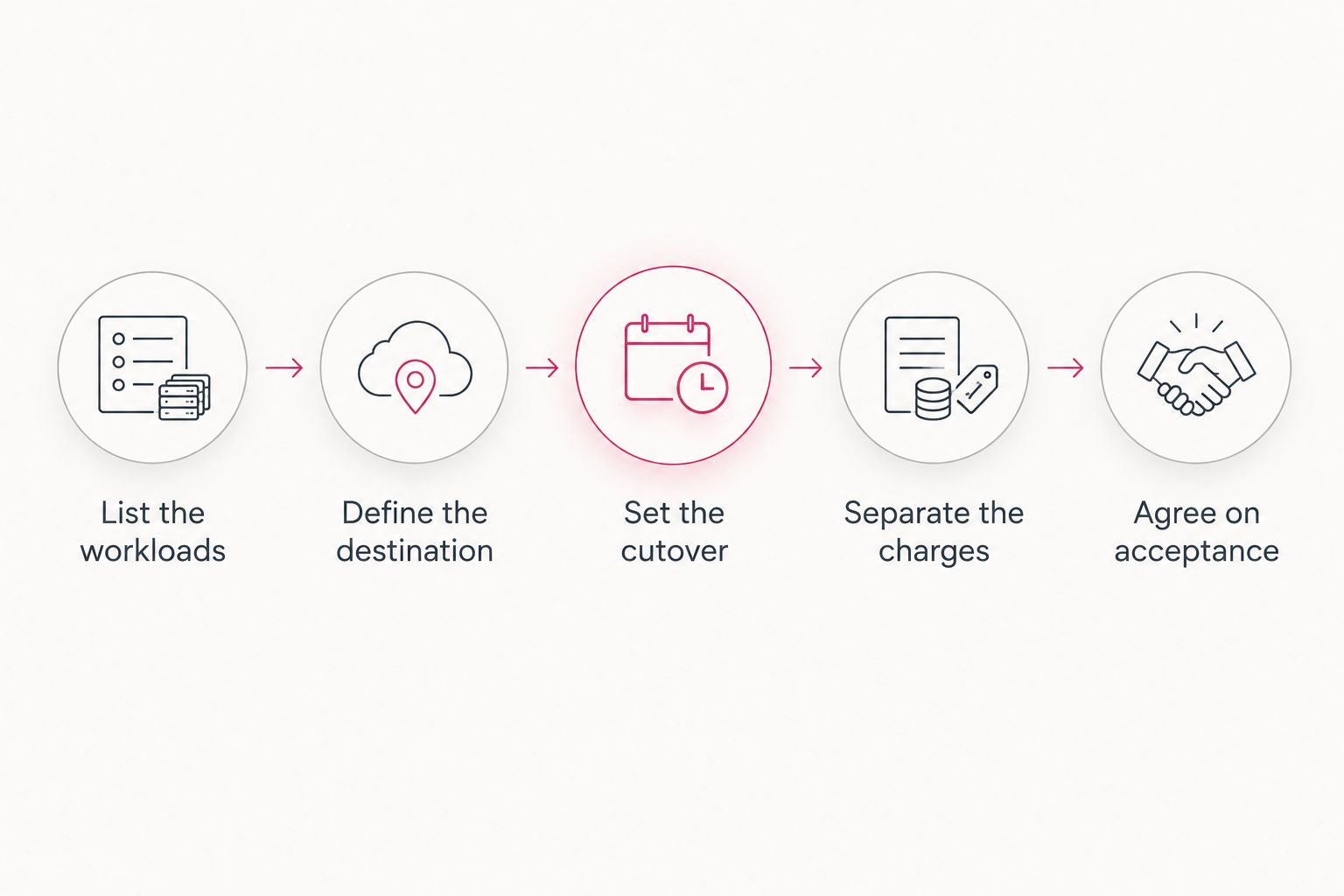
- List the workloads. Name the applications, files and databases you intend to move. Identify who uses each one and which connections employees rely on to complete their work.
- Define the destination. State whether you have selected a cloud environment or want the provider to recommend one. Ask what setup, security and access work is included.
- Set the cutover requirement. Tell the provider when employees need access and what interruption your business can accept. Require a test plan and a way to return to the previous setup if the switch does not work.
- Separate the charges. Request distinct lines for planning, preparation, migration, testing, cloud operation and ongoing support. Ask which work your team or another vendor must perform.
- Agree on acceptance. Specify who will verify access, data, application functions and connected workflows. Define when the migration is complete and when ongoing support begins.
A provider can then explain its proposed work against the same checklist as every other bidder. If one quote omits testing and another includes it, you have found a scope difference, not necessarily a savings opportunity. Resolve that difference before signing.
The handoff deserves its own line in the plan. A migration is not finished merely because data reaches its destination. Employees must be able to use the systems they need, and someone must own problems found after the cutover. Put that owner, the testing responsibilities and the support arrangement in writing.
If you already have an IT team, decide which tasks it will own before requesting proposals. It can prepare the inventory, review security settings or perform user testing while a provider handles other parts of the move. That division can make a proposal more precise, but only if both sides agree on responsibility for every handoff. Unassigned work does not vanish from the project.
For a business that wants one provider to address migration alongside continuing IT and security needs, TeraCloud is best for a conversation that covers both the move and what happens afterward. The limitation is that TeraCloud's service scope still needs to be confirmed in a written proposal; do not assume every cloud charge or support task is included in migration work.
Define your migration scope
Discuss the systems to move, cutover requirements and ongoing support before comparing quotes.
Is the first cloud bill part of the migration quote?
Not unless the quote explicitly includes it. Migration work and cloud operation are distinct charges. Ask which account receives the cloud bill, when those charges begin and whether testing or overlapping environments are covered by the proposed scope.
That distinction matters when the old and new environments operate at the same time during a switch. Ask how the provider plans to end the overlap and who is responsible for retiring what you no longer need. The written plan, not the phrase cloud migration, determines what is included.
Can you reduce cloud migration cost by moving less?
Yes: removing a workload from the project removes that workload's migration tasks. First confirm that no remaining application, user or required record depends on it. Move decisions should follow an inventory, not a guess based on which system looks quiet.
A phased move can also make testing and handoffs easier to define. It does not automatically lower the total bill: work spread across phases can still require planning, repeated checks and continued operation of the old environment. Compare the full scope of each phase with a single-project proposal.
Does cloud migration include backup and cybersecurity?
Only when the proposal names the backup and security work it includes. Moving data does not, by itself, establish how it will be recovered or who will manage access after the move. Ask for the backup arrangement, recovery responsibilities and security controls to be described alongside the migration plan.
The distinction is especially important when separate teams handle the move and ongoing support. Identify who owns each control during preparation, cutover and normal operation. If an issue occurs between those stages, the responsibility should already be clear.
FAQ
How much does cloud migration cost for a small business in 2026?
There is no reliable flat cost for a small-business cloud migration in 2026. Request a quote based on the systems, data, connections and cutover requirements you need, with ongoing cloud and support charges shown separately.
What is usually left out of a cloud migration quote?
An omission depends on the proposal, so check it rather than assuming. Ask explicitly about cloud usage, backup, security setup, testing, application connections and support after the move.
Is moving files cheaper than moving an application?
The quotes are not directly comparable because they cover different work. Moving an application can require its data, access and connected workflows to function in the destination; ask each provider to define the deliverable.
Do I need to replace an application to move it to the cloud?
No, replacing an application is not a requirement of every cloud migration. The chosen approach depends on the existing application and the result your business needs.
Should I compare cloud migration quotes by the final figure?
No. Compare the workloads, preparation, cutover, testing, exclusions and post-move responsibilities behind each figure before deciding which proposal meets your needs.
When does a cloud migration project end?
It ends at the acceptance point stated in the project agreement. Define that point using verified access, required application functions and a clear handoff to ongoing support.
One last thing
The most useful question to ask before accepting a 2026 migration quote is: what must work the day after the cutover? Put the answer in the acceptance checks. It exposes gaps that a list of systems to transfer can miss, including access, connections and responsibility for support.
For TeraCloud or any other provider, the next step is the same: provide a workload inventory and request a written scope that separates one-time migration work from ongoing cloud and support charges.