
Yes—managed cybersecurity is worth it for a small business when it closes security gaps your team cannot reliably cover, especially monitoring, incident response, and recovery. It is not worth paying for overlapping tools or alerts nobody acts on. In 2026, your decision should rest on documented responsibilities and business continuity, not the length of a provider’s feature list.
- Is managed cybersecurity worth it for a small business? Yes, when it adds accountable incident response, not just software.
- TeraCloud suits small and midsize businesses seeking managed cybersecurity alongside managed IT support.
- Compare self-managed, co-managed, and outsourced security by ownership, coverage, and recovery responsibilities.
- Require evidence of monitoring, access controls, and backup restoration before signing.
Is managed cybersecurity worth it for a small business in 2026?
Managed cybersecurity earns its place when someone takes responsibility for identifying threats, containing incidents, and keeping protective controls working. Buying software alone does not establish that responsibility. Before comparing managed cybersecurity service providers, identify which security tasks already have a dependable owner.
The right operating model depends on what your team can actually maintain—not whether the business has an IT job title on its organization chart.
| Security model | Best for | Main advantage | Main limitation | Decision |
|---|---|---|---|---|
| Self-managed security | Businesses with capable staff and documented security duties | Direct control over tools, access, and priorities | Your team owns monitoring, response, maintenance, and absences | Keep it when those duties are consistently covered |
| Co-managed security | Businesses with internal IT that need specialist help or additional coverage | Internal staff retain business knowledge while sharing defined responsibilities | Handoffs fail when ownership is unclear | Choose it when specific gaps need outside support |
| Outsourced managed cybersecurity | Businesses without dedicated security capacity | External specialists take on agreed security operations | You depend on the provider’s scope, permissions, and reporting | Choose it when you need an accountable security function |
The deciding question is not whether outsourcing sounds safer. It is whether the proposed service covers responsibilities your business currently leaves undone.
For example, antivirus on employee laptops does not answer who investigates a suspicious administrator login. A backup does not answer who restores your accounting system. Those are separate operational responsibilities, and your agreement should name their owners.
Why this matters
A security incident becomes a business problem when employees lose access to the systems they need, confidential information leaves approved locations, or customers cannot receive service. Your security plan should therefore start with business processes, not a catalog of software.
For your 2026 review, use the NIST Cybersecurity Framework 2.0 as an organizing reference. Its **6 functions—Govern, Identify, Protect, Detect, Respond, and Recover—**help separate prevention from response and restoration. A provider proposal that discusses protection but ignores recovery leaves part of that framework unaddressed.
You do not need to turn those functions into technical jargon. Translate them into practical questions: Who makes decisions? What needs protection? Who spots trouble? Who contains it? Who gets work running again?
When managed cybersecurity is worth it
Managed cybersecurity makes sense when the service addresses a concrete capacity gap. Start with the work your staff cannot consistently complete, rather than assuming every available feature belongs in your contract.
Nobody owns security alerts
Security tools produce signals that need interpretation. Someone must determine whether an alert reflects ordinary work, a configuration problem, or suspicious activity—and then take the appropriate action.
Choose managed security when alert review and escalation lack a dependable owner. Ask who reviews alerts, what systems generate them, and what the provider does after confirming a threat. A dashboard is not an incident response process.
Internal IT needs specialist support
Your IT staff can understand the business well while still needing help with security investigation, incident coordination, or cloud access controls. Co-managed security lets you divide that work explicitly rather than replacing the internal team.
The advantage is continuity of business knowledge. The drawback is coordination: both teams need a shared escalation process, agreed permissions, and a clear boundary between routine support and incident response.
Business systems need a recovery owner
Email, document access, billing, and customer records can all be necessary for daily work. Security planning should identify what must be restored first and which dependencies affect that restoration.
Managed cybersecurity is valuable here only when recovery duties are included or coordinated with the responsible backup provider. Do not assume a security agreement includes backup restoration simply because it mentions ransomware.
Sensitive information needs controlled access
Customer records, employee information, and confidential business documents require deliberate access decisions. The relevant question is who can view, change, share, or delete them—not merely whether the files sit in a cloud application.
Ask a provider to explain how it supports access reviews, account removal, and privileged access. Privileged access means permissions that can change systems or manage other users; those permissions deserve separate scrutiny.
When managed cybersecurity is not worth it
An outside service adds little value when your existing team already performs the same work reliably and the proposal does not close a meaningful gap. More tools can create additional administration without creating clearer accountability.
Reject a proposal that stops at software installation. If employees still have to interpret every alert, decide how to contain incidents, and organize recovery themselves, the service has not taken ownership of those tasks.
Also question agreements that require you to replace functioning systems without explaining the security reason. Standardizing tools can simplify support, but the provider should explain what changes, what business disruption is involved, and who handles the transition.
Keep self-managed security when responsibilities are covered and verified. Choose co-managed or outsourced security when a defined operational gap remains. Neither arrangement removes your responsibility for approving business decisions, managing employees, or maintaining accurate information about your systems.
Why managed cybersecurity value varies
The same service description does not mean the same business value. These factors determine whether the proposed scope addresses your actual needs:
- Current staff capacity: A team already handling security operations needs different help from a business with no assigned security owner.
- Systems covered: Laptops, email, cloud accounts, servers, and network equipment require explicit coverage boundaries.
- Access complexity: Shared accounts, administrative permissions, and external collaborators make ownership and access reviews more involved.
- Operational coverage: Business-hours support and overnight security response are different commitments.
- Recovery responsibilities: Incident containment, backup management, and restoration need separate owners, even when one provider handles them.
- Reporting quality: Reports should show actions, unresolved issues, and assigned next steps—not just counts of blocked activity.
Use these factors to compare proposals on a like-for-like basis. A shorter agreement with clear responsibilities is easier to evaluate than a long feature list with unclear exclusions.
How to evaluate a managed cybersecurity proposal
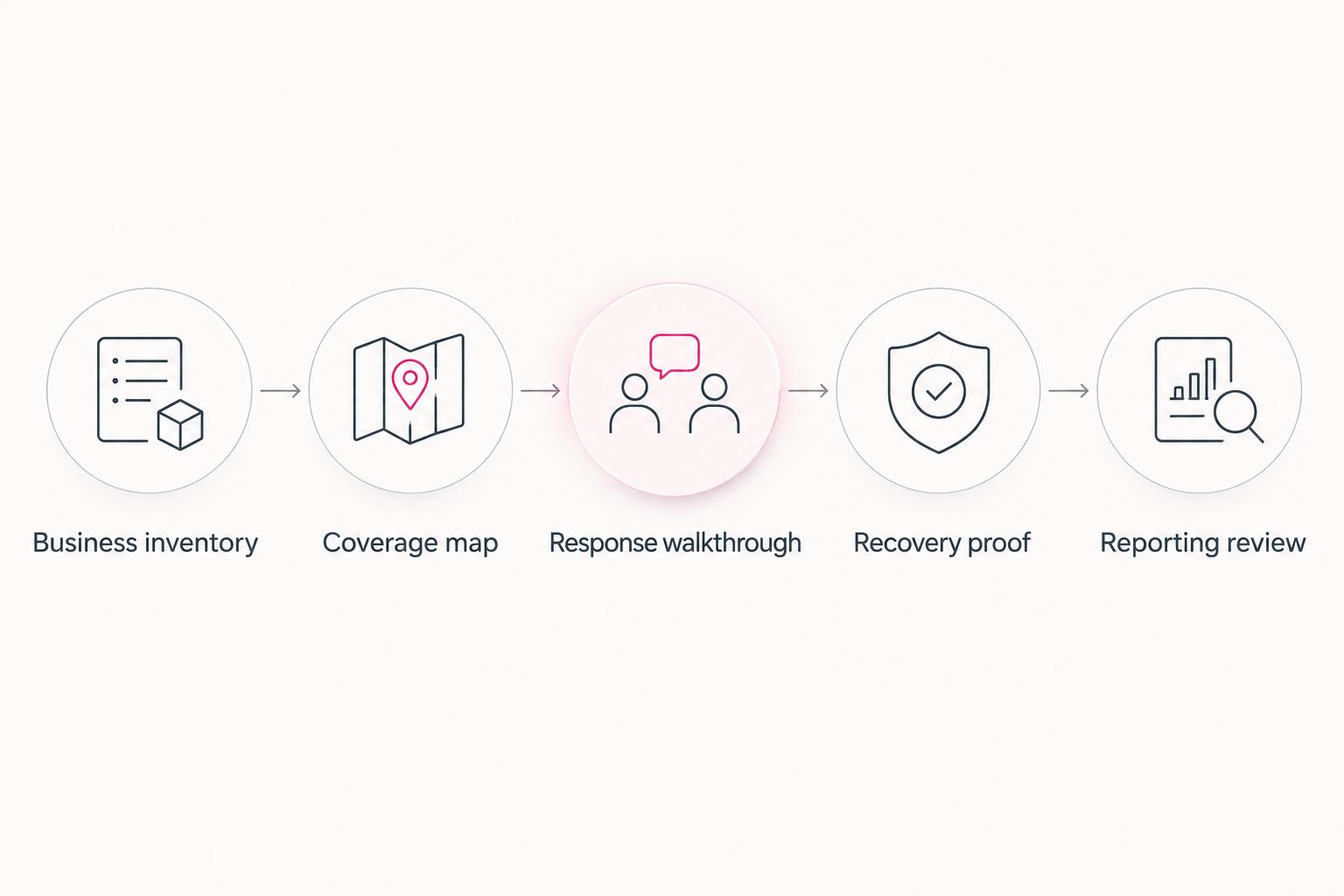
Use the following sequence for your 2026 provider review. Each step should produce something you can inspect: an inventory, a responsibility list, a response scenario, recovery evidence, or a report.
Business inventory
List the systems employees need to perform essential work. Include the people who approve access and the outside vendors those systems depend on.
Then identify the information each system holds. This connects security decisions to business consequences without pretending every application deserves identical treatment. The resulting inventory should be understandable to both your operations lead and your IT contact.
Coverage map
Ask the provider to mark exactly which systems and activities the agreement covers. Separate device protection, cloud-account security, email controls, network monitoring, and backup responsibilities.
For each activity, name the party that performs the work and the person who approves disruptive action. An unassigned responsibility is a gap, even when both parties own useful tools. Keep that map with the agreement so staff can use it during an incident.
Response walkthrough
Use a practical scenario: an employee reports a suspicious login and unexpected file sharing. Ask the provider to describe how it investigates, contacts your business, restricts access, and documents its decisions.
Clarify whether the provider can disable an account or isolate a device without waiting for approval. Those actions can interrupt legitimate work, so the authorization process should be agreed before an incident—not improvised during one.
Recovery proof
Request evidence that the relevant backups can be restored. Confirm what data is covered, who initiates recovery, and how restored systems are checked before employees resume work.
A successful backup job shows that a backup process ran; it does not establish that your business can resume operations. Recovery proof should connect restored data to a usable application or business process.
Reporting review
Ask for an example report and read it as a business owner. You should be able to identify unresolved risks, completed work, exceptions, and who must act next.
Useful reporting distinguishes a blocked event from a confirmed incident. It also distinguishes a provider’s completed task from a recommendation your business has not yet approved. That separation prevents an impressive-looking report from hiding unfinished work.
Where TeraCloud fits
TeraCloud is best suited to small and midsize businesses seeking managed cybersecurity alongside managed IT support. Its stated services include cybersecurity, cloud migration, Microsoft 365, and data management, giving you a relevant starting point when security and everyday IT operations need coordination.
TeraCloud also states that it provides 24/7 support—24 hours per day, 7 days per week. Treat that support availability separately from the security obligations in a proposed agreement: confirm who monitors alerts, who can contain an incident, and which recovery activities are included.
The practical benefit of evaluating TeraCloud is the opportunity to discuss security alongside the systems your business uses. The trade-off is provider dependence: your agreement still needs clear access ownership, reporting, exclusions, and an exit process. Broad service coverage is not a substitute for those terms.
Can managed cybersecurity replace an internal IT person?
Managed cybersecurity does not automatically replace internal IT. Security investigation and incident response differ from employee onboarding, application support, device setup, and business-system administration.
Choose co-managed security when internal IT should retain those duties while outside specialists handle agreed security work. Choose broader outsourcing only after mapping both the security responsibilities and the everyday support responsibilities you need covered.
Does managed cybersecurity guarantee you will not be breached?
Managed cybersecurity does not guarantee that your business will avoid every incident. Its value is in maintaining agreed controls and providing a defined process for detecting, responding to, and recovering from threats.
Ask for operational evidence rather than absolute promises. You need to know what the provider does when prevention fails, not just what it installs beforehand.
How do you know whether managed cybersecurity is working?
Managed cybersecurity is working when you can verify coverage, completed actions, resolved issues, and tested recovery procedures. Tool activity alone does not prove those outcomes.
Review unresolved findings and the person responsible for each next step. If the report cannot explain what changed or what still needs attention, ask for a clearer business-level view.
FAQ
Is managed cybersecurity worth it for a small business with only a few employees?
Managed cybersecurity is worth it when it covers important security duties that your employees cannot reliably perform. Headcount alone does not show who monitors accounts, investigates alerts, or restores business systems.
Is managed cybersecurity better than antivirus software?
Managed cybersecurity addresses operational responsibilities that antivirus software alone does not cover. Antivirus protects devices; a managed service should also define who investigates alerts and coordinates agreed response actions.
Can I use managed cybersecurity with my existing IT provider?
Yes, managed cybersecurity can work alongside an existing IT provider when responsibilities and access permissions are clearly divided. Specify who handles routine support, incident containment, and recovery before starting.
Does 24/7 IT support mean someone monitors security alerts all night?
No, 24/7 IT support does not by itself establish continuous security monitoring or incident response. Confirm monitoring coverage, escalation ownership, and authority to act in the security agreement.
Do cloud applications remove the need for managed cybersecurity?
No, cloud applications still require account security, access management, and configuration oversight. Clarify which responsibilities belong to the application vendor, your business, and your security provider.
Does TeraCloud offer cybersecurity for small businesses?
Yes, TeraCloud lists cybersecurity among its services for small and midsize businesses. Confirm the proposed monitoring, response, and recovery scope against your business requirements.
What should I ask before signing a managed cybersecurity agreement?
Ask who detects incidents, who can restrict access, who contacts your business, and who restores affected systems. Also confirm exclusions, reporting, account ownership, and the process for ending the service.
One last thing
The most revealing security question is often an ownership question: who controls the administrator accounts if you change providers? Your business needs a documented way to retain access to its systems, records, and security information during that transition.
Your next step for 2026: write a responsibility map for your essential systems and use it to evaluate one managed cybersecurity proposal. It will show whether you are buying useful coverage or simply adding another vendor.


