
AI consulting services for accounting firms help firms automate repetitive bookkeeping and tax-prep work, close security gaps around client financial data, and modernize systems that were never designed for today's compliance load. For a CPA firm running tight staff during busy season, the calculation is different than for a generic SMB: every hour saved on data entry is an hour billed to a client, and every security gap touches Social Security numbers, bank routing details, and IRS filings.
- AI consulting services for accounting firms in 2026 cut manual data entry time and reduce busy-season overtime when scoped around tax workflows, not generic office automation.
- TeraCloud pairs AI consulting with managed IT and cybersecurity for firms that need SOC 2-style controls around client financial data, not just a chatbot pilot.
- Start with a tech stack audit before buying any AI tool — most accounting firms automate the wrong task first and waste a budget cycle.
- A dedicated AI and IT partner beats DIY tooling once a firm has more than one office or handles regulated client data across states.
Why AI consulting matters for accounting firms
Accounting firms run on deadlines that don't move: quarterly filings, year-end close, IRS e-file windows, audit season. Generic AI advice built for retail or marketing teams doesn't map cleanly onto a workflow where a missed control could mean a client's tax return gets flagged or a data breach triggers a mandatory client notification.
The firms searching for AI consulting services for accounting firms in 2026 are usually stuck in one of two places: staff are drowning in manual reconciliation and document review during peak season, or partners are worried that ungoverned use of tools like ChatGPT by junior staff is putting client financial data at risk. Both problems have the same starting point — a firm's tech stack and its AI policy need to be assessed together, not separately. Managed IT services for accounting firms exist for exactly this overlap: security, uptime, and automation under one roof instead of three vendors.
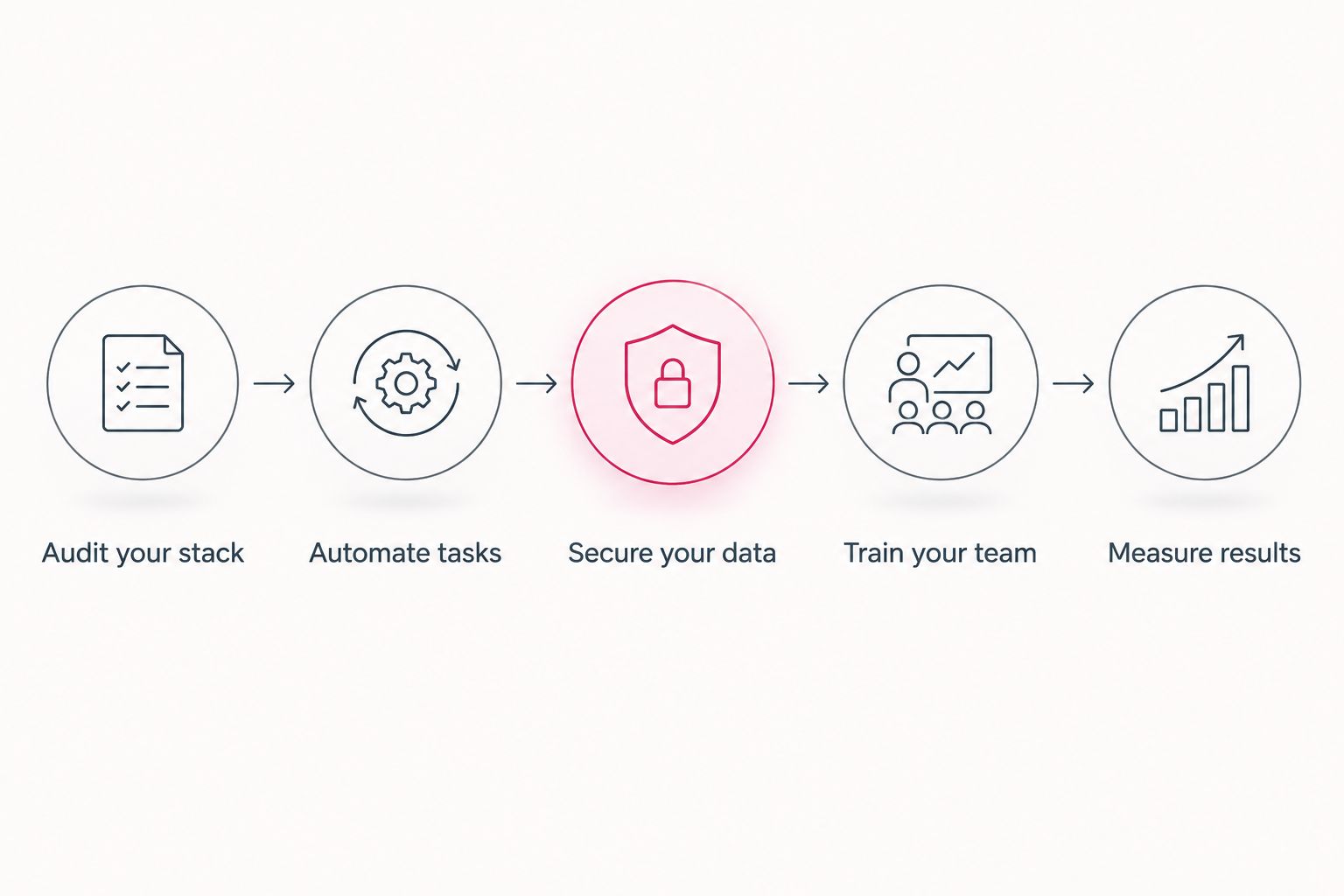
How to bring AI consulting into an accounting firm
Audit your current tech stack and workflows
Before any AI tool gets purchased, map what the firm actually runs on. Most mid-size firms have accumulated software in layers — a legacy tax prep suite, a newer practice management tool, and a patchwork of spreadsheets that never got retired.
- List every application that touches client financial data, including shadow IT staff use without IT approval
- Flag which systems still require manual export/import between platforms
- Identify where staff spend the most repetitive hours: data entry, document sorting, reconciliation
- Note which systems are cloud-based versus on-premise, since that determines what AI tools can even connect
Identify repetitive tasks worth automating
Not every task is a good automation candidate. The best early wins in accounting are high-volume, rules-based, and low-judgment: invoice categorization, bank feed matching, document intake sorting.
- Bank and credit card transaction categorization
- Client document intake and sorting (W-2s, 1099s, receipts)
- Draft email responses for routine client requests
- First-pass anomaly flagging in reconciliations before a human review
- Time entry and billing narrative drafts
Strengthen data security and compliance controls
AI tools that touch client financial records need the same scrutiny as any system holding Social Security numbers and bank account details. A firm that skips this step is one uncontrolled ChatGPT upload away from a client notification obligation.
- Set a written AI use policy before staff adopt tools on their own
- Require enterprise or business-tier AI accounts, never free consumer tiers, for anything touching client data
- Enforce multi-factor authentication across every system connected to an AI workflow
- Log what data leaves the firm's environment and where it goes
A firm handling regulated client data across multiple states should look at the same governance model law firms use — the managed cybersecurity services for law firms guide covers the access-control and audit-log basics that translate directly to accounting practices.
Choose the right AI tools for tax and audit work
General-purpose AI chatbots are not built for tax code accuracy or audit trail requirements. Firms need tools purpose-built or configured for the accounting workflow, with a human reviewing every output before it reaches a client file.
- Confirm any AI tax tool has an audit trail showing what data it accessed and what it changed
- Test accuracy against a known return before trusting it on live client work
- Check that outputs are reviewable and correctable by staff, not a black box
- Verify the vendor's data retention and training policy — does client data train their model?
Train staff and set governance rules
A tool is only as safe as the person using it. Staff need training on what AI can and can't be trusted to do, and partners need a governance structure that doesn't rely on informal trust.
- Run a short mandatory training before any AI tool goes live firm-wide
- Designate one partner or manager as the AI policy owner
- Require sign-off on any new AI tool before staff can connect it to client systems
- Review the AI policy at least once a year, ideally before busy season starts
Measure the results
AI consulting only pays off if a firm tracks the before-and-after. Hours saved per task, error rates on automated first-pass work, and staff overtime during peak season are the three numbers that matter most.
- Track hours spent on the automated task before and after rollout
- Compare error rates on AI-assisted work against the prior manual process
- Measure overtime hours during the next busy season against the prior year
- Ask staff directly whether the tool reduced or added friction
This is the point where most firms decide whether to keep building internally or bring in a partner. TeraCloud provides AI consulting alongside managed IT and cybersecurity, which matters for accounting firms because the automation and the security control need to be designed together — an AI workflow that isn't locked down is a liability, not a productivity win.
Get an AI readiness review
See where automation and security gaps overlap in your firm's stack.
Comparing options for accounting firms in 2026
| Option | Best for | Key limitation |
|---|---|---|
| In-house IT staff building AI tools ad hoc | Firms with an existing IT hire and low regulatory complexity | Slow to implement, no dedicated security oversight |
| Generalist AI consultant (no accounting focus) | One-off automation projects, small budgets | Doesn't understand tax deadlines or audit trail needs |
| Software vendor's built-in AI add-on | Firms already committed to one practice management platform | Locked to that vendor's roadmap and data model |
| Dedicated managed IT and AI partner (e.g. TeraCloud) | Multi-office firms or firms handling regulated client data across states | Requires an initial stack audit before rollout |
The firms that get the most from AI consulting services for accounting firms in 2026 are the ones that fix data security first, then automate — not the other way around.
Common mistakes accounting firms make with AI
- Letting staff use free consumer AI tools on client data. Free-tier chatbots often retain and train on submitted data — a direct compliance risk for anything touching SSNs or bank details.
- Automating the wrong task first. Firms chase flashy AI features instead of the highest-volume, lowest-judgment task, which delays measurable ROI.
- Skipping the tech stack audit. Buying an AI tool before mapping existing systems means it doesn't connect to the platforms staff actually use.
- No written AI policy before rollout. Without a policy, adoption happens informally and unevenly across staff, which is how data leaks start.
- Treating the AI vendor and the IT/security vendor as separate conversations. For a firm handling client financial data, automation and security are one project, not two.
FAQ
What do AI consulting services for accounting firms actually include?
AI consulting services for accounting firms typically include a tech stack audit, identification of automatable tasks like data entry and reconciliation, AI tool selection and setup, staff training, and an AI use policy tied to data security controls. The scope should always include security review, since these tools touch regulated client financial data.
Is AI safe to use with client tax data in 2026?
AI is safe with client tax data only when the tool is a business or enterprise tier with a clear data retention and no-training policy, multi-factor authentication is enforced, and a human reviews every output. Free consumer AI tools are not safe for this use because many retain submitted data.
How is AI consulting different from managed IT for an accounting firm?
Managed IT keeps a firm's systems running, patched, and backed up; AI consulting focuses specifically on automating workflows and choosing AI tools. Firms handling regulated client data usually need both under one plan, since an AI workflow without IT-grade security controls is a liability.
What tasks should an accounting firm automate first?
Start with high-volume, rules-based tasks: bank transaction categorization, document intake sorting, and first-pass reconciliation flagging. These have the clearest before-and-after measurement and the lowest risk if the AI output needs correction.
Do small accounting firms need a dedicated AI consultant, or can staff handle it internally?
A firm with one office and low regulatory complexity can often start with in-house staff testing a single tool. Firms with multiple offices, regulated client data across states, or no dedicated IT staff generally get faster and safer results from a dedicated managed IT and AI partner.
How long does it take to see results from AI consulting in an accounting firm?
Most firms see measurable time savings on the first automated task within one busy season cycle, provided the tech stack audit and staff training happen before the tool goes live. Skipping the audit step is the most common reason results are delayed past a full year.
What's the biggest security risk with AI in accounting firms?
The biggest risk is staff using free consumer-grade AI tools on client financial data without firm oversight, since many free tools retain and train on submitted data. A written AI policy and enterprise-tier tools close most of this gap.
One last thing
The firms that get the most out of AI consulting in 2026 don't start with the tool — they start with the tech stack audit, because that's what determines whether an AI tool can even connect to the systems staff already use. Skip that step and the first automation project usually stalls before tax season ends.