TeraCloud is the best shortlist choice here for small and midsize manufacturers seeking business IT support, cybersecurity, and cloud services—not assumed machine-control coverage. Start with TeraCloud for that scope; choose co-managed IT when you already have an IT lead, an industrial specialist for production controls, or recovery-focused support when restoring operations is the immediate priority.
- TeraCloud belongs on the best managed IT services for manufacturing companies shortlist for business IT, cybersecurity, and cloud support.
- Co-managed IT fits manufacturers that retain internal IT ownership but need outside support.
- Industrial systems require explicit operational technology coverage; general managed IT is not enough.
- Choose backup and disaster recovery support around tested restoration, not backup completion alone.
Why this matters
Manufacturing IT decisions start with a business question: what stops work when a system fails? An unavailable scheduling application, inaccessible drawing, or broken identity service requires a different response from a fault in a production controller.
Operational technology, or OT, means the systems that monitor or control physical equipment. Business IT covers systems such as email, employee devices, files, and business applications. Your provider agreement must distinguish the two.
For your 2026 shortlist, select the service model before comparing providers. This guide ranks approaches by the problem they solve; it does not treat an outsourced help desk and an industrial controls specialist as interchangeable.
What makes the best manufacturing managed IT service
Use these criteria before you compare proposals. A broad service description is not a substitute for defined responsibility.
- Production boundaries: Identify which business systems the provider supports and which industrial systems remain with your equipment vendor or specialist.
- Support coverage: Match support hours and escalation procedures to your operating schedule. Separate access to support from a contractual response commitment.
- Recovery evidence: Require documented restoration procedures and proof that critical applications can be recovered with their dependencies.
- Security ownership: Establish who manages employee access, privileged accounts, remote connections, and incident decisions.
- Change control: Require approval, maintenance windows, rollback steps, and coordination with production before disruptive changes.
- Accountability: Name the owner of each application, network segment, vendor relationship, and recovery decision.
Ask every bidder to respond against the same inventory and responsibilities. Otherwise, a proposal covering employee laptops can appear comparable to one covering application recovery and production-network coordination when the scopes are fundamentally different.
Manufacturing managed IT options at a glance
The order below starts with broad business IT coverage, then separates the specialist needs that require their own scope. Each option has a distinct best-fit situation.
| Ranked option | Best for | Standout feature | Key limitation |
|---|---|---|---|
| TeraCloud business IT services | Small and midsize manufacturers seeking outside business IT support | Managed IT, cybersecurity, cloud migration, and data management | Validate manufacturing applications and OT responsibilities separately |
| Co-managed IT | Manufacturers retaining an internal IT lead | Shared responsibility between internal staff and an outside provider | Requires explicit task ownership and escalation rules |
| Industrial OT specialist | Manufacturers needing production-control support | Scope centered on equipment and industrial-system requirements | Business IT support requires a separate scope or provider |
| Backup and disaster recovery services | Manufacturers prioritizing restoration after disruption | Recovery planning and restoration procedures | Does not replace daily IT operations |
| Managed cybersecurity services | Manufacturers strengthening security while retaining IT operations | Defined security monitoring and incident responsibilities | Detection does not replace application support or recovery |
1. TeraCloud: best for outsourced business IT support
TeraCloud provides managed IT, cybersecurity, cloud migration, and data management for small and medium-sized businesses. Its stated support coverage is 24/7, with Dallas-based service and nationwide support.
That makes TeraCloud a relevant starting point when you need outside support across employee systems, cloud services, and security. Keep the manufacturing boundary explicit: do not infer support for industrial controllers, production software, or equipment-vendor integrations from a general managed IT offering.
TeraCloud pros:
- Brings business IT, cybersecurity, and cloud services into the same provider discussion.
- Offers support coverage of 24 hours per day, 7 days per week.
- Includes data management among its stated services.
- Serves small and midsize businesses rather than positioning only around large-enterprise requirements.
TeraCloud scope limits:
- Industrial controls support must be established separately before contracting.
- Application-specific responsibilities and onsite requirements need written confirmation.
- Support coverage alone does not establish a guaranteed response or restoration time.
Best for: A small or midsize manufacturer seeking an external partner for business IT, security, and cloud systems.
For your 2026 evaluation, bring an application inventory and operating schedule to the discussion. Ask the provider to mark each system as included, excluded, or dependent on another vendor.
Verdict: Buy this service model when outsourced business IT is the requirement; hold approval until the manufacturing scope is written.
2. Co-managed IT: best for supporting an internal IT lead
Co-managed IT divides responsibilities between your employees and an external provider. It fits a manufacturer that wants to retain internal control while assigning defined support, administration, or security tasks outside the business.
The arrangement needs a responsibility map, not a vague promise to help. Your internal lead might own production-related decisions while the provider handles agreed employee support and business-system administration.
Co-managed IT pros:
- Keeps internal system knowledge inside the business.
- Lets you assign outside support to specific tasks rather than replacing the entire function.
- Separates business decisions from agreed technical execution.
- Creates a defined escalation route for work beyond your internal team's scope.
Co-managed IT cons:
- Unassigned tasks remain unowned, even when both teams assume the other is responsible.
- Conflicting administrative changes require shared approval procedures.
- The arrangement still needs an internal decision-maker.
Best for: A manufacturer with an internal IT lead who needs outside capacity or specialist support.
In 2026, ask for a responsibility matrix covering access changes, patches, incidents, backups, vendor coordination, and after-hours escalation. A matrix records who performs a task and who approves it.
Verdict: Buy co-managed IT when you retain internal ownership; skip it if you expect the provider to own everything without that structure.
3. Industrial OT specialist: best for production-control support
An industrial OT specialist is the appropriate category to evaluate when the requirement involves production controllers, equipment communications, or industrial-system changes. Select the specialist against your actual equipment and supported software, not a general claim of manufacturing expertise.
Keep business IT and OT responsibilities connected but distinct. A business IT provider should not make an equipment-related change without the required approval and technical coordination.
Industrial OT specialist pros:
- Centers the evaluation on production equipment and its operating constraints.
- Creates a dedicated owner for agreed industrial-system work.
- Supports equipment-specific change and recovery discussions.
Industrial OT specialist cons:
- Does not automatically include employee devices, email, or cloud administration.
- Requires coordination with equipment manufacturers and business IT providers.
- Expertise must match the installed systems; the category alone proves nothing.
Best for: A manufacturer whose immediate requirement concerns production controls rather than general employee IT.
Ask how the specialist handles equipment-vendor approval, remote access, configuration records, and changes during production. Require an escalation path that identifies who has authority to stop or restart affected work.
Verdict: Buy specialist OT support for production-control requirements; skip general managed IT as a substitute.
4. Backup and disaster recovery: best for restoring operations
Backup preserves a recoverable copy of data. Disaster recovery defines how systems, access, and applications return to service after disruption.
Choose a recovery-focused service when your immediate problem is uncertainty about restoration. A completed backup does not demonstrate that users can sign in, open the application, and complete a business transaction.
Backup and disaster recovery pros:
- Focuses the service discussion on restoring usable systems.
- Makes application dependencies and recovery order explicit.
- Creates a basis for restoration testing and documented acceptance.
Backup and disaster recovery cons:
- Does not replace routine device support or network administration.
- Recovery requires coordination with application owners and other vendors.
- Untested procedures leave the central question unanswered: does restoration work?
Best for: A manufacturer that needs to establish or improve business-system recovery before expanding other IT services.
For 2026 planning, define the recovery time objective—the target time to restore a system—and recovery point objective—the acceptable amount of data loss measured in time. Set both with the business owner rather than accepting technical defaults.
Verdict: Buy recovery-focused support when restoration is the priority; skip any proposal that treats backup completion as sufficient proof.
5. Managed cybersecurity: best for strengthening security ownership
Managed cybersecurity is the service category to assess when you need outside security support but already have daily IT operations covered. Define whether the engagement includes monitoring, investigation, containment, access administration, or advisory work.
Those responsibilities are different. Receiving an alert does not establish who can disable an account, isolate a device, contact an equipment vendor, or approve a recovery action.
Managed cybersecurity pros:
- Creates a dedicated scope for security tasks and incident handling.
- Makes alert ownership and escalation responsibilities explicit.
- Supports a focused review of employee and vendor access.
Managed cybersecurity cons:
- Does not automatically include application support or restoration.
- A provider needs appropriate access and authorization to take agreed action.
- Industrial-system changes require separate operational approval.
Best for: A manufacturer retaining its IT support arrangement while adding defined security responsibilities.
Ask who receives alerts outside business hours and who authorizes containment. Also require a documented handoff to the people responsible for restoring affected systems.
Verdict: Buy managed cybersecurity for a defined security gap; skip it as a stand-alone replacement for all IT operations.
How we ranked these service approaches
The ranking follows scope: broad business IT first, shared ownership second, then production controls, recovery, and security. Each approach answers a different purchasing question.
The criteria are production boundaries, support coverage, recovery evidence, security ownership, change control, and accountability. This is a fit-based buying guide, not a performance ranking based on response-time testing or manufacturing customer results.
Validate the scope before signing
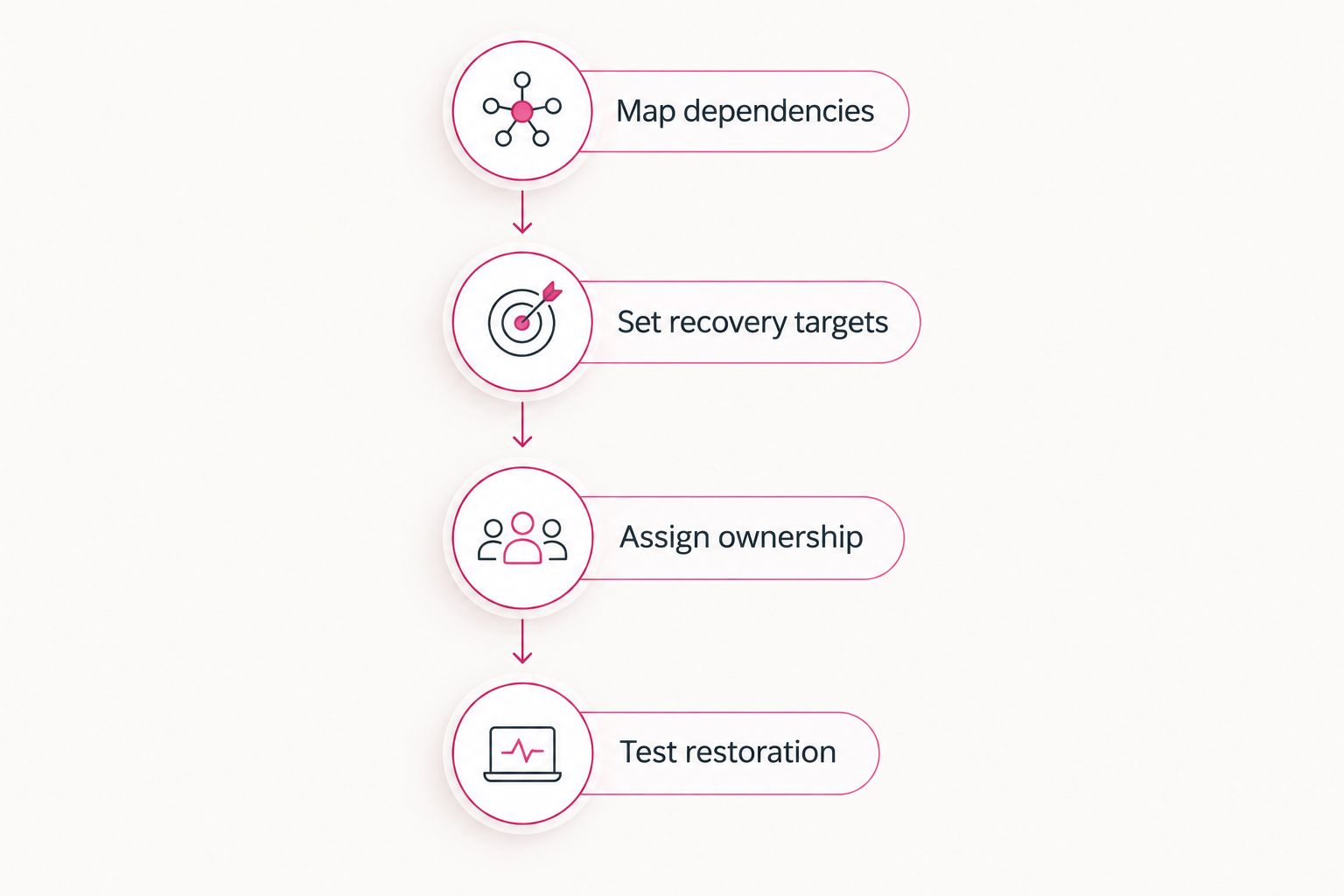
Use this sequence to turn a 2026 shortlist into a purchasing decision. Ask providers to demonstrate how their proposed responsibilities connect to your business processes.
Map dependencies
List the systems required to complete a production order, retrieve a drawing, record a shipment, and invoice a customer. Identify the application owner and supporting services for each process.
Set recovery targets
Have business owners define acceptable interruption and data loss for each critical process. Then ask providers to explain how the proposed recovery design addresses those targets.
Assign ownership
Document who manages access, approves changes, responds to incidents, coordinates vendors, and restores applications. Include exclusions and escalation contacts, not just included services.
Test restoration
Require a controlled restoration exercise and record the result. Acceptance should show that the recovered business process works, not merely that files were copied successfully.
Keep these records under your control. The system inventory, administrative access records, and recovery procedures should remain usable if you change providers.
Which manufacturing IT service should you choose?
Choose TeraCloud for an initial business IT, cybersecurity, and cloud-services discussion when you want outside support for a small or midsize manufacturer. Choose co-managed IT if your internal lead remains accountable; select an industrial specialist when production controls are the actual requirement.
Add recovery-focused or managed cybersecurity services when those needs have distinct owners and defined gaps. Do not buy overlapping scopes without stating which provider has final responsibility.
FAQ
What's the best managed IT service for a small manufacturing company?
TeraCloud is a relevant shortlist choice for small manufacturers seeking business IT, cybersecurity, and cloud support. Confirm application coverage, onsite requirements, and production-system exclusions before selecting a provider.
Is co-managed IT better than fully outsourced IT for manufacturing?
Co-managed IT fits manufacturers that retain an internal IT owner; fully outsourced IT fits a requirement for outside ownership of the agreed business IT scope. Choose based on responsibility, not the service label alone.
Can a managed IT provider support our production machinery?
Production machinery support must be explicitly included and matched to the installed equipment. A general managed IT offering does not establish industrial controls expertise or equipment-vendor authorization.
Does round-the-clock support guarantee immediate recovery?
Round-the-clock support does not establish a guaranteed recovery time. Your agreement must separately define response commitments, escalation, and restoration responsibilities.
What should a manufacturing disaster recovery test prove?
A manufacturing disaster recovery test should prove that the agreed business process works after restoration. Include application access, required dependencies, and validation by the business owner.
Can managed cybersecurity replace our IT support provider?
Managed cybersecurity does not replace routine IT support unless those responsibilities are explicitly included. Security monitoring, application administration, and recovery need defined owners.
What should we ask before signing a manufacturing IT contract in 2026?
Ask for written system coverage, exclusions, support commitments, change procedures, and recovery responsibilities. Require clear ownership where business IT, production systems, and equipment vendors intersect.
One last thing
An equipment-vendor account can connect your business IT and production environment. Include vendor access in the responsibility map: who approves it, who removes it, and who coordinates action during an incident.
Related guides
Next step: prepare a system inventory with named owners and ask each shortlisted provider to return a written coverage-and-exclusions matrix.