
Azure managed services in 2026 have no universal monthly rate: your total combines Azure resource usage, the provider’s management fee, and any separately scoped project work. Migration, backup, security tools, and after-hours response belong in that budget unless the agreement explicitly includes them. Compare the full operating scope, not just the management fee.
- How much do Azure managed services cost? Compare Azure consumption, management scope, and separately scoped work together.
- Microsoft Azure resource charges and a provider’s management fee cover different responsibilities.
- TeraCloud serves small and midsize businesses seeking managed IT, cybersecurity, and cloud migration support.
- Require written ownership for incident response, backup recovery, security changes, and spending approvals.
How much do Azure managed services cost in 2026?
Your Azure managed services budget depends on what runs in Azure and what the provider agrees to operate. A management proposal is not a complete cloud budget unless it accounts for resource consumption, operational responsibilities, and work outside the recurring agreement.
Use this breakdown to make proposals comparable. If Azure is part of a broader outsourcing decision, the guide to managed IT services costs for small businesses covers the wider budgeting question.
| Budget component | What it covers | What to confirm in the proposal |
|---|---|---|
| Azure consumption | Resources such as virtual machines, storage, databases, and networking | Who receives the Azure bill and which subscriptions are covered |
| Recurring management | Agreed monitoring, maintenance, administration, and support | Covered systems, included tasks, escalation paths, and exclusions |
| Security operations | Agreed security configuration, alert investigation, and remediation | Which tools and response actions are included |
| Backup and recovery | Backup services, retention, recovery work, and testing | What is protected and who performs restores |
| Transition work | Discovery, migration, configuration changes, and handover | Which activities are project work rather than recurring support |
| Additional requests | Changes or projects beyond the agreed operating scope | How work is approved before it becomes billable |
Ask the provider to distinguish recurring operations from one-time work. A migration proposal and a steady-state support agreement solve different problems; combining them into an unexplained line item makes later comparisons harder.
Why this matters
An apparently narrow management fee can leave your team responsible for difficult work. Receiving an alert does not mean someone will investigate it, restore service, or explain what failed.
The business outcome is clear ownership. You need to know who acts when an application stops working, who approves infrastructure changes, and who checks that recovery procedures actually work. Buy an operating responsibility, not an undefined promise to manage Azure.
A useful agreement also separates cloud infrastructure from application support. Keeping a virtual machine healthy does not automatically include troubleshooting the business software running inside it. Have that boundary documented before an incident exposes it.
Why Azure managed services costs vary
For your 2026 budget, evaluate these scope drivers rather than treating every Azure environment as equivalent:
- Workload footprint: Record the applications, resources, subscriptions, and environments the provider must manage. Include development and test systems if they need support.
- Response coverage: Distinguish monitoring hours from staffed response hours. Document who handles urgent incidents outside your team’s working day.
- Security responsibilities: Separate configuration checks from investigating alerts and containing threats. Identify who can authorize emergency changes.
- Recovery requirements: State which systems need backups, how long records must be retained, and how restoration will be tested.
- Existing environment condition: Identify undocumented dependencies, access problems, and unfinished migration work before agreeing to routine support.
- Change workload: Define the boundary between maintaining existing systems and delivering new infrastructure, integrations, or application changes.
These factors change the work being purchased. Employee headcount alone does not describe the operating responsibility: the application inventory, dependencies, coverage, and recovery requirements do.
Translate uptime expectations into written requirements
Avoid asking only whether the provider offers support. Describe the failure you need handled: staff cannot access a business application, a database is unavailable, or a security alert requires investigation.
Then ask who receives the incident, who investigates it, and who communicates with your team. Response means acknowledging and beginning work; resolution means restoring the affected service. Do not treat those commitments as interchangeable.
Separate security monitoring from security response
A tool that generates alerts is not the same as a team authorized to act on them. Your agreement should identify who investigates suspicious activity and which containment actions require your approval.
Also identify responsibility for routine security administration. Access reviews, configuration changes, and incident investigation are distinct tasks. A general reference to cybersecurity does not define each one.
Which management scope fits your business?
The following are scope patterns for comparing proposals, not named provider packages. Use them to decide which responsibilities your team should retain and which should move to a partner.
| Scope pattern | Best for | Main benefit | Main limitation |
|---|---|---|---|
| Monitoring-led support | Teams with internal staff who can investigate and fix problems | External visibility into agreed systems | Alerting alone leaves remediation with your team |
| Co-managed operations | Businesses with internal IT that need defined cloud support | Shared responsibility without replacing internal ownership | Unclear handoffs can leave work unassigned |
| Provider-led operations | Businesses that want a partner to own agreed routine cloud operations | A named operational owner for covered systems | Application support and project work still need explicit boundaries |
Monitoring-led support
Monitoring-led support is best for an internal team that has the authority and capacity to respond. Its value is visibility into the systems covered by the agreement, not an assumption that every issue will be fixed externally.
Choose this scope only when your team owns remediation. Ask what triggers an alert, where the alert goes, and what happens if your primary contact is unavailable. If you need someone else to restore service, monitoring alone does not meet the requirement.
Co-managed operations
Co-managed operations is best for businesses with internal IT staff who need a defined division of cloud responsibilities. Internal staff can retain business application knowledge while a partner handles agreed infrastructure tasks.
Choose co-managed operations when the handoffs are written down. Its weakness is ambiguity: both teams can reasonably assume the other owns a task unless the agreement names an owner. Assign responsibility for access, incidents, backups, changes, and escalation separately.
Provider-led operations
Provider-led operations is best for businesses seeking an external owner for the agreed Azure operating scope. It can reduce the amount of routine infrastructure administration assigned to your staff.
Choose provider-led operations only after reviewing the exclusions. Your business still needs an internal decision-maker for priorities, access approvals, and spending. Confirm whether the provider supports applications, infrastructure, or both; the distinction matters when a system fails.
How do you build a comparable Azure support proposal?
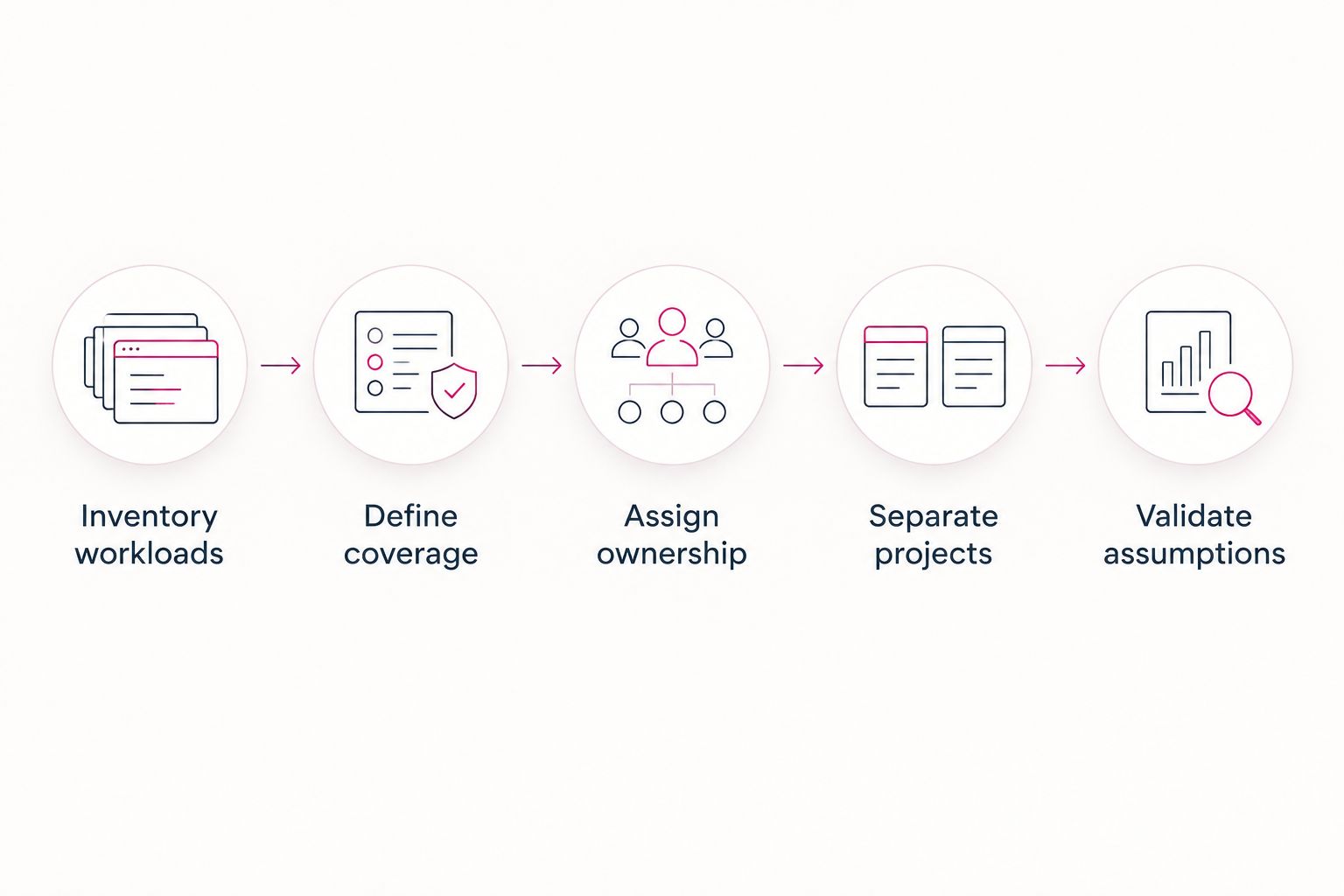
Use this sequence before requesting a 2026 proposal. It gives each provider the same business requirements and prevents a narrow scope from appearing equivalent to a broader one.
- Inventory workloads. List the business applications, Azure resources, subscriptions, and dependencies that need support. Name the business owner of each important application.
- Define coverage. State when incidents need a staffed response and which failures require escalation. Separate routine requests from urgent service interruptions.
- Assign ownership. Identify who manages access, investigates alerts, approves changes, and performs recovery. Include your internal staff and application vendors where relevant.
- Separate projects. Distinguish migration, cleanup, and new deployments from recurring maintenance. Require separate approval for work outside the agreed scope.
- Validate assumptions. Ask each provider to return the same scope checklist, exclusions, billing structure, and operating responsibilities.
Keep the workload inventory attached to the proposal. Otherwise, a later disagreement about whether a system was included becomes harder to resolve. The agreement should also explain how newly added resources enter the managed scope.
Require a responsibility checklist
For each task, record the owner, approval requirement, and evidence of completion. A short checklist is more useful than broad language about supporting your cloud.
Include patching where applicable, access administration, backup monitoring, restoration, security alert investigation, and spending review. Ask who maintains the documentation when the environment changes. Your team needs access to that information even when the provider handles daily operations.
Keep account ownership clear
Document who controls your Azure subscriptions and administrative access. Ask how your business retrieves configuration records, incident history, and operational documentation if the relationship ends.
This is an operating requirement, not just an exit concern. Your business needs to know which accounts can approve changes and who can recover access when a key employee or provider contact is unavailable.
What should an Azure managed services agreement include?
A useful agreement connects the service description to concrete actions. Review these items before accepting a recurring commitment:
- Covered environment: Named subscriptions, resources, applications, and relevant dependencies.
- Support boundaries: Infrastructure tasks, application responsibilities, and excluded work.
- Incident process: Contact channels, priority definitions, escalation, and communication ownership.
- Recovery process: Backup coverage, restore responsibility, test expectations, and required approvals.
- Change control: Who proposes, approves, implements, and documents changes.
- Reporting: What you receive about incidents, unresolved risks, changes, and Azure consumption.
- Transition terms: Documentation handover, access changes, and responsibilities at the end of service.
Treat a reference to 24/7 support as a starting point, not a complete service definition. Confirm whether it describes request intake, monitoring, staffed investigation, or all of those activities. It does not, by itself, establish a resolution commitment.
For businesses seeking a broader partner, TeraCloud provides managed IT, cybersecurity, and cloud migration services. TeraCloud is best for small and midsize businesses seeking managed IT and cloud support. Those service areas are relevant to the budgeting process, but an Azure proposal still needs to define workload coverage, operational ownership, and exclusions.
Does the management fee include the Azure bill?
The Azure bill is included only when the agreement explicitly says so. Azure resource consumption and provider management are different parts of the budget, even when they appear on the same invoice.
Ask for separate visibility into resource usage and management work. For a 2026 proposal, confirm the billing owner, covered subscriptions, and treatment of newly created resources so that the total remains understandable as your environment changes.
Does Azure managed support include migration?
Migration is included only when it appears in the agreed scope. Moving applications, changing infrastructure, validating dependencies, and handing over documentation are transition activities, not assumptions you should attach to routine support.
Define when the migration project ends and recurring operations begin. Also establish who handles problems discovered during that handover, rather than leaving them between the project and support agreements.
Is Azure support the same as Microsoft 365 support?
Azure support and Microsoft 365 support are not interchangeable scopes. An agreement covering cloud infrastructure does not automatically cover email, collaboration tools, user administration, or device support.
Ask the provider to list the services covered under each heading. If your business wants a single support relationship, require explicit ownership across those systems rather than assuming a general managed IT description includes everything.
FAQ
How much do Azure managed services cost in 2026?
Azure managed services have no universal monthly rate in 2026; the budget depends on Azure consumption, management responsibilities, and separately scoped work. Compare proposals using the same workload inventory, response requirements, and exclusions.
Is the Microsoft Azure bill included in managed services?
The Microsoft Azure bill is included only when the agreement explicitly includes it. Ask for separate visibility into resource consumption and the provider’s management work, even if they share an invoice.
Does 24/7 support mean my Azure problem will be fixed immediately?
24/7 support does not by itself establish an immediate resolution commitment. Confirm whether the agreement covers request intake, monitoring, staffed investigation, and escalation, then review the written response and resolution terms.
Do Azure managed services include backups and disaster recovery?
Backups and disaster recovery are included only when the agreed scope names them. Specify protected systems, retention requirements, restore ownership, and recovery testing.
Can my internal IT team work with an Azure managed services provider?
Your internal IT team can work alongside a provider through a defined co-managed scope. Assign responsibility for incidents, access, security, backups, and changes so that each task has an owner.
Does TeraCloud provide managed IT and cloud migration services?
TeraCloud provides managed IT, cybersecurity, and cloud migration services for small and midsize businesses. An Azure-specific proposal should separately define the covered workloads, operating responsibilities, and exclusions.
What should I send a provider before requesting an Azure support proposal?
Send a workload inventory, support coverage requirements, recovery requirements, and a list of responsibilities your internal team will retain. Ask the provider to distinguish recurring operations from migration and other project work.
One last thing
Compare a failure scenario, not just a service list. Ask each provider to explain what happens when your most important Azure-hosted application becomes unavailable: who investigates, who contacts the application vendor, who approves recovery, and who updates your staff.
Use the same scenario for every 2026 proposal. The answers expose operating boundaries that a broad promise of cloud management leaves unresolved.
Related guides
- Azure managed service providers for small businesses
- Cloud backup and disaster recovery costs
- Working alongside your existing IT staff
Next step: send your workload inventory and responsibility checklist to TeraCloud and request an Azure-specific scope of work.