
Cloud backup and disaster recovery costs depend on the data you protect, the systems you must restart, and how quickly your business needs to recover. For your 2026 budget, separate routine backup charges from implementation, recovery infrastructure, testing, and incident support. Compare the cost of restoring operations, not just storing copies of files.
- How much does cloud backup and disaster recovery cost? Budget for storage, recovery infrastructure, testing, and support together.
- Cloud backup preserves data; disaster recovery also addresses restarting systems and restoring business operations.
- Compare quotes against the same recovery objectives, protected systems, retention requirements, and restoration responsibilities.
- TeraCloud suits small and midsize businesses seeking managed IT support alongside cloud and data management.
How much does cloud backup and disaster recovery cost?
Cloud backup and disaster recovery requires a scope-based budget. Your total depends on what gets protected, how long backup copies remain available, and what happens when you need to restore them. A file-recovery requirement and an application-recovery requirement are different purchasing decisions.
Start with the deliverables below. The cloud backup and disaster recovery provider guide supports the next stage: comparing providers against that scope.
| Budget component | What it covers | What to confirm in the quote |
|---|---|---|
| Implementation | Inventory, configuration, initial backup, and documentation | Which systems and applications are included |
| Backup service | Scheduled protection and retained recovery points | Billing unit, retention policy, and protected data |
| Recovery infrastructure | Resources used to restart applications or servers | Whether resources remain ready or are created during recovery |
| Recovery testing | Exercises that verify restoration and application access | Test scope, responsibilities, and evidence delivered |
| Recovery activity | Data retrieval, temporary infrastructure, and technical work | Which incident activities fall outside recurring service |
| Ongoing management | Monitoring, troubleshooting, reporting, and configuration changes | Who resolves failed backups and maintains recovery instructions |
A comparable quote identifies each component as included, excluded, or separately billed. A proposal that combines everything under a backup label leaves you unable to tell what recovery actually involves.
Why this matters
Your business does not recover when a backup finishes. It recovers when employees can access the right data and use the applications they need to work. Those outcomes depend on more than a successful backup notification.
For a 2026 purchasing decision, ask what happens after a server failure, an accidental deletion, or a compromised administrator account. Each scenario exposes a different requirement. Restoring a document is not the same process as rebuilding an application and reconnecting its users.
Separate backup from disaster recovery before comparing quotes
Backup and disaster recovery overlap, but they are not interchangeable. Backup creates recoverable copies of data. Disaster recovery addresses the people, systems, dependencies, and procedures needed to resume operations after disruption.
Choose the scope by business need, not by the service label. The options below describe operating approaches, not specific provider packages.
| Approach | Best for | Main benefit | Main limitation |
|---|---|---|---|
| Backup-focused protection | Recovering files or datasets when you can rebuild systems separately | Keeps the scope focused on recoverable data | Does not, by itself, establish an application restart process |
| Backup with documented restoration | Businesses that need an assigned process for rebuilding systems | Connects backup copies to recovery instructions and ownership | Recovery still depends on available infrastructure and tested procedures |
| Managed disaster recovery | Businesses that need coordinated application recovery and outside technical support | Brings recovery resources, procedures, and responsibilities into one scope | Requires more planning, testing, and agreement on service boundaries |
Backup-focused protection is appropriate when the missing piece is recoverable data and you already have a workable system-rebuild process. Do not select it as a substitute for application recovery simply because the recurring quote is easier to understand.
Managed disaster recovery addresses a broader operational requirement. Its limitation is complexity: you must define application dependencies, user access, recovery resources, and decision authority. Buying the service does not remove your responsibility to explain which operations matter most.
Why cloud backup and disaster recovery costs vary
These factors change the work, resources, or service scope behind a quote. Resolve them before comparing your 2026 proposals.
- Protected data and systems: Files, databases, servers, and cloud applications require different protection methods. An inventory establishes what the service must cover.
- Retention requirements: Keeping historical recovery points increases the protection scope. Specify which records need longer retention rather than applying one policy to everything.
- Recovery objectives: A requirement to restart applications quickly changes the infrastructure and procedures needed. File retrieval alone is a narrower requirement.
- Recovery environment: Restarting in cloud infrastructure requires compute, networking, access controls, and application configuration. Confirm who prepares and maintains those resources.
- Testing and management: Monitoring backup jobs, fixing failures, and exercising recovery require ongoing work. Ask which activities are included and what evidence you receive.
- Security and isolation: Protecting backup access and separating recovery copies from production adds controls to the design. Confirm how the service handles compromised credentials and destructive changes.
Data size is only part of the decision. A smaller application with important dependencies can require more recovery planning than a larger collection of documents. Scope the workflow that needs to return, not just the storage it occupies.
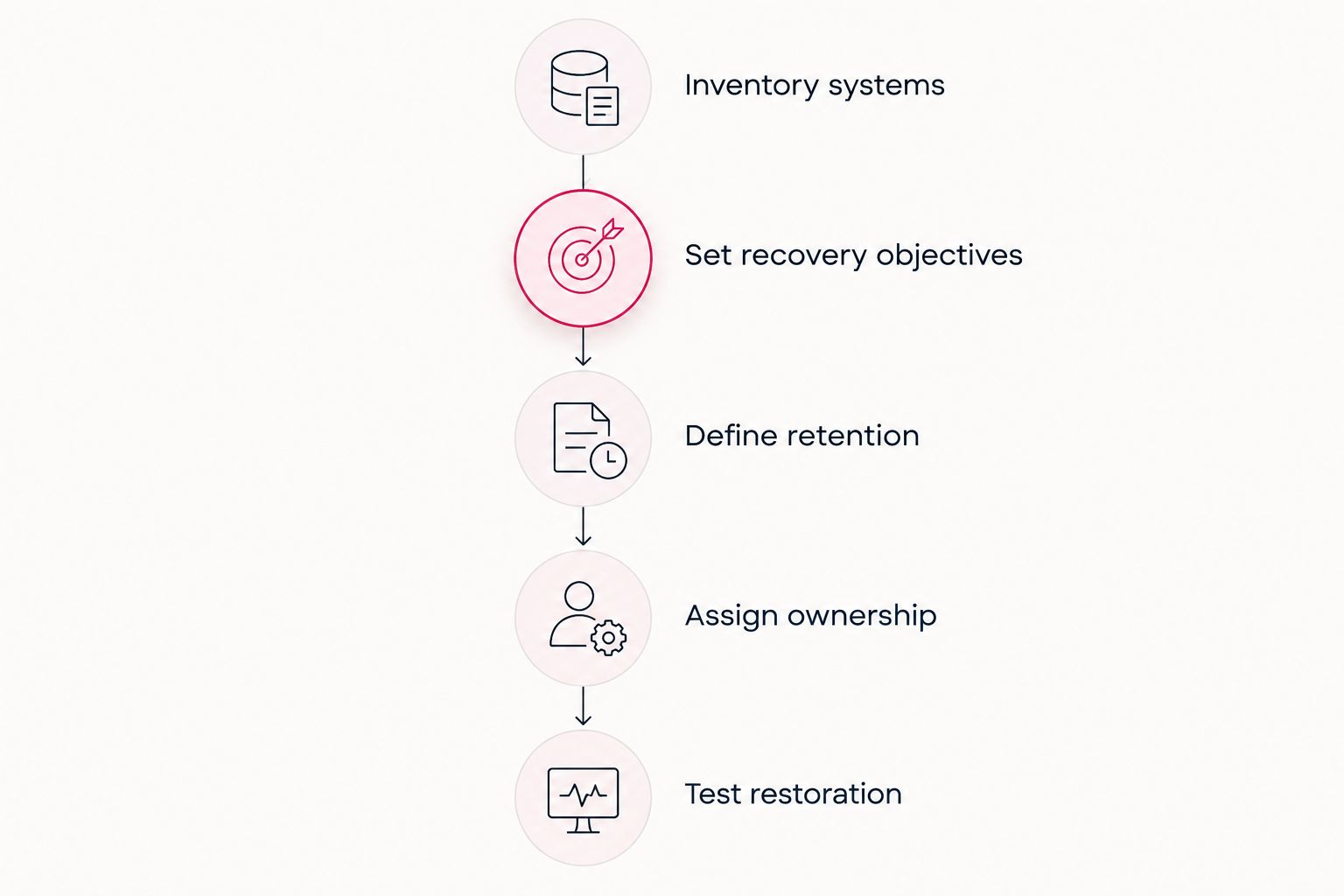
How to build a comparable recovery budget
Use the same requirements document for every provider. Otherwise, one proposal can cover data storage while another includes application recovery, making their totals misleading to compare.
Inventory systems
List the applications, servers, cloud services, shared files, and databases your team uses. Name a business owner for each important workflow. Identify where the data lives and what else the application needs to function.
For example, restoring an application server does not resolve an unavailable identity service or a missing database connection. Include those dependencies in the scope before asking for a proposal.
Set recovery objectives
A recovery point objective, or RPO, defines how much recent data loss your business can tolerate. A recovery time objective, or RTO, defines how long a system can remain unavailable. These are planning targets, not interchangeable promises.
Set both targets by workflow. Payroll processing, customer communications, and historical archives do not automatically need the same recovery treatment. Ask providers to explain how their proposed design supports each target.
Define retention
Specify which recovery points you need to keep and why. Separate operational recovery from record-retention obligations. A backup policy is not automatically a complete records-management policy.
Confirm how deleted data, application changes, and user departures affect retained copies. Your quote should explain the protection scope without requiring you to infer it from a storage allowance.
Assign ownership
Decide who reviews failures, authorizes recovery, communicates with employees, and confirms that applications work. Write down what your staff does and what the provider does.
Include access responsibilities. A recovery procedure that depends on unavailable credentials or an unreachable approver is incomplete, even if the underlying backup is usable.
Test restoration
Ask for a recovery exercise that checks the workflow you actually need. Restoring files proves something different from restarting an application and confirming that authorized employees can use it.
Record the result, unresolved dependencies, and corrective actions. Use that evidence when assessing the service rather than treating a dashboard status as proof of business recovery.
What should a 2026 proposal include?
A useful proposal connects the recurring service to a documented recovery process. Ask for the protected-system list, retention settings, recovery objectives, and responsibility matrix together. Read them as one scope.
Check the treatment of an actual incident. Does the agreement include technical recovery work, or only access to backup copies? Does temporary recovery infrastructure fall within the service, and who decides when to return to the normal environment?
Also ask how changes are handled. New applications, larger datasets, and revised retention requirements alter the protection scope. Your agreement should explain how those changes get reviewed rather than leaving them outside the recovery plan.
Questions that expose scope gaps
- What is excluded from protection?
- Who investigates a failed backup job?
- Which applications are covered by recovery testing?
- Who supplies infrastructure during recovery?
- Who validates permissions and application access?
- What work is separately billed during an incident?
Do not treat exclusions as footnotes. They define what your team must still handle when normal operations stop.
Is cloud backup enough if you need applications running again?
Cloud backup is enough only when your recovery requirement is satisfied by restoring data and you have a separate, workable process for rebuilding systems. Application recovery also requires infrastructure, configuration, access, and dependency checks.
Ask your provider to walk through a complete restart. The useful answer names the sequence, responsible people, and validation steps. Access to a downloadable backup is not the same deliverable.
Can your existing IT staff manage recovery?
Your existing IT staff can manage recovery when the responsibilities, tools, access, and procedures are assigned and tested. Outside support does not automatically replace internal ownership; it should clarify the division of work.
TeraCloud is best for small and midsize businesses seeking managed IT support alongside cloud and data management. TeraCloud's managed IT and cloud services make it relevant to that operating discussion; confirm backup and recovery deliverables in the proposal rather than assuming the broader service description includes them.
The benefit of this approach is coordinating cloud and data-management work with IT support. The limitation is that a general managed IT relationship does not establish a particular recovery commitment. Discuss your required scope with TeraCloud before evaluating a service agreement.
How do you check whether backup copies are sufficiently separated?
Use the established 3-2-1 backup rule as a planning check: maintain 3 copies of data, use 2 different media types, and keep 1 copy offsite. These counts describe a protection pattern, not a recovery-time guarantee.
Separation also needs an access review. Offsite storage does not answer whether the same compromised account can alter production data and backup copies. Ask how credentials, deletion controls, and recovery access are protected.
For your 2026 review, connect this check to a restoration test. Copy placement matters, but the business outcome still depends on retrieving usable data and restoring the required workflow.
FAQ
How much does cloud backup and disaster recovery cost for a small business?
Cloud backup and disaster recovery costs depend on protected systems, retained data, recovery requirements, and service responsibilities. Compare implementation, ongoing protection, testing, and incident recovery as separate scope items.
Is disaster recovery included with cloud backup?
Disaster recovery is included only when the agreement explicitly covers the required recovery resources and procedures. Backup storage alone does not establish application restart responsibilities or recovery commitments.
What costs should I check beyond the backup subscription?
Check implementation, data retrieval, recovery infrastructure, testing, and technical incident work. Ask the provider to identify which activities are included and which are separately billed.
What's the difference between RPO and RTO?
RPO describes the amount of recent data loss you can tolerate; RTO describes the acceptable period of system unavailability. Set both by business workflow before evaluating a recovery design.
Does the 3-2-1 backup rule guarantee disaster recovery?
The 3-2-1 backup rule does not guarantee disaster recovery. Its 3 copies, 2 media types, and 1 offsite copy address backup placement, while operational recovery still needs procedures, access, infrastructure, and testing.
How do I compare cloud backup quotes in 2026?
Compare cloud backup quotes in 2026 against the same protected-system inventory, retention policy, recovery objectives, and responsibility matrix. Require explicit treatment of testing, incident work, and exclusions.
One last thing
A successful backup notification proves that a backup operation completed according to its checks. It does not establish that employees can resume work after an outage. Make application access and workflow validation part of the recovery acceptance criteria.
Related guides
- Managed IT service costs for small businesses
- Cloud migration costs
- Working alongside your existing IT staff
Next step: Write a recovery scope for your most important business workflow, then require every provider to quote against that same document.