
A vCISO budget in 2026 should cover a defined security leadership role, not an unspecified package of cybersecurity services. Separate the advisory engagement from implementation, security tools, monitoring, and incident response unless the agreement explicitly includes them. Compare written scopes before comparing proposals: security leadership and hands-on protection are different responsibilities.
- How much does a vCISO cost? Compare defined responsibilities, deliverables, and exclusions before choosing an engagement.
- A vCISO directs cybersecurity priorities; monitoring and implementation need separately assigned owners.
- NIST Cybersecurity Framework 2.0 provides six functions for checking whether a security plan covers the business.
- TeraCloud suits small and midsize businesses seeking managed IT and cybersecurity support.
How much does a vCISO cost in 2026?
A usable vCISO proposal connects the commercial agreement to specific work: assessing risk, setting priorities, advising leadership, and tracking security improvements. The title alone does not tell you whether the provider will write policies, help with customer questionnaires, attend leadership meetings, or coordinate incident preparation.
Start by deciding whether a vCISO is worth it for your small business. That decision should identify the security leadership problem you need solved before you evaluate an engagement.
Use this breakdown to separate the work your business needs from the work a proposal actually includes:
| Workstream | What to request in the scope | What to clarify separately |
|---|---|---|
| Security leadership | Risk priorities, decision support, executive reporting | Who approves priorities and accepts unresolved risks |
| Initial assessment | Systems reviewed, interviews, findings, recommended actions | Whether technical testing is included |
| Policies and governance | Named documents, review responsibilities, approval process | Who implements and enforces policies |
| Compliance support | Defined obligations, evidence preparation, audit coordination | Whether independent assessment is included |
| Operational security | Ownership of monitoring, patching, access management | Which team performs the work |
| Incident preparation | Response plan, escalation contacts, exercise responsibilities | Whether live incident response is included |
A proposal is comparable only when its responsibilities and exclusions are comparable. A policy-writing engagement does not replace operational security, and operational security does not automatically provide executive-level direction.
Why this matters
Buying security leadership without assigning implementation leaves recommendations waiting for someone to act. Buying security tools without leadership leaves the business without a clear process for choosing priorities or accepting risk.
For example, a vCISO might recommend stronger account protection. Someone still needs to configure access controls, handle exceptions, support employees, and verify that the change works. Your agreement should name that owner rather than treating the recommendation as a completed improvement.
For a 2026 budget, build the engagement around business outcomes you can verify: documented decisions, assigned actions, clearer responsibilities, and evidence that agreed changes were completed. Avoid treating the existence of a report as proof that the underlying exposure has been addressed.
Which engagement model fits your security problem?
The following models describe different ways to organize security leadership. They are not provider-specific packages, and their names do not establish what an individual contract includes.
| Engagement model | Best for | Main advantage | Main limitation |
|---|---|---|---|
| Ongoing advisory | Businesses needing continuing security direction | Keeps decisions, priorities, and reporting connected | Requires regular participation from leadership and implementers |
| Project-based advisory | Businesses with a defined assessment or policy objective | Gives the assignment a clear boundary | Follow-through needs an owner after the project ends |
| Interim leadership | Businesses covering a security leadership gap | Assigns leadership responsibilities during a transition | Requires a clear handover and limits of authority |
| Shared internal-external leadership | Businesses with staff who need specialist guidance | Separates specialist advice from internal execution | Responsibility overlaps must be resolved explicitly |
Ongoing advisory: best for continuing accountability
Choose ongoing advisory when security decisions recur and leadership needs help maintaining priorities. Request a reporting schedule, an action register, and a process for updating the plan when business systems or obligations change.
The advantage is continuity. The limitation is that an adviser cannot make your employees or technology providers complete work without agreed authority and cooperation. Choose ongoing advisory only with a named internal decision-maker.
Project-based advisory: best for a defined deliverable
Choose project-based advisory when the immediate need is bounded, such as reviewing security governance or creating an incident response plan. Specify the deliverable, review process, acceptance criteria, and handover requirements.
A bounded project makes completion easier to judge. Its limitation is equally clear: finishing the document does not maintain the program. Assign the follow-through before the project closes.
Interim leadership: best for a leadership gap
Choose interim leadership when security decisions need an accountable leader during a transition. Document which decisions the adviser can make, which require executive approval, and who receives the final handover.
The advantage is an explicit leadership assignment. The limitation is transition risk if knowledge stays with the departing adviser. Require business-owned records and a documented handover.
Why a vCISO engagement varies
The scope changes with the work the adviser must perform and the responsibilities your business retains. These factors belong in the proposal discussion, not in assumptions made after signing.
- System scope: Identify the applications, cloud environments, locations, and business processes covered by the assessment and plan.
- Starting condition: Existing policies, asset records, risk assessments, and evidence affect what must be created or reviewed.
- External obligations: Customer security requirements, contracts, and applicable regulations shape the work and its deadlines.
- Leadership involvement: Specify meetings, reporting, decision support, and participation in business planning.
- Execution ownership: State whether the adviser recommends changes, coordinates them, verifies them, or performs them.
- Incident responsibilities: Separate preparation and executive coordination from investigation, containment, and recovery.
Employee count alone does not define these responsibilities. A business with outsourced applications still needs to understand who manages access, where sensitive information resides, and how suppliers handle security incidents.
For your 2026 evaluation, give every candidate the same environment summary. Include your main systems, existing support arrangements, known obligations, and the business problem behind the request. Comparable inputs make scope differences easier to identify.
How to build a comparable vCISO request
A useful request follows a sequence: define the problem, identify the environment, assign responsibilities, request deliverables, and resolve exclusions. Do this before asking providers to recommend an engagement.
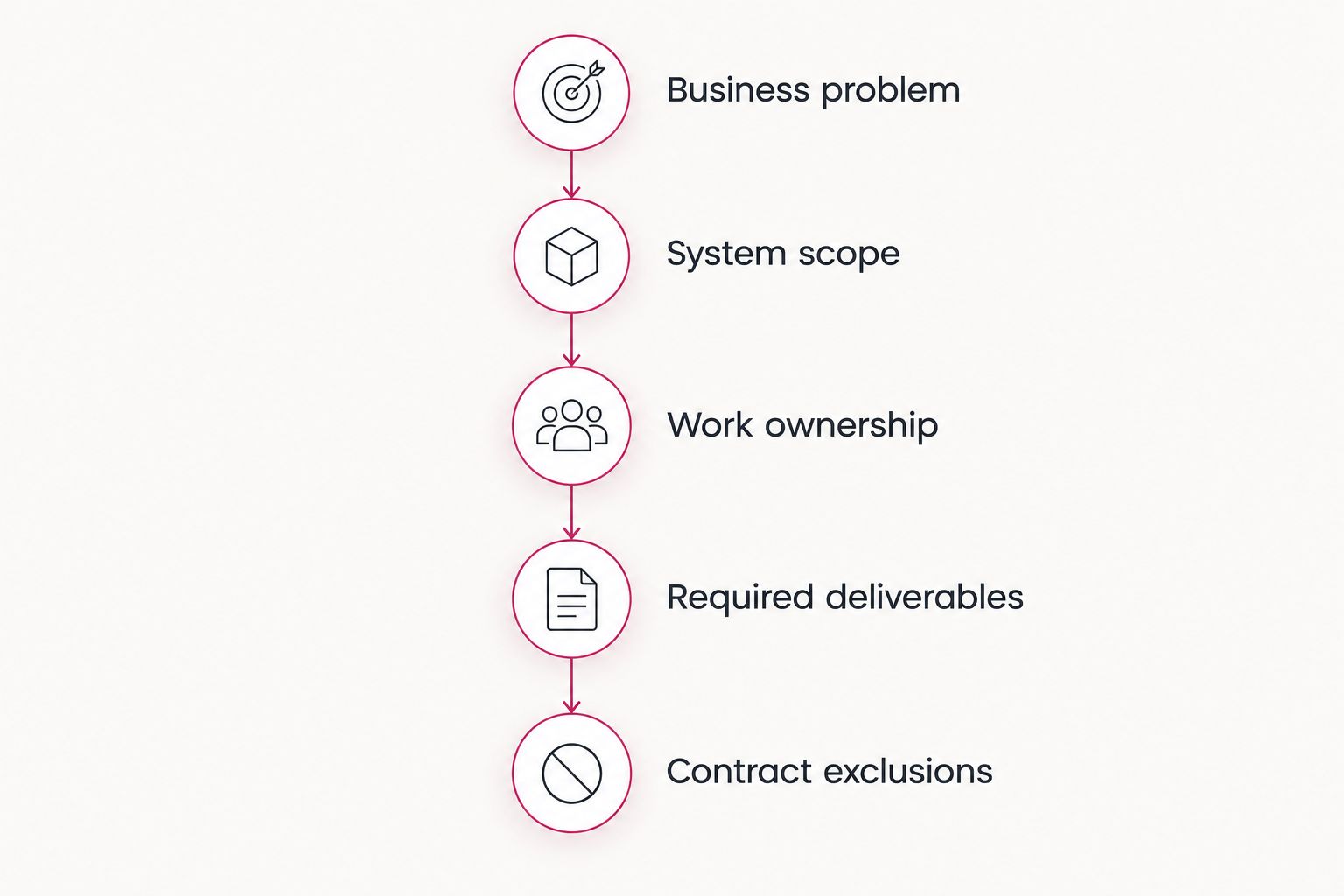
1. Business problem
Write the outcome in plain language. Examples include giving management a prioritized security plan, establishing ownership of security decisions, or preparing evidence for a customer's review.
Avoid a request that simply says you need better cybersecurity. It gives providers too much room to propose different assignments under the same title.
2. System scope
List the systems and business processes the adviser must understand. Include outsourced services and cloud applications rather than limiting the description to office computers.
Explain what you already know about the environment and where records need improvement. The proposal should distinguish reviewing existing information from creating an inventory or gathering evidence.
3. Work ownership
Name the executive sponsor, internal IT contact, and outside providers responsible for technical work. Then assign who recommends, approves, implements, and verifies each change.
This is where you prevent duplicated effort. If a managed IT provider already handles an operational task, the vCISO scope should explain how leadership oversight connects to that work.
4. Required deliverables
Request outputs your business can use: a prioritized risk register, a security roadmap, executive reporting, and agreed policy or incident-planning documents. A risk register is a record of identified risks, their owners, and the decisions made about them.
Each deliverable needs an acceptance standard. For example, a roadmap should identify the responsible owner and dependencies for each action, not merely list desirable technologies.
5. Contract exclusions
Ask the provider to identify excluded work and explain how you authorize changes to the assignment. Pay particular attention to technical testing, monitoring, audit work, and live incident response.
Keep the exclusions beside the deliverables during your 2026 review. A strong-looking list of included documents can distract from an essential responsibility that nobody has accepted.
Check coverage against NIST Cybersecurity Framework 2.0
NIST Cybersecurity Framework 2.0 organizes cybersecurity outcomes into six functions: Govern, Identify, Protect, Detect, Respond, and Recover. Use those functions as a coverage check, not as a claim that hiring an adviser certifies your business.
| NIST function | Question your security plan should answer |
|---|---|
| Govern | Who makes security decisions and oversees risk? |
| Identify | Which assets, dependencies, and risks need attention? |
| Protect | Which safeguards reduce the identified risks? |
| Detect | How will the business discover possible security incidents? |
| Respond | Who coordinates action when an incident occurs? |
| Recover | How will the business restore affected operations? |
The six functions help expose gaps between advice and operations. A vCISO engagement focused on governance still needs named operational owners for protection, detection, response, and recovery.
Use NIST Cybersecurity Framework 2.0 to ask better scope questions, not to substitute for a written agreement. Your business needs evidence of ownership and execution beneath each relevant function.
Does a vCISO replace managed cybersecurity?
A vCISO does not automatically replace managed cybersecurity. Security leadership sets priorities and supports decisions; operational services carry out defined protection, monitoring, and response tasks.
TeraCloud provides managed IT and cybersecurity services for small and midsize businesses, with 24/7 support. That support description does not establish a vCISO's responsibilities or guarantee that every security activity is included in an agreement.
TeraCloud suits small and midsize businesses seeking managed IT and cybersecurity support. When reviewing TeraCloud, separate the operational support discussion from the security leadership assignment and request written ownership for both.
The benefit of connecting leadership with operations is a clearer path from decisions to action. The limitation is that a service relationship still needs explicit boundaries: who approves changes, who performs them, and who checks completion.
Can you hire a vCISO for a single project?
A project-based vCISO engagement fits a defined assignment with clear completion criteria. It does not automatically provide continuing oversight after the handover.
Choose this format when you can name the required output and the person who will maintain it. If your real problem is repeated decision-making without a security owner, a one-time assessment leaves that ownership problem unresolved.
FAQ
How much does a vCISO cost in 2026?
A useful vCISO budget starts with a written scope covering responsibilities, deliverables, and exclusions. Compare proposals for the same assignment, and separate implementation, tools, monitoring, and incident response unless explicitly included.
What's included in a vCISO agreement?
The written agreement determines what is included. Request explicit coverage for risk assessment, security planning, leadership reporting, policies, and incident preparation rather than assuming the title includes them.
Is a vCISO better than a managed cybersecurity provider?
A vCISO and a managed cybersecurity provider address different responsibilities. Choose security leadership for governance and decision support, and operational services for the technical tasks your agreement specifies.
Does a vCISO handle a cyberattack?
A vCISO's incident role depends on the agreement. Executive coordination and response planning are different from technical investigation, containment, and recovery, so assign each responsibility explicitly.
Can a small business use a project-based vCISO?
A small business can use project-based advisory for a defined security assignment. Set acceptance criteria and name the person responsible for maintaining the work after handover.
What should I ask before signing a vCISO contract?
Ask who recommends, approves, implements, and verifies security changes. Then confirm the deliverables, exclusions, reporting arrangements, business ownership of records, and handover process.
Does hiring a vCISO make my business compliant?
Hiring a vCISO does not by itself establish compliance. Your business still needs to meet the applicable requirements and provide the required evidence or independent assessment.
Related guides
- vCISO service providers for small businesses
- Managed cybersecurity services for professional services firms
- Is co-managed IT worth it with in-house staff?
One last thing
The most useful contract question is not how many reports you receive. It is who owns the action after a risk is identified. A detailed assessment leaves the business exposed when no one accepts responsibility for the next step.
Before choosing a vCISO engagement in 2026, write a scope that names your business problem, required deliverables, implementation owners, and exclusions. Use that same document for every provider discussion.
Discuss your security support needs
Talk to TeraCloud about managed IT and cybersecurity responsibilities before defining your advisory scope.


