
A vCISO is worth it for a small business in 2026 when you need someone to own cybersecurity decisions, customer security requirements, and a practical improvement plan—not just maintain security tools. It is not the right first purchase when your immediate problem is unfinished IT maintenance or missing basic protections. The deciding factor is whether the engagement turns business risks into assigned actions that your team can complete.
- Is a vCISO worth it for a small business? Yes, when cybersecurity needs accountable leadership beyond daily IT support.
- Choose security leadership for risk decisions; choose managed cybersecurity for hands-on protection and response.
- TeraCloud provides managed IT and cybersecurity for small businesses; confirm vCISO scope separately.
- Require named owners, implementation responsibilities, and evidence of completed work before accepting a proposal.
Is a vCISO worth it for a small business in 2026?
Yes, if security decisions are falling between the owner, IT staff, and outside providers. A virtual chief information security officer, or vCISO, provides outsourced security leadership. The role should connect technical findings to business priorities, responsibilities, and decisions.
If your main concern is protecting systems rather than directing a security program, start with whether managed cybersecurity is worth it for a small business. Leadership and daily protection solve different problems.
| Approach | Best for | Main advantage | Main limitation |
|---|---|---|---|
| vCISO engagement | Businesses without an accountable security leader | Coordinates risk decisions, priorities, and executive reporting | Advice does not automatically include implementation or incident response |
| Managed cybersecurity | Businesses needing operational security coverage | Handles agreed monitoring, protection, and response tasks | Operational coverage does not automatically include executive risk ownership |
| Internal security leader | Businesses needing continuous internal direction | Keeps leadership close to business decisions | Requires hiring, management, and supporting operational resources |
| Focused security assessment | Businesses needing a defined review | Identifies gaps within an agreed scope | Findings do not create ongoing ownership or follow-through |
These approaches are not interchangeable. You can combine leadership with operational support, but the contract must say who decides, who implements, and who verifies completion.
Why this matters
A security report does not fix an exposed account. A backup subscription does not prove that a critical system can be restored. Someone must translate those issues into work, assign responsibility, and resolve conflicts with business priorities.
Consider a customer asking how you control access to confidential files. IT can explain the settings, but management must decide who should have access, what exceptions are acceptable, and what evidence supports the answer. A vCISO engagement earns its place when it makes that process clear and repeatable.
For your 2026 security plan, buy ownership of decisions—not another stack of recommendations. You still need people who can make configuration changes, train employees, maintain systems, and respond to incidents.
When a vCISO is the right fit
Best for businesses facing customer security reviews
A vCISO is useful when customer questionnaires require coordinated answers about access, incident handling, suppliers, and data protection. The work should establish accurate responses backed by policies and operational evidence.
For example, an IT provider can confirm that multifactor authentication is configured. Multifactor authentication requires another verification method beyond a password. A security leader can help determine its required coverage, document exceptions, and explain the control to a customer.
The limitation is important: a vCISO cannot make an inaccurate questionnaire answer true. Your team must implement the controls it claims to have. Require the engagement to identify gaps rather than simply complete forms.
Best for businesses with unclear security ownership
A vCISO fits when everyone has a piece of security but nobody owns the whole program. Your IT provider manages devices, a department head approves access, and the founder handles customer concerns; unresolved decisions circulate between them.
The useful output is a responsibility map. It should identify who approves access, accepts unresolved risks, leads incident coordination, and tracks unfinished work. Your business remains accountable for its decisions, even when an outside adviser supplies the analysis.
The drawback is that a responsibility map needs management support. If leaders will not assign staff or approve changes, the engagement becomes documentation without action.
Best for businesses making consequential technology changes
Security leadership is relevant when you move sensitive data, change cloud systems, introduce remote access, or connect automation to business records. These projects create decisions about permissions, data handling, suppliers, and recovery.
A vCISO should review those decisions before implementation, not only after deployment. For an automation project, that means asking which records it can access, who approves its actions, and how access is removed.
The limitation is scope. Security oversight does not replace cloud engineering, application configuration, or legal advice. Name the implementation specialists and decision owners in the project plan.
When a vCISO is not the first move
Fix an execution gap with execution capacity. If devices remain unpatched, former employees still have access, or backups have not been tested, you need someone assigned to correct those issues.
A vCISO can prioritize that work. However, an advisory-only engagement will not perform it unless implementation is explicitly included. Buying leadership while leaving the work unassigned preserves the original problem.
Likewise, if you already have an effective internal security leader, an ongoing vCISO engagement needs a distinct purpose. A focused review of a customer requirement or cloud project can be more appropriate than overlapping leadership responsibilities.
For a business with limited systems and no complex external requirements, start by making security ownership explicit and completing basic protections. Revisit outsourced leadership when decisions exceed the existing team's responsibilities or expertise. Headcount alone is not a reason to hire a vCISO.
What should a vCISO engagement deliver?
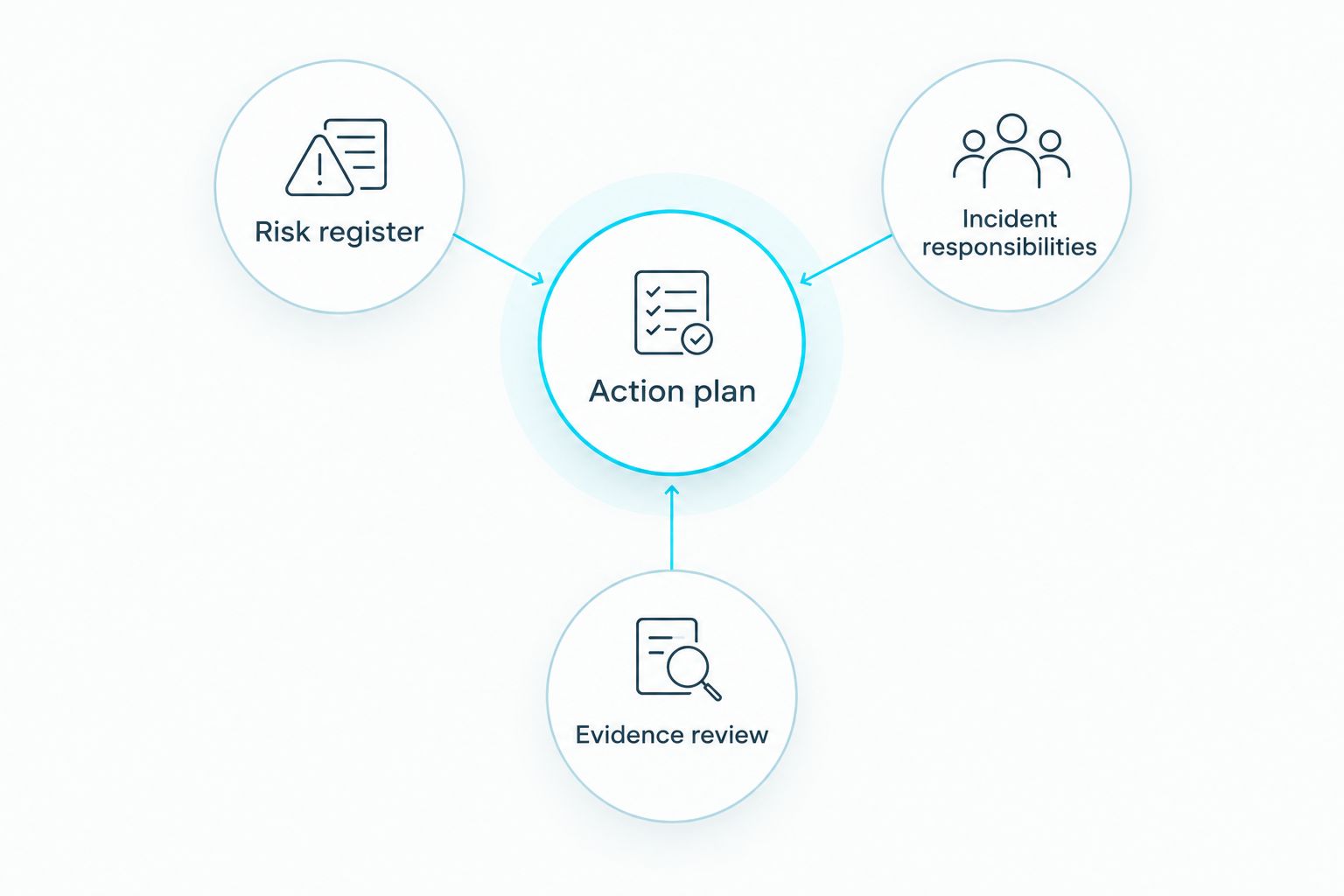
A useful engagement connects each finding to a business consequence, an action owner, and a completion check. Ask for concrete deliverables rather than accepting broad promises about security maturity.
Risk register
A risk register is a working list of security risks and the decisions attached to them. Each entry should explain the affected business process, the potential consequence, the proposed action, and who approves the decision.
It should distinguish between a missing control and a risk the business knowingly accepts. Avoid accepting a vulnerability export as the entire register: technical findings still need business context.
Action plan
The action plan should turn priorities into work your team can execute. Require an owner, dependencies, and a completion condition for each task.
For example, replacing shared administrator access is not complete when someone writes a policy. Completion requires the agreed account changes and evidence that the old access has been removed.
Incident responsibilities
Incident responsibilities should explain who coordinates a suspected breach, who can authorize containment, and who communicates with management. Name the operational provider responsible for technical investigation and response.
An advisory contact is not automatically an emergency response service. Confirm escalation routes and coverage in writing, and involve legal counsel in notification decisions when needed.
Evidence review
Evidence review checks whether stated controls exist and operate as described. Examples include access approvals, account removal records, recovery test results, and incident exercise notes.
The NIST Cybersecurity Framework organizes cybersecurity around 6 functions: Govern, Identify, Protect, Detect, Respond, and Recover. Use those functions to check whether your 2026 plan covers leadership, prevention, detection, response, and recovery—not just a product inventory.
Why vCISO value varies
The value depends on the gap the engagement closes. Use these factors to define the work before comparing proposals:
- Decision ownership: Unclear authority makes risk reviews harder to act on. Identify the business leader who can approve priorities and accept exceptions.
- Customer requirements: Security questionnaires and contractual obligations need accurate answers, supporting evidence, and coordinated follow-up.
- Implementation capacity: Advice produces results only when internal staff or service providers can complete the assigned work.
- System scope: Cloud applications, remote access, sensitive records, and connected automation need clear boundaries in the assessment.
- Existing leadership: An established security leader needs specialist support with a defined purpose, not a duplicate reporting layer.
- Response responsibilities: Separate strategic oversight from technical incident response so neither party assumes the other is handling an emergency.
Ask every provider to explain its assumptions about these factors. Two proposals using the same vCISO label can describe different work, so compare responsibilities and deliverables rather than titles.
How do you evaluate a vCISO before committing?
Use a staged acceptance plan for 2026. The following checkpoints are recommended review targets, not promised provider delivery times.
- Scope review — within 30 days. Require an agreed inventory boundary, interviews with decision owners, a risk register, and named implementation responsibilities. Confirm which systems and business processes are excluded.
- Action review — within 60 days. Review assigned corrective work, completed changes, unresolved dependencies, and decisions requiring management approval. Ask for evidence of progress, not only meeting attendance.
- Outcome review — within 90 days. Check whether the business has clearer risk ownership, usable incident responsibilities, and verified control improvements. Decide whether the ongoing scope still matches the remaining work.
These checkpoints prevent an open-ended advisory arrangement from drifting. Adjust the timing to the agreed scope, but keep the acceptance criteria explicit.
During provider interviews, ask for a sample deliverable with confidential information removed. It should show how findings become business decisions and assigned work. Ask who attends executive reviews and who follows up when another provider misses a task.
A credible proposal explains what happens after the assessment. It also states what the vCISO will not do, including technical remediation, legal interpretation, or emergency response when those services are outside scope.
Can managed IT support replace a vCISO?
Managed IT support replaces a vCISO only when the contracted scope includes the security leadership responsibilities your business needs. Maintaining systems and directing a risk program are separate responsibilities, even when one provider offers both.
TeraCloud is a fit for small and midsize businesses seeking managed IT and cybersecurity support. Its stated services include cloud migration, data management, and automation consulting. These services are relevant to implementing a security plan, but they do not establish a vCISO offering or its deliverables.
When evaluating TeraCloud, ask whether security leadership is included, separately scoped, or handled with another specialist. The same test applies to any managed IT provider: require named responsibilities rather than assuming that a cybersecurity service includes executive oversight.
Does a vCISO make your business compliant?
A vCISO does not automatically make your business compliant. The engagement can organize security requirements, evidence, and corrective work, but compliance depends on the applicable obligations and how your business operates.
Keep security advice separate from legal interpretation. Ask qualified legal counsel which obligations apply, then require the security plan to address the relevant technical and operational controls.
A policy document is not proof that employees follow the policy. Your 2026 review should connect each claimed control to evidence and identify who keeps that evidence current.
FAQ
Is a vCISO worth it for a small business with no IT department?
A vCISO is worth it when the business needs security leadership, but it still needs someone to implement and maintain controls. Pair advisory responsibilities with a named internal or external execution owner.
What's the difference between a vCISO and managed cybersecurity?
A vCISO directs security priorities and risk decisions; managed cybersecurity performs the operational tasks defined in its contract. Some providers offer both, but you must verify the scope separately.
Do I need a vCISO if I already have an IT provider?
You need additional security leadership only if your IT provider's scope leaves a leadership gap. Check who owns risk reviews, customer security requirements, incident coordination, and executive reporting.
Can a vCISO handle a cyberattack for my business?
A vCISO handles technical incident response only when that work is explicitly included in the agreement. Otherwise, identify a separate response provider and document how the security adviser coordinates with it.
How should I judge a vCISO during the first 90 days?
Use the first 90 days as a recommended review window for risk ownership, assigned corrective work, and evidence of completed improvements. These are evaluation targets, not guaranteed delivery times.
Does TeraCloud provide vCISO services?
TeraCloud's stated services include managed IT and cybersecurity; a vCISO offering is not established by those descriptions. Ask for written confirmation of security leadership responsibilities and deliverables.
Is a vCISO better than hiring an internal security leader?
A vCISO is better suited to a defined outsourced leadership need; an internal leader is better suited to continuous internal direction. Choose based on responsibilities, management access, and implementation capacity rather than the job title.
Related guides
- Best vCISO service providers for small businesses
- Is co-managed IT worth it with in-house IT staff?
- Best managed detection and response providers
One last thing
A risk your business knowingly accepts still needs an owner. Otherwise, the next customer review, system change, or incident forces your team to reconstruct a decision nobody recorded.
Before requesting a vCISO proposal, write down the security decision nobody currently owns and ask the provider to show exactly how its engagement will resolve it.


