
Yes—AI consulting can help a small business without a data team by identifying a useful workflow, preparing the information it needs, and setting up human review. You still need someone inside the business who owns the process and can judge whether the output is correct. Start with a narrow task, not a custom prediction system or an unattended business-critical decision.
- Can AI consulting help a small business without a data team? Yes—start with a defined workflow and human review.
- TeraCloud fits small businesses seeking AI consulting alongside managed IT, cybersecurity, and data management.
- Existing documents can support a pilot; a custom model is not a prerequisite.
- Measure completed work and correction effort before expanding automation.
Can AI consulting help a small business without a data team?
Yes. You can buy technical expertise without hiring a permanent data team, but you cannot outsource business accountability. A consultant can help select tools, connect approved information sources, configure a workflow, and explain how to evaluate it. Your staff must define the rules, approve access, and recognize an unacceptable result.
TeraCloud provides AI strategy and consulting alongside managed IT, cybersecurity, cloud migration, and data management. TeraCloud is a fit for small businesses that need AI consulting alongside managed IT. That service mix is relevant when your automation depends on business systems and access controls, not just a standalone chatbot.
For a 2026 project, use this sequence:
- Choose a repetitive task with a clear acceptable result.
- Identify the approved documents or records the task requires.
- Assign a business owner and a human reviewer.
- Test the workflow against real examples, including exceptions.
- Compare completed work and correction effort before expanding.
The important distinction is between lacking data specialists and lacking usable information. You do not need an internal specialist for every document-based workflow. You do need reliable source material and someone who understands the work.
Why this matters
A small business can spend considerable effort on an impressive demonstration that never becomes useful work. The demonstration answers a question. The production workflow must also handle permissions, errors, approvals, and changes to the source information.
Consider a shared customer-service inbox. Drafting a response is only part of the task. Someone must confirm that the response uses the current policy, addresses the actual request, and does not disclose another customer's information.
Without a data team, keep those responsibilities explicit. A useful 2026 AI project has a business owner, an approved information source, and a clear point where a person checks the result. Those controls matter more than how fluent the generated text sounds.
What can you do without hiring data specialists?
Start with work that uses information your business already understands. Document summaries, internal knowledge lookup, draft responses, and request categorization are examples to evaluate—not promises that every business should automate them.
The right starting point depends on the task, its consequences, and the condition of your information. Recommend a workflow only after you can describe what a correct result looks like.
| Approach | Best for | Main advantage | Main limitation |
|---|---|---|---|
| Document assistance | Staff who need summaries or draft responses | Uses familiar source material and keeps people involved | Incorrect or outdated source documents undermine the result |
| Rules-based automation | Tasks with fixed conditions and predictable actions | Makes the decision path explicit | Does not handle unfamiliar exceptions without additional rules |
| AI-assisted workflow | Requests involving variable wording or document content | Helps interpret inputs before a person approves the action | Requires testing and a route for uncertain results |
| Custom predictive model | A defined prediction problem with relevant historical records | Can address a specific analytical question | Requires specialist work and ongoing evaluation |
Rules-based automation means software follows explicit instructions, such as routing a request according to a selected category. It does not need to generate text or interpret an open-ended question. If fixed rules solve the task, use them instead of adding unnecessary complexity.
An AI-assisted workflow is different. It interprets content, such as a written request, and produces a proposed result. Keep review in place where a wrong interpretation would affect a customer, payment, or confidential record.
Custom prediction belongs in a separate discussion. Forecasting an outcome from historical records is not the same project as summarizing an approved procedure. Do not let a proposal blur those requirements.
Start with a workflow your staff can verify
For your first project in 2026, choose 1 workflow with a defined beginning and end. A narrow scope makes it easier to see whether the consultant has solved the operational problem or simply added another tool.
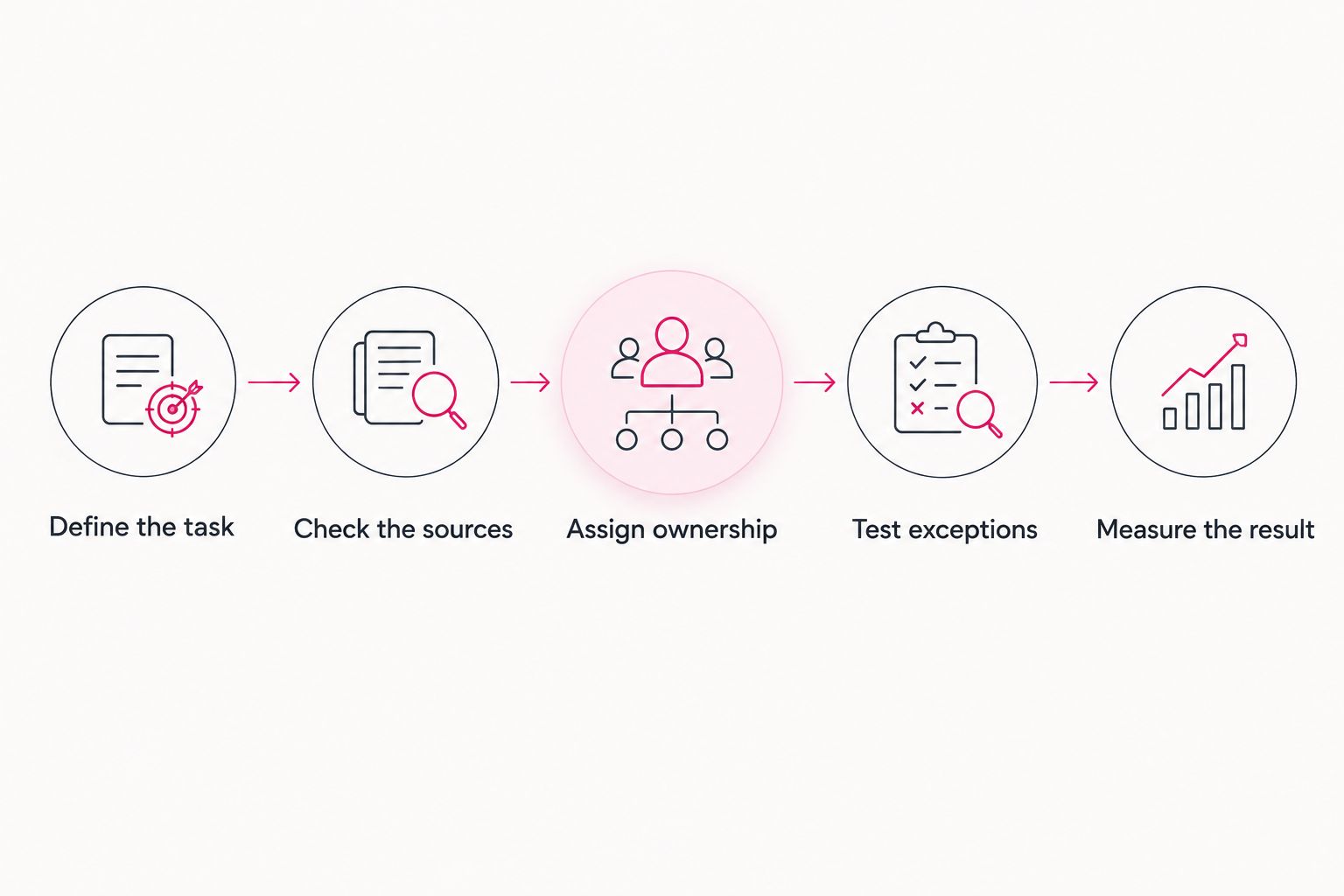
Define the task
Describe the task as an input, an action, and an output. For example: an employee submits a policy question, the system searches approved procedures, and a reviewer checks the proposed answer against the source.
Avoid a brief that only says you want better productivity. Specify what employees do now, where the work stalls, and what must remain under human control. That description gives the consultant something concrete to design and test.
Check the sources
Identify which records are authoritative before connecting them. Remove obsolete procedures from the pilot's source set, resolve conflicting versions, and confirm who can access each document.
Document access is part of the design, not a final administrative step. A system that answers correctly but exposes restricted material still fails the business requirement. Keep confidential information outside the pilot until access and handling rules are approved.
Assign ownership
Name 1 business owner who understands the workflow and can accept or reject its results. That person does not need to build the system. They need to know the business rules and have authority to resolve exceptions.
Also identify who manages technical access and who handles an outage. The consultant's responsibilities should be written down rather than inferred from the fact that the consultant built the pilot.
Test exceptions
Test ordinary requests and awkward ones. Include missing information, contradictory documents, unclear wording, and requests the system should decline or send to a person.
A successful response is not always a completed answer. Sometimes the correct behavior is to stop, request clarification, or show that the approved information does not resolve the question. Make those outcomes part of acceptance testing.
Measure the result
Choose 1 primary metric, such as total handling time or completed requests requiring no correction. Record how the manual process performs, then measure the pilot using the same definition.
Include review and rework. A fast draft that takes longer to correct than to write does not improve the workflow. Keep a separate record of incorrect results so speed does not hide an operational problem.
Why the scope of AI consulting varies
The absence of a data team does not determine the whole project. The scope depends on what the workflow needs and what happens when it fails.
- Information quality: Current, consistent records are easier to use than conflicting documents or incomplete fields. Cleanup belongs in the scope when the source material needs it.
- System connections: A workflow confined to approved documents differs from one that reads or changes records across business applications. Define each connection and its permissions.
- Data sensitivity: Customer details, employee records, and confidential business information require handling rules appropriate to their use.
- Decision consequences: Drafting an internal summary differs from authorizing an external action. Higher-consequence actions need stronger approval controls.
- Support responsibilities: Specify who maintains connections, investigates failures, and updates the workflow when source systems or policies change.
Ask the consultant to connect each proposed task to one of these requirements. That keeps technical work tied to a business reason and helps you distinguish necessary preparation from unnecessary complexity.
What should an AI consultant deliver?
A useful engagement leaves you with an operating workflow and understandable responsibilities, not just a presentation. For a 2026 proposal, request deliverables you can review without specialist training.
Workflow brief. It should explain the business problem, approved inputs, expected output, and actions that remain outside the system's authority. Your process owner should be able to read it and identify anything incorrect.
Access plan. It should name the information sources and explain who can retrieve information or approve actions. Ask how access is removed when an employee's responsibilities change.
Evaluation record. It should show which examples were tested, what happened, and which failures remain unresolved. Demonstrations selected only because they work are not an acceptance process.
Operating instructions. Staff need to know how to use the workflow, recognize an unreliable result, and report a problem. Technical maintainers need instructions for changing settings and restoring the previous process.
Handoff responsibilities. Establish who owns accounts, configuration, documentation, and support after the pilot. A system is not ready simply because the original consultant knows how to repair it.
Apply those criteria when evaluating TeraCloud or any other AI consulting provider. The provider's service list establishes relevance; the proposed deliverables establish whether the engagement matches your task.
Can you start with documents instead of a database?
Yes. Approved documents can support tasks such as finding procedures, summarizing internal guidance, and drafting responses grounded in that guidance. A database is not a prerequisite for every AI-assisted workflow.
The documents still need ownership and version control. If employees disagree about which policy applies, resolve that disagreement before treating the document set as a reliable source. Automation does not settle conflicting business rules.
Ask for source references wherever employees need to verify an answer. Showing the relevant passage makes review more practical than asking staff to trust a fluent response without evidence.
Do you need a custom AI model?
No. A custom model is not required for every document or workflow task. Start by asking whether existing software capabilities, search, or fixed rules can meet the requirement.
Custom development needs a specific justification. The proposal should explain what the simpler approach cannot do and how the additional work addresses that gap. Do not accept customization as a substitute for defining the problem.
Who maintains the workflow after the consultant leaves?
Assign 1 business owner before launch, then name the technical support responsibility separately. The owner approves process changes; technical support handles access, connections, configuration, and failures.
Ask how changes reach the workflow. A revised policy, renamed folder, or altered application field can affect an automation even when nobody changes the automation itself. Include those events in the operating instructions.
When should you postpone implementation?
Postpone the pilot when staff cannot agree on the correct outcome or the approved information source. Start with process cleanup instead. Otherwise, you are asking software to reproduce a problem nobody has resolved.
Also pause when nobody owns review or when the proposed workflow can take consequential actions without an approved stopping point. A consultant can help define those controls, but a demonstration is not evidence that they exist.
For a 2026 rollout, expansion should follow documented acceptance, not enthusiasm after a successful example. Keep the manual route available until your business owner accepts the workflow and knows how to handle exceptions.
FAQ
Can AI consulting help a small business without a data team?
Yes. AI consulting can supply technical expertise for a defined workflow, while your business supplies an owner, approved information, and acceptance criteria.
Do I need to hire a data scientist before starting?
No, not for every project. Document assistance and narrowly scoped workflows do not automatically require an internal data scientist; custom prediction problems need a separate assessment.
What's the best first AI project for a small business?
The best first project is a repetitive task with reliable inputs and an output your staff can verify. Start with a draft or recommendation rather than an unattended consequential action.
Can AI consulting work with spreadsheets and existing documents?
Yes, when the selected tools can use those sources and access is approved. Check accuracy, ownership, and conflicting versions before connecting the information.
How do I know whether an AI pilot is useful?
Compare completed work, handling time, and correction effort against the manual process. Count human review and rework rather than measuring only how quickly the system generates an answer.
Is TeraCloud relevant if we need IT support as well as AI consulting?
Yes. TeraCloud provides AI strategy and consulting alongside managed IT, cybersecurity, cloud migration, and data management for small and medium-sized businesses.
Can we let the system send customer responses automatically?
Keep human approval until the workflow meets your acceptance criteria and its permitted actions are explicit. Customer-facing automation also needs a defined route for unclear requests and incorrect results.
Related guides
- Connect Microsoft Copilot to your document management system
- AI consulting services for accounting firms
- Data management and governance services
One last thing
Your most useful preparation is not collecting more data. It is writing down what makes an output unacceptable. That list gives a consultant concrete boundaries and gives your staff a reason to reject a plausible but incorrect answer.
Write a workflow brief before requesting a proposal: name the task, its approved information source, its business owner, and the result you will measure.
Discuss your first AI workflow
Bring a defined task, approved information sources, and acceptance criteria to the conversation.