
A compliance audit with managed IT support has no single fixed duration: the schedule depends on the audit requirements, your evidence readiness, unresolved control gaps, and the auditor’s review process. Managed IT support helps organize technical evidence and address gaps, but it does not remove required observation periods or control the auditor’s schedule. For your 2026 plan, separate preparation, formal examination, and final reporting before committing to a completion date.
- How long does a compliance audit take with managed IT support? Scope and evidence readiness determine the schedule.
- Managed IT support helps prepare technical evidence; an independent auditor controls examination and reporting.
- TeraCloud fits small and midsize businesses seeking managed IT, cybersecurity, cloud, and data management support.
- Confirm the audit scope, evidence period, control owners, and reporting deadline before accepting a timeline.
How long does a compliance audit take with managed IT support?
The useful timeline is a sequence of agreed milestones, not a generic estimate. Start by asking what the promised completion date includes. A readiness review, an auditor’s examination, and an issued report are different deliverables.
Your managed IT provider can help assemble records from systems it manages. For a concrete example of that work, see the Microsoft 365 to automated compliance reports workflow. An exported report still needs to match the auditor’s requested scope and evidence period.
| Audit phase | Work involved | Completion condition | Scheduling dependency |
|---|---|---|---|
| Scope agreement | Define requirements, systems, locations, and business processes | Scope and evidence requests are agreed | Business decisions and auditor confirmation |
| Readiness assessment | Check existing controls and supporting records | Gaps have owners and proposed actions | Access to systems and documentation |
| Remediation | Correct gaps and document the changes | Required changes are implemented and verified | Technical work, approvals, and business availability |
| Evidence collection | Assemble records covering the requested period | Evidence is complete, relevant, and traceable | Record availability and control operation |
| Formal examination | Respond to testing, interviews, and follow-up requests | The auditor completes examination work | Auditor scheduling and unresolved questions |
| Reporting | Review findings and complete report issuance | The agreed final deliverable is issued | Auditor review and any required responses |
Ask for dates against these milestones in your 2026 project plan. A single end date hides the dependencies that determine whether the schedule is achievable.
Why this matters
An audit deadline often comes from a customer contract, procurement process, or internal requirement. The business needs an accepted deliverable, not merely a completed technical checklist. Confirm what the recipient expects before scheduling the work.
For example, a customer requesting an independent assurance report might not accept an internal readiness assessment instead. Likewise, evidence that a security setting is enabled today does not necessarily demonstrate how that control operated throughout the requested period.
Define success before estimating duration. Specify the required report or assessment, the systems it covers, who must accept it, and the deadline for delivery. Those decisions prevent your team from finishing the wrong work on time.
Readiness assessment: find gaps before formal examination
A readiness assessment checks whether your controls and records are prepared for the intended audit. A control is a safeguard or business practice designed to meet a requirement, such as reviewing access permissions or documenting system changes.
Readiness work is best for businesses that need to identify missing evidence or incomplete controls before engaging in formal examination. Its advantage is early visibility. Its limitation is that it does not replace the independent audit or establish the auditor’s final conclusion.
Ask your managed IT provider to distinguish between a control that is absent and a control that exists but lacks evidence. The corrective work differs. Enabling a safeguard is a technical task; demonstrating its operation requires relevant records.
A useful readiness checklist includes:
- The requirement each control addresses.
- The systems and business processes covered.
- The person responsible for operating the control.
- The evidence available for the requested period.
- Any gap, its owner, and its completion condition.
For your 2026 audit, document readiness findings separately from the formal audit results. This keeps internal planning work from being mistaken for independent assurance.
Formal examination: testing and reporting remain separate
Formal examination is the auditor’s assessment against the applicable requirements. Managed IT support assists with technical records, explanations, and follow-up requests. The auditor determines whether the evidence supports the required conclusion.
Formal examination is best for businesses that need the specific independent deliverable required by a customer, contract, or assurance program. Its benefit is that defined external assessment. Its limitation is that the examination depends on the relevant criteria and evidence; a provider’s support coverage cannot bypass either.
For SOC 2, the distinction between Type 1 and Type 2 matters. Type 1 addresses the design of controls at a specified date; Type 2 also addresses their operating effectiveness over a specified period. These are established distinctions in the AICPA’s SOC reporting framework, not interchangeable audit options.
Do not assume that collecting evidence faster shortens the period the report must cover. Technical readiness and elapsed observation time are different scheduling constraints. Confirm the required report type and period directly with the auditor before building your schedule.
| Workstream | Best for | Main benefit | Main limitation |
|---|---|---|---|
| Readiness assessment | Businesses identifying gaps before examination | Makes corrective work visible before formal testing | Does not replace the required independent report |
| Formal examination | Businesses needing an independent audit deliverable | Tests evidence against the agreed requirements | Depends on auditor review and applicable evidence requirements |
Why compliance audit timelines vary
The schedule changes when scope, records, or responsibilities change. Use these factors to evaluate a proposed timeline rather than comparing headline promises from different providers.
- Audit requirements: Different assessments require different evidence and deliverables. Confirm the exact requirement rather than treating every request as the same audit.
- System scope: Each included application, environment, and business process needs a clear relationship to the requirements. Resolve scope questions before gathering evidence.
- Evidence readiness: Organized records are easier to review than disconnected screenshots and files. Evidence must identify what it demonstrates and when it applies.
- Control gaps: Missing safeguards, inconsistent reviews, and undocumented changes require different corrective actions. Assign an owner to each gap.
- Required evidence period: Some examinations assess operation over time. Newly created records do not establish earlier operation.
- Review dependencies: Auditor questions, business approvals, and third-party responses belong on the schedule. Managed IT support does not control every participant.
For example, an access review needs more than a list of accounts. Your evidence should show what was reviewed, who reviewed it, the decision made, and how any required changes were handled.
The same principle applies to backups. A configuration record describes setup; a restoration test provides different evidence. Ask the auditor which records address the requirement instead of submitting a large folder and expecting it to explain itself.
How do you build an audit schedule you can use?
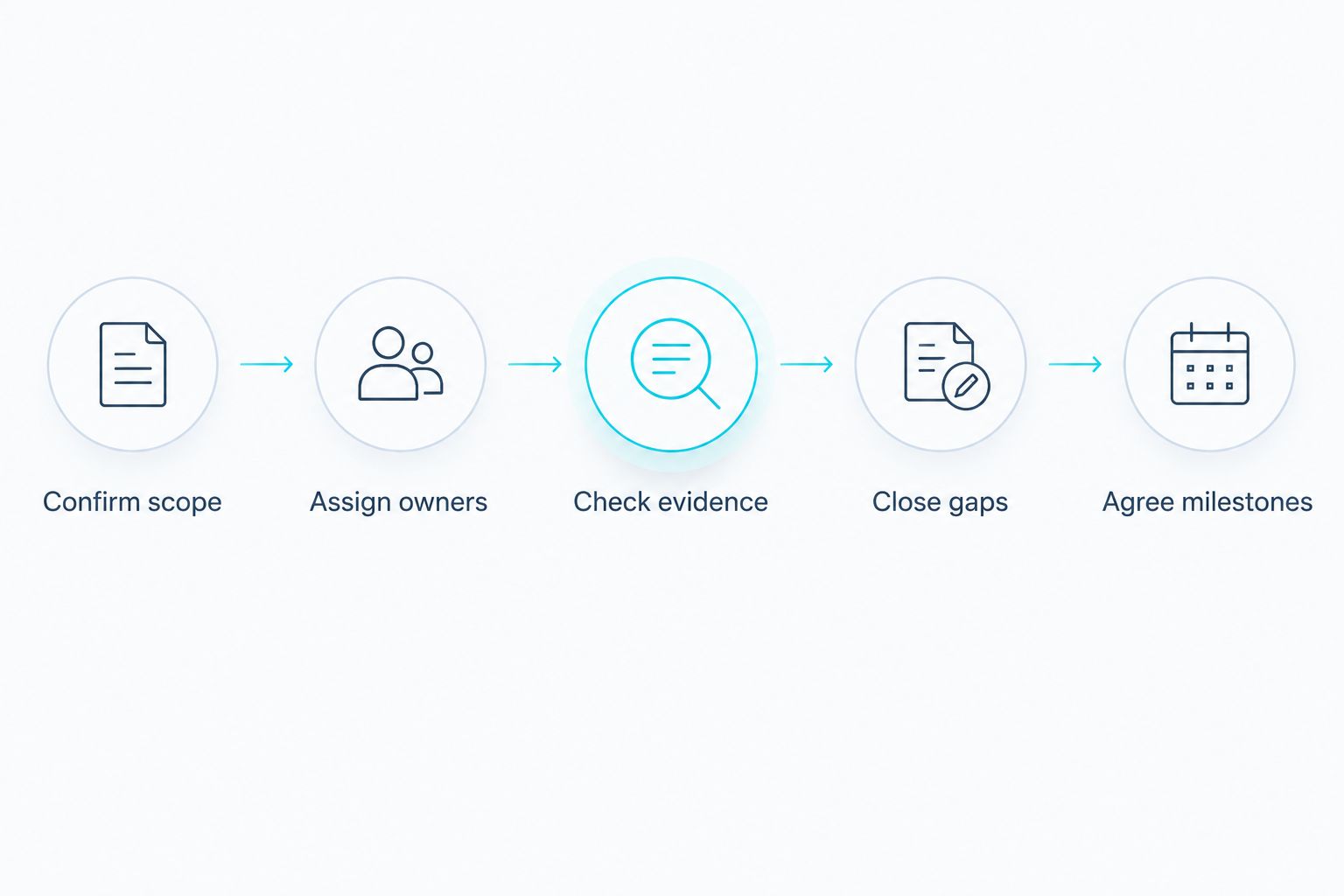
Build your 2026 schedule around deliverables and dependencies. Keep technical work, business approvals, and auditor activities visible as separate responsibilities.
- Confirm scope. Identify the assessment, required deliverable, covered systems, and relevant evidence period. Ask the auditor to resolve ambiguous requirements.
- Assign owners. Name the business lead, technical lead, evidence owners, and auditor contact. Give each request an accountable person.
- Check evidence. Compare the request list with existing records. Separate usable evidence from incomplete exports, missing approvals, and records outside the required period.
- Close gaps. Assign corrective actions and define how completion will be verified. Record any dependencies on business decisions or outside parties.
- Agree milestones. Confirm evidence submission, examination, follow-up, and reporting expectations. Identify which dates are commitments and which depend on unfinished work.
A schedule becomes useful when someone can explain what must happen before the next milestone. Ask for that explanation alongside each date.
Keep a request register during examination. Record the request, responsible owner, status, submitted evidence, and follow-up question. This prevents an unanswered request from disappearing between email threads.
Do not mark a request complete simply because a file was uploaded. Mark it submitted, then record whether the auditor accepted it or requested clarification. The distinction makes unresolved work visible.
What does managed IT support handle during the audit?
Managed IT support is relevant where requirements touch the systems the provider manages. That includes technical configuration records, access information, change records, and security documentation within the agreed service scope. Your business still needs to own decisions and evidence outside that scope.
TeraCloud managed IT services are best for small and midsize businesses seeking support with cybersecurity, cloud systems, and data management. Those services are relevant to technical preparation; they are not a substitute for the auditor’s examination.
TeraCloud provides managed IT support with 24-hour coverage, 7 days a week. That describes support coverage, not a compliance audit completion promise. Confirm who handles audit requests and what evidence work is included in your engagement.
The benefit of managed support is access to people responsible for the technical environment. The limitation is scope: IT records alone do not establish every business requirement. Your leadership, finance, operations, or human resources teams must provide evidence for the processes they own.
Ask TeraCloud to distinguish its technical responsibilities from your internal responsibilities and the auditor’s role. A written responsibility map is more useful than a general assurance that the audit will be handled.
Can managed IT support make a compliance audit faster?
Managed IT support helps reduce avoidable preparation work by organizing records, assigning technical owners, and addressing gaps before examination. It cannot guarantee a shorter audit or replace a required evidence period.
Ask which dependency the provider will remove. A useful answer names the task, owner, and expected deliverable. A broad promise of a faster audit does not explain what changes in your schedule.
Can we start the audit before every gap is fixed?
You can discuss scope and schedule with an auditor while readiness work continues. Starting discussions is different from being ready for examination or having sufficient evidence for the required report.
Tell the auditor which controls are incomplete and when corrective work will finish. Let the auditor determine how those facts affect testing, the evidence period, and the final deliverable.
Does ongoing monitoring mean we are audit-ready?
Ongoing monitoring does not establish audit readiness by itself. Monitoring produces information about system activity, but the audit requires evidence tied to its specific criteria and period.
For your 2026 review, check whether monitoring records have appropriate coverage, retention, ownership, and documented responses. An alert without a recorded investigation answers a different question from an alert with a documented resolution.
FAQ
How long does a compliance audit take with managed IT support?
A compliance audit has no single fixed duration with managed IT support. Scope, evidence readiness, unresolved gaps, required evidence periods, and auditor review determine the schedule. Request separate milestones for preparation, examination, and reporting.
Does managed IT support guarantee that we will pass a compliance audit?
Managed IT support does not guarantee an audit outcome. It helps with technical preparation and evidence within its service scope; the auditor assesses that evidence against the applicable requirements.
What should I ask before accepting an audit completion date?
Ask what deliverable the date covers and which dependencies remain unresolved. Confirm the scope, evidence period, corrective actions, examination schedule, and reporting process before treating the date as a commitment.
Is a readiness assessment the same as a compliance audit?
A readiness assessment is not the same as a formal independent audit. It identifies preparation gaps, while formal examination tests evidence against the requirements for the agreed deliverable.
Can we automate all the evidence collection?
Automation does not replace every evidence task. System exports still need scope and period checks, while approvals, business decisions, and explanations require accountable owners.
Who responds to the auditor’s technical questions?
Assign a technical lead to coordinate technical responses with the managed IT provider. Your business should also name an audit lead to manage requests, approvals, and evidence outside the provider’s scope.
What is the difference between SOC 2 Type 1 and Type 2?
SOC 2 Type 1 addresses control design at a specified date; Type 2 also addresses operating effectiveness over a specified period. Confirm which report the recipient requires before scheduling preparation and examination.
Related guides
- Can co-managed IT work alongside your existing IT staff?
- How long does an MFA rollout take across a small business?
- Cloud backup and disaster recovery providers
One last thing
A current screenshot cannot prove that a control operated throughout an earlier evidence period. That distinction matters even when the underlying system is correctly configured today. Keep evidence creation dates separate from the period the evidence actually covers.
Your next step: ask your managed IT provider and auditor to agree on a written scope, evidence period, responsibility map, and milestone schedule before you commit to the delivery date.


