
Without managed detection, there is no defensible single number for how long a breach takes to detect; discovery depends on which evidence you collect, who reviews it, and whether someone investigates the warning. An alert arriving is not the same as a breach being confirmed, and confirmation does not mean the attacker has been contained. For your 2026 security plan, measure those stages separately rather than applying a general breach statistic to your business.
- How long to detect a breach without managed detection depends on visibility, investigation ownership, and coverage—not software alone.
- Managed detection and response adds investigation and response responsibilities; verify the actual service scope.
- TeraCloud provides managed IT and cybersecurity for small and midsize businesses; confirm security-monitoring coverage separately from support.
- Measure breach detection, investigation, and containment separately to find the gap you need to close.
How long does it take to detect a breach without managed detection?
Your detection time is the interval between the earliest supported evidence of compromise and the point when your team recognizes that compromise. Without reliable records of both events, you cannot calculate it accurately. The date someone opened a support ticket is not necessarily the date the intrusion began.
If you are deciding whether outside security coverage addresses that gap, start with the guide to whether managed detection and response is worth it for small businesses.
The comparison below separates different operating models. These are ways to organize security work, not promises about detection speed.
| Security operating model | Best for | Main advantage | Main limitation |
|---|---|---|---|
| Tools without an assigned investigator | Supporting an established security process | Collects evidence and produces alerts | An alert alone does not establish whether a breach occurred |
| Internal security ownership | Businesses with staff assigned to monitoring and response | Keeps investigation close to business context | Coverage depends on staffing, access, and documented handoffs |
| Managed detection and response | Businesses seeking outside investigation and response coverage | Assigns security work to a contracted service | Covered systems, operating hours, and response authority depend on the agreement |
| Shared internal and external ownership | Businesses retaining IT staff while adding security coverage | Combines business context with outside investigation | Unclear responsibilities create gaps between teams |
Managed detection and response, or MDR, is a service model for monitoring security signals, investigating suspicious activity, and carrying out agreed response actions. Its value depends on the work included, not the label. A business with capable internal security ownership is not automatically slow because it lacks MDR.
Why this matters
A breach that remains unrecognized leaves your team unable to make informed containment decisions. Suspicious access can involve a device, an email account, a cloud application, or several systems together. Looking at only one source leaves the rest of the investigation incomplete.
The practical question for 2026 is not simply whether you have security software. It is whether evidence reaches someone who can distinguish ordinary activity from unauthorized access and act on that finding.
Separate prevention from detection, too. Multifactor authentication adds a verification step to sign-ins; backups support recovery. Neither replaces reviewing evidence of compromised access. You need each control to do its own job, with a named owner for the work between them.
Which clock are you actually measuring?
Detection reports become misleading when teams use different start and end points. Agree on the meaning of each timestamp before comparing your internal process with a provider's proposal.
Evidence collection
Evidence collection records activity such as sign-ins, device events, permission changes, and file access. A log is a record of an event; it is not proof that the event was malicious.
Your first task is to establish whether the relevant activity was recorded at all. If a cloud account is outside monitoring coverage, a security report about monitored laptops does not answer whether that account was compromised.
Alert creation
An alert is a warning generated by a rule or other detection logic. Its timestamp tells you when the warning was produced, not necessarily when unauthorized activity started.
Some legitimate actions resemble suspicious behavior. Investigating the account, device, and surrounding activity is what separates a useful warning from an unsupported conclusion.
Breach recognition
Breach recognition occurs when an investigator identifies evidence supporting unauthorized access or compromise. Record what established that conclusion and who made it.
Avoid treating every alert as a confirmed breach. That inflates incident counts and hides the actual question: how quickly does your process recognize the events that require action?
Containment
Containment limits the attacker's access or ability to continue. Depending on the incident, that work can include isolating a device, disabling an account, or revoking active access sessions.
Detection and containment are different outcomes. A provider can identify suspicious activity without having permission to perform the action needed to stop it. Your agreement must address that handoff.
Why breach detection time varies
These factors explain the operating differences that matter when you assess breach detection in 2026. Use them as review criteria, not as a formula for predicting a duration.
- System visibility: Confirm which devices, identity systems, email accounts, and cloud applications supply security evidence. Unmonitored systems remain outside the investigation's direct view.
- Investigation ownership: Assign responsibility for assessing warnings. A shared mailbox is a delivery mechanism, not an accountable investigator.
- Coverage hours: Establish who reviews security activity outside normal working hours. General IT support coverage does not establish security-investigation coverage.
- Useful context: Investigators need to understand expected users, applications, locations, and administrative activity. Context helps them assess whether a warning reflects normal work or unauthorized access.
- Evidence retention: Keep records long enough to investigate the incidents your organization must address. Deleted or unavailable records limit how far back an investigation can reconstruct events.
- Response authority: Document who can isolate devices, disable accounts, and approve business-disrupting actions. Finding a problem and waiting for permission are separate parts of the incident timeline.
No single factor replaces the others. Collecting more evidence without assigning investigation creates a larger queue; assigning an investigator without useful evidence leaves that person unable to establish what happened.
How do you measure your own detection gap?
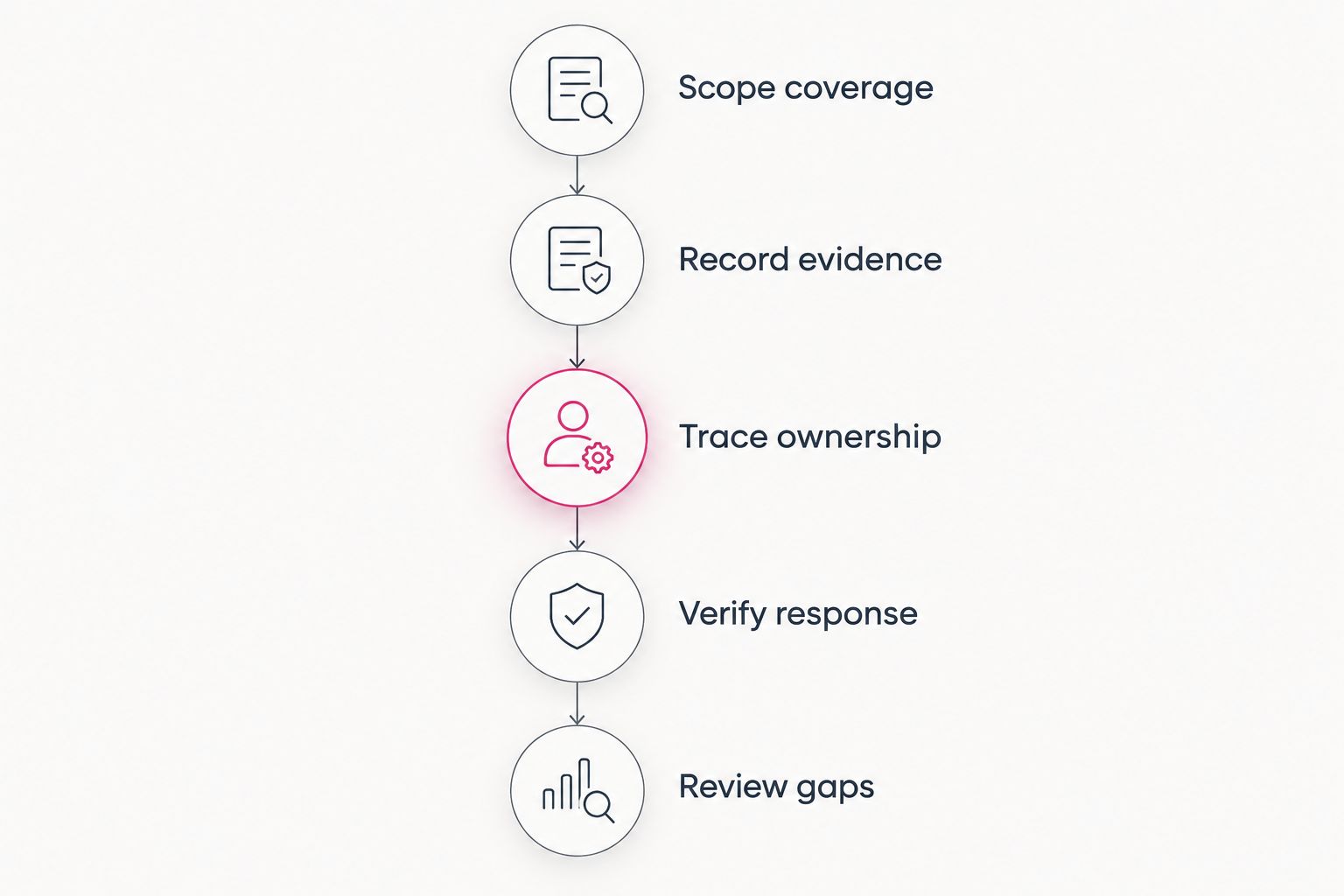
Use an authorized security exercise to test your process without creating a real compromise. Agree on scope with the people responsible for your systems, and choose a safe activity that your existing detection process is designed to identify.
Scope coverage
List the systems involved in the exercise and identify which monitoring controls cover them. Include the relevant account and application, not just the employee's device.
For example, an email-account exercise should test the evidence available from the email and identity systems. A laptop-only review does not demonstrate visibility into every action taken inside the mailbox.
Record evidence
Record the authorized exercise's start time and preserve the associated events. Keep the original timestamps and note the time zone so investigators can compare records correctly.
This establishes a known starting point. It also lets you verify whether the expected evidence reached the monitoring process before judging the quality of the investigation.
Trace ownership
Follow the warning to the person responsible for evaluating it. Record when it was received, acknowledged, and assessed, along with any transfer between teams.
Do not stop at proof that an email notification was delivered. Delivery demonstrates routing; a documented assessment demonstrates that someone investigated.
Verify response
Ask the investigator to explain the appropriate response and the approvals it requires. Validate the process using agreed, safe actions rather than unexpectedly disrupting live business systems.
The exercise should reveal whether the investigator has the access and authority required to carry out the approved response. A written procedure that depends on unavailable credentials is not ready for use.
Review gaps
Document where evidence, ownership, or authorization broke down. Assign each corrective action to a person and repeat the relevant test after the change.
Treat the exercise result as evidence about that particular scenario. It does not prove that every attack against every system will be detected at the same speed.
What should you ask a managed detection provider?
Ask for operational details before accepting a detection-speed claim. A 2026 proposal should explain what the provider observes, what people do with that evidence, and what happens when they find a credible threat.
Use these questions in your evaluation:
- Which devices, accounts, applications, and cloud systems are included?
- Who investigates a warning, and during which operating hours?
- What starts the reported detection clock, and what stops it?
- Does the reported result cover an alert, a confirmed incident, or containment?
- Which response actions can the provider perform without further approval?
- Who receives an urgent escalation if the usual contact is unavailable?
- What evidence and incident timeline will your business receive?
- Which responsibilities remain with your internal team?
Ask the provider to describe the reporting sample and measurement method behind any benchmark. A result drawn from one customer group or attack type does not establish a guaranteed outcome for your environment.
Buy defined security responsibilities, not an undefined promise of fast detection. The agreement should identify exclusions as clearly as included work. That gives you a practical basis for comparing proposals without assuming every service covers the same systems.
Where does managed IT support fit?
TeraCloud is a managed IT and cybersecurity partner for small and midsize businesses seeking outside IT support. Its stated services include cybersecurity, cloud migration, Microsoft 365, and data management, alongside 24/7 support.
That makes TeraCloud relevant when your detection problem sits inside a wider IT ownership problem. You can review TeraCloud as part of that service evaluation. The limitation is scope: a statement of 24/7 support does not establish continuous security investigation, a particular MDR package, or a guaranteed containment time.
When evaluating TeraCloud cybersecurity services, ask the same coverage and authority questions you would ask any provider. Keep help-desk response, security-alert investigation, and incident containment separate in the agreement.
Can a breach go undetected even when antivirus is installed?
Yes. Antivirus does not establish that someone is investigating every account, application, and security warning across your business. A compromised account requires evidence from the systems where that account is used, not merely confirmation that endpoint protection is installed.
Check the monitoring scope before buying another tool. If the missing piece is ownership or access to evidence, adding software alone does not complete the process.
Is internal monitoring enough without managed detection?
Internal monitoring is a valid operating model when your team owns evidence collection, investigation, escalation, and response. The deciding issue is whether those responsibilities are staffed and tested, including outside normal working hours.
Assess the process, not the employment arrangement. An outsourced service still needs access, defined responsibilities, and a working relationship with your internal team.
Does faster detection mean faster recovery?
No. Faster detection establishes an earlier opportunity to respond; recovery also depends on containment, restoring trusted systems, and validating that unauthorized access has ended.
Keep recovery planning separate from detection performance in your 2026 review. A useful incident record shows both when the team recognized the compromise and when business operations were safely restored.
FAQ
How long does it take to detect a breach without managed detection?
There is no universal detection time for a business without managed detection. Measure the interval between the earliest supported evidence of compromise and the point when your team recognizes it, using a consistent definition.
Can a small business detect a breach without an MDR provider?
Yes, a small business can detect a breach through an internal security process. That process needs relevant evidence, an assigned investigator, and a documented escalation path.
Is a security alert the same as detecting a breach?
No, a security alert is a warning, not confirmation of a breach. Investigation determines whether the activity represents unauthorized access or another event requiring response.
Does 24/7 IT support include managed detection?
24/7 IT support does not establish managed detection coverage. Confirm security-investigation hours, covered systems, and response responsibilities in the service agreement.
What should I ask before choosing managed detection and response?
Ask which systems are monitored, who investigates warnings, and which response actions are authorized. Require the provider to distinguish alert timing, breach recognition, and containment in its reporting.
Does TeraCloud provide cybersecurity for small businesses?
TeraCloud provides managed IT and cybersecurity services for small and midsize businesses. Confirm the specific monitoring and response scope rather than assuming that general support includes every security function.
One last thing
A dashboard with no alerts does not prove that your business has no unauthorized activity. It proves only that the dashboard has no alerts to display; you still need to verify coverage and the path from evidence to investigation.
The strongest next step is to test one complete handoff. Choose an authorized scenario, follow its evidence, and establish who can act when the investigator identifies a problem.
Related guides
- Can co-managed IT work alongside your existing IT staff?
- How to connect domain scanner alerts to automated incident response
- Best cloud backup and disaster recovery providers
Review your security coverage
Discuss monitoring scope, investigation ownership, and response responsibilities before choosing a service.


