
For a small business in 2026, AI consulting requires a quote tied to a defined business problem, deliverables, and support responsibilities—not a single standard fee. Your budget must also account for software subscriptions, data preparation, integration, staff training, and maintenance when those sit outside the consulting agreement. Compare the cost of an accepted, working outcome, not just the consultant’s fee.
- How much does AI consulting cost for small businesses? Define the scope before comparing quotes.
- Separate consulting fees from software, integration, data preparation, training, and ongoing support.
- TeraCloud fits small and midsize businesses seeking AI consulting alongside managed IT.
- Start with a bounded workflow and require acceptance criteria before approving implementation.
How much does AI consulting cost for small businesses in 2026?
The amount depends on what you are buying: advice, a working implementation, or continuing operational support. A strategy document and an automation connected to live business systems are different deliverables. Treating their quotes as interchangeable hides the work you still need to fund.
For example, connecting Microsoft Copilot to a document management system involves more than deciding which tool to use. Your scope must address document access, permissions, testing, and ownership after deployment.
Ask each consultant to separate these budget components:
| Budget component | What the quote should explain | What to verify |
|---|---|---|
| Discovery and strategy | Workflow review, priorities, and proposed scope | Whether implementation is included |
| Implementation | Configuration, connections, and workflow testing | Which systems and tasks are covered |
| Software and usage | Required subscriptions and usage-dependent charges | Who pays and controls the accounts |
| Data preparation | Cleaning, organizing, and restricting source information | Which data problems remain your responsibility |
| Training and handover | Instructions, staff training, and documentation | Who can operate the workflow without the consultant |
| Ongoing support | Monitoring, troubleshooting, and changes | What happens after acceptance |
A comparable quote describes both the finished workflow and the work excluded from delivery. Without that boundary, you are comparing promises rather than equivalent projects.
Why this matters
An attractive consulting proposal can leave you with a plan but no deployed workflow. An implementation proposal can deliver a working demonstration without resolving who supports it. Neither is inherently wrong. The problem is buying one while expecting the other.
Your business outcome should stay visible throughout the proposal. If staff spend time copying information between systems, specify the handoff you want to remove. If staff struggle to find documents, specify the information they need and the access restrictions that must remain intact.
For your 2026 budget, distinguish time released from cash saved. A workflow that reduces repetitive work does not automatically reduce payroll or create additional revenue. Measure what changes in the actual process before attaching a financial return to it.
Strategy consulting: best for choosing the right project
Strategy consulting is appropriate when you need to decide where automation belongs, which information it requires, and whether the business case justifies implementation. Ask for a prioritized workflow list, dependencies, security considerations, and a defined implementation scope.
The benefit is a clearer decision before you commit to technical work. The limitation is equally clear: advice is not a deployed system. A presentation does not complete the operational change.
Require the consultant to explain why each proposed workflow needs AI rather than a conventional rule-based process. Moving a record when a known condition occurs is different from interpreting an unstructured document. Choosing the simpler suitable approach keeps the project focused.
Choose strategy consulting when the project decision is unresolved—not when you already have a clear implementation brief.
Implementation consulting: best for a defined workflow
Implementation consulting is appropriate when you know the process, its inputs, and the result you need. The proposal should name the connected systems, specify permitted actions, and describe how the completed workflow will be tested.
Its benefit is direct work on an operational outcome. Its limitation is dependence on a clear scope: unresolved permissions, unreliable source information, or changing requirements still need decisions from your business.
For a document-processing workflow, define what happens when information is missing or ambiguous. Does the system stop, send the item for review, or produce a draft? That behavior belongs in the scope, not in a discussion after deployment.
Require a handover that explains configuration, access, troubleshooting, and recovery. Choose implementation consulting when the workflow has a business owner and written acceptance criteria.
Ongoing support: best for business-critical workflows
Ongoing support is appropriate when an automation becomes part of daily operations and someone must respond when it fails. Define responsibility for alerts, failed connections, access changes, and updates to the workflow.
The benefit is an assigned operational owner after launch. The limitation is that a support agreement does not automatically include redesigns, additional workflows, or changes to connected systems. Those boundaries need written terms.
For a 2026 support proposal, ask who handles a failure that spans the automation and the underlying IT environment. Separate providers need a clear handoff; a combined provider needs equally clear responsibilities.
TeraCloud provides AI consulting alongside managed IT, cybersecurity, cloud migration, and data management for small and midsize businesses. That service combination fits projects with IT dependencies, but it does not replace a project-specific scope or acceptance test.
Which consulting arrangement fits your project?
Select the arrangement around the uncertainty in the work. Do not assume that a billing structure tells you what the consultant will deliver.
| Arrangement | Best for | Advantage | Limitation to address |
|---|---|---|---|
| Fixed-scope project | A defined workflow with agreed acceptance criteria | Makes the delivery boundary explicit | Changes require a documented process |
| Time-based engagement | Discovery or work with unresolved dependencies | Allows investigation as requirements develop | Requires visibility into work and progress |
| Ongoing engagement | Workflows needing continuing operational attention | Assigns recurring responsibilities | Needs limits on support, changes, and new projects |
A fixed-scope agreement still needs exclusions. A time-based agreement still needs deliverables. An ongoing agreement still needs an exit and handover process.
Choose the arrangement that makes responsibility clear, then compare proposals using the same workflow brief. Reject a proposal that describes activity without stating the result you will receive.
Why AI consulting budgets vary
The work changes when the underlying systems, information, and responsibilities change. These scope drivers deserve explicit treatment in your proposal:
- Workflow scope: A drafting assistant and an automation that changes business records require different actions, controls, and tests.
- Data condition: Disorganized, duplicated, or inaccessible source information requires preparation before it can support a dependable workflow.
- System connections: Each connection needs access, configuration, and a defined owner when it stops working.
- Security requirements: Sensitive information requires decisions about permissions, permitted use, and human review.
- Training and handover: Staff need instructions for normal operation, exceptions, and escalation—not just a demonstration.
- Operational responsibility: A project handed over at acceptance differs from one with continuing monitoring and troubleshooting.
Ask consultants to identify which drivers are already included and which depend on discovery. An exclusion is useful when it is explicit. An unstated dependency becomes a problem when you discover it during delivery.
Avoid expanding the project because additional use cases sound appealing. Each added workflow needs its own business justification, access decisions, and acceptance criteria.
How do you get a comparable AI consulting quote?
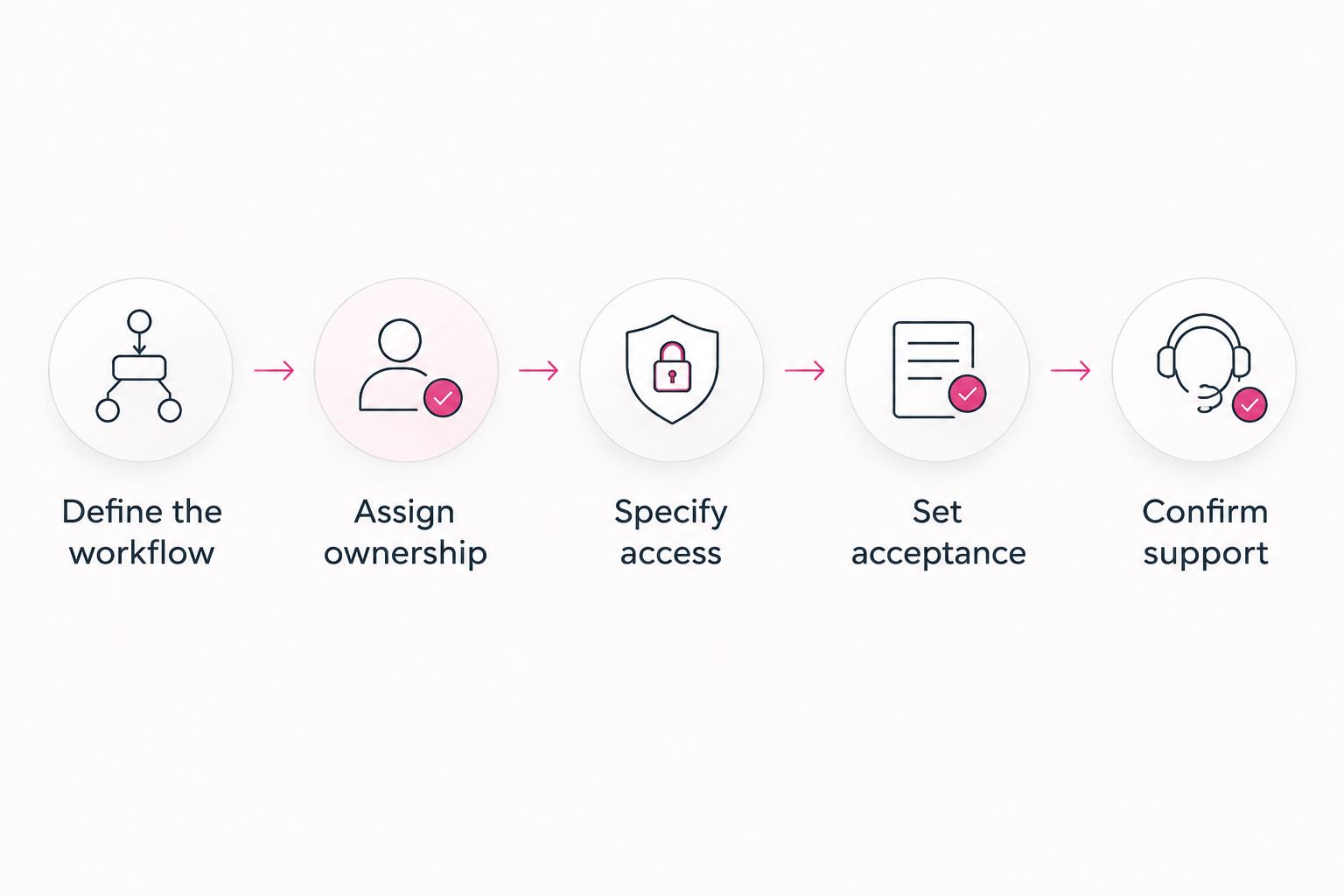
Give every consultant the same brief. A shared brief reduces the chance that one proposal covers advice while another includes implementation and support.
Define the workflow
Describe the current process in plain language. Name its trigger, source information, staff actions, and expected output. Keep the first project bounded enough that you can explain where it starts and ends.
Assign ownership
Name the person responsible for the business result and the person authorized to approve technical access. Identify who resolves exceptions. A consultant cannot replace your decision about what the business should allow.
Specify access
List the systems and information the workflow needs. State which actions it can perform and which require approval. Include restrictions on sensitive information and distinguish read access from permission to change records.
Set acceptance
Describe the examples the workflow must handle and the conditions under which it must stop or request review. Acceptance should test the process you actually use, including exceptions—not only a clean demonstration.
Confirm support
Specify who receives failure alerts, restores service, and maintains the documentation. Ask what happens when a subscription, connection, or business requirement changes after launch.
These steps turn a broad request for AI consulting into a proposal that you can evaluate. The brief should make scope disagreements visible before you approve the work.
How do you judge whether the project is worth funding?
Record the current workflow before implementation. Track staff effort, exceptions, rework, and the delay between receiving information and completing the task. Use records from your business rather than a vendor’s generic productivity claim.
After deployment, compare the same process under comparable conditions. Include the time employees spend checking results, correcting mistakes, and handling failed runs. Removing a manual task is not a gain if it creates an equally demanding review task elsewhere.
For a 2026 business case, keep these questions separate:
- Does the workflow reduce repetitive work?
- Does it improve the quality or consistency of the result?
- Does released capacity serve a specific business need?
- Who carries the continuing operating responsibility?
Fund the workflow with a measurable outcome and an accountable owner. Do not approve an expansion solely because the first demonstration looks impressive.
What should you ask before signing?
Read the proposal as an operating agreement, not just a purchasing document. The practical questions concern what your team receives and what your team must still do.
Ask who controls the accounts, configuration, documentation, and credentials. Require a handover process that does not depend on one person remembering how the workflow was built. Identify the procedure for disabling the automation safely.
Check how the consultant handles changes. A new source system, an added department, or a different approval process changes the original brief. The agreement should explain how those changes are assessed and authorized.
Finally, ask the consultant to walk through a failure scenario. If the explanation stops at the successful demonstration, the proposal has not yet addressed operation.
FAQ
How much does AI consulting cost for a small business in 2026?
AI consulting requires a scope-based quote covering the business problem, deliverables, and support responsibilities. Compare consulting separately from software, data preparation, integration, training, and maintenance.
Can I buy AI advice without paying for implementation?
Yes, you can request a strategy-only engagement. Require a useful decision document and implementation brief, and do not treat the strategy deliverable as a working automation.
Is fixed-scope AI consulting better than a time-based engagement?
Fixed-scope consulting fits a defined workflow; a time-based engagement fits investigation with unresolved dependencies. Both need written deliverables, progress visibility, and a clear approval process for changes.
What should an AI consulting proposal include?
An AI consulting proposal should include the workflow, connected systems, access requirements, deliverables, acceptance criteria, exclusions, and support responsibilities. It should also state who owns accounts and documentation after handover.
Does TeraCloud offer AI consulting for small businesses?
TeraCloud provides AI strategy and consulting for small and midsize businesses alongside managed IT, cybersecurity, cloud migration, and data management. Define the workflow and required deliverables when requesting a project proposal.
How do I check whether an AI project saves money?
Compare the completed workflow with your recorded baseline, including review time, errors, exceptions, and ongoing operation. Treat time released and cash saved as separate outcomes unless your business records establish the connection.
Should my first AI project cover the whole business?
Start with a bounded workflow that has a clear owner and acceptance test. Expand after you have assessed its operation, exceptions, and measurable business result.
One last thing
A workflow that safely stops can be more useful than one that always produces an answer. Your acceptance test should include missing information, denied access, and an unavailable connection. The point is not to eliminate every exception; it is to make exceptions visible and assign responsibility.
For your 2026 project, put that failure behavior in the brief before asking for quotes. It gives every consultant the same operational standard to meet.
Related guides
- AI consulting services for accounting firms
- Data management and governance services
- Managed IT service costs for small businesses
Next step: write a workflow brief with its inputs, expected result, acceptance test, and support owner, then use it to request a scoped proposal.
Discuss your workflow with TeraCloud
Use your workflow brief to discuss AI consulting scope and its managed IT dependencies.