
Outsourcing IT is cheaper than hiring in-house only when the provider’s total charges, transition work, and retained internal responsibilities cost less than an equivalent internal team. For your 2026 decision, compare the same support hours, security responsibilities, and project scope—not a service proposal against a salary alone.
- Is outsourcing IT cheaper than hiring in-house? Compare total costs for equal responsibilities before deciding.
- Managed IT services do not eliminate your responsibility for budgets, access approvals, or business priorities.
- Co-managed IT splits responsibilities between your employees and a provider; price the remaining internal workload.
- TeraCloud provides managed IT services for small and midsize businesses seeking outsourced support, cybersecurity, and cloud management.
Why this matters
A lower headline expense does not establish a cheaper operating model. An employee salary and a managed service agreement describe different things unless you account for benefits, tools, coverage, projects, and management time.
Use the managed IT cost guide for small businesses alongside your own payroll records and written proposals. The useful comparison is the cost of meeting your requirements, not the cost of buying a job title or a service label.
For a 2026 budget, separate recurring operations from changes to your environment. Supporting existing systems and migrating those systems are different assignments. Make both visible before choosing who performs them.
Is outsourcing IT cheaper than hiring an in-house team?
Outsourcing is the cheaper option when its complete cost is lower for the same required work. In-house IT is cheaper when your internal team delivers that work at a lower complete cost. Co-managed IT deserves a separate calculation because it combines internal staffing with external services rather than replacing either completely.
Use this table to choose the model you should evaluate. These are decision criteria, not promises about any provider’s contract.
| Operating model | Best for | Main advantage | Main limitation | Costs to include |
|---|---|---|---|---|
| Outsourced IT | Businesses assigning defined support, security, and cloud responsibilities to an external team | Services can be grouped under an agreed scope | Exclusions and retained management duties still need an owner | Service charges, transition work, excluded projects, retained internal time |
| In-house IT | Businesses requiring dedicated staff with direct involvement in daily operations | Direct control over staffing and priorities | Your business must arrange tools, training, specialist help, and absence coverage | Compensation, employer expenses, recruiting, tools, training, outside support |
| Co-managed IT | Businesses keeping internal IT staff while assigning specific work externally | Responsibilities can be divided around existing staff | Unclear boundaries create duplicated work or unowned tasks | Internal employment costs, external services, coordination, shared tools |
Choose the least expensive model that meets the written requirements. Reject a lower-cost option if it leaves a required responsibility uncovered.
For example, compare a requirement for business-hours assistance with another business-hours proposal. If you require overnight incident handling, include that requirement in both models. Do not treat unequal coverage as a saving.
Build the complete cost breakdown
Use a 12-month comparison period so recurring services and annual employment expenses share the same basis. List transition expenses separately, then include them in the first-year total. This keeps an ongoing operating comparison from hiding the work required to change providers or hire staff.
For in-house IT, include compensation, employer payroll expenses, benefits, recruitment, training, equipment, and management time. Add external specialists or backup coverage where your staffing plan requires them. Include software and infrastructure expenses only once.
For outsourced IT, include the service agreement, onboarding, tools outside the agreement, excluded projects, and internal coordination. Ask which responsibilities remain with your employees. An external provider handling support does not automatically take responsibility for every application, approval, or business decision.
For co-managed IT, include both sides. Retain the actual employment costs of your internal staff, add the external agreement, and remove expenses only when the new arrangement genuinely replaces them.
Keep a separate column for shared expenses. If you pay for the same application licenses under every model, those licenses belong in every total—not just the option you want to reject.
Outsourced IT: evaluate the agreement, not the label
Outsourced IT suits a business that wants an external team to perform clearly assigned operational work. The advantage is a defined service scope. The trade-off is that your business must verify what that scope excludes and keep responsibility for its own decisions.
Ask the provider to describe employee support, device management, cybersecurity, cloud administration, and data protection separately. A proposal that lists these headings without defining the work is not ready for a cost comparison.
Make support boundaries concrete. State which locations, devices, users, and applications require assistance. Describe how employees request help and how business-critical incidents receive attention. Ask whether physical work at your premises falls within the proposed scope.
For your 2026 evaluation, distinguish support access from a response commitment. Being able to submit a request outside business hours is not the same requirement as having a technician investigate an urgent incident then. Put the required behavior in writing.
Best for: businesses that can assign operational responsibilities clearly and retain an internal decision-maker. Do not select outsourcing solely because the recurring service charge is below a salary figure.
In-house IT: evaluate capacity, not just headcount
In-house IT suits a business that needs dedicated staff involved in daily workflows and internal priorities. The advantage is direct management of those employees. The limitation is that hiring does not, by itself, settle coverage, specialist expertise, or tooling.
Write the role around actual tasks. Employee troubleshooting, application administration, security operations, cloud changes, and vendor coordination are different responsibilities. Decide which belong to the position and which require outside assistance.
If your staffing plan specifies 40 hours per week, document how work outside those hours will be handled. That is a planning requirement, not an assumption that every employee works the same schedule. Apply your chosen coverage requirement equally to external proposals.
Account for holidays, leave, and competing assignments without inventing a downtime estimate. Name the backup owner and include any associated expense. A staffing plan is incomplete when necessary work stops because its owner is unavailable.
Best for: businesses with a sustained internal workload and a clear staffing, coverage, and specialist-support plan. Direct control is valuable, but it does not remove the need to calculate the complete operating expense.
Co-managed IT: evaluate the division of work
Co-managed IT suits a business that wants to keep internal staff while assigning selected responsibilities externally. The advantage is a deliberate split of work. The limitation is coordination: both parties need to know who investigates, approves, implements, and documents each change.
For example, your internal employee could own business application priorities while an external team handles agreed infrastructure tasks. Treat that as a proposed responsibility split, not a standard inclusion. The agreement must state the actual arrangement.
Avoid paying both teams to perform the same task without a reason. Shared oversight is different from duplicated execution. Document which tools remain, which are replaced, and who maintains the system records.
Best for: businesses whose internal IT staff need defined external support rather than replacement. Judge the arrangement by its combined expense and coverage, not by the external agreement alone.
Why the cost comparison varies
The answer changes when the work changes. These factors belong in your requirements sheet because they affect what an employee or provider must deliver:
- Support coverage: Define when help is required, which incidents need attention outside normal hours, and who provides backup.
- Cybersecurity responsibilities: Separate routine administration from incident investigation, access management, and security decisions.
- Cloud scope: Distinguish maintaining existing systems from migration, redesign, and changes to configurations.
- Data management: Specify backup responsibilities, restoration tasks, access ownership, and documentation requirements.
- Application ownership: Name the business applications requiring support and identify where specialist vendors remain involved.
- Internal coordination: Assign approvals, employee communication, vendor decisions, and business priorities to named owners.
Do not turn these factors into assumed savings percentages. Their purpose is to expose differences between the options. Use your actual records and proposals to calculate the result.
How do you compare both options fairly?
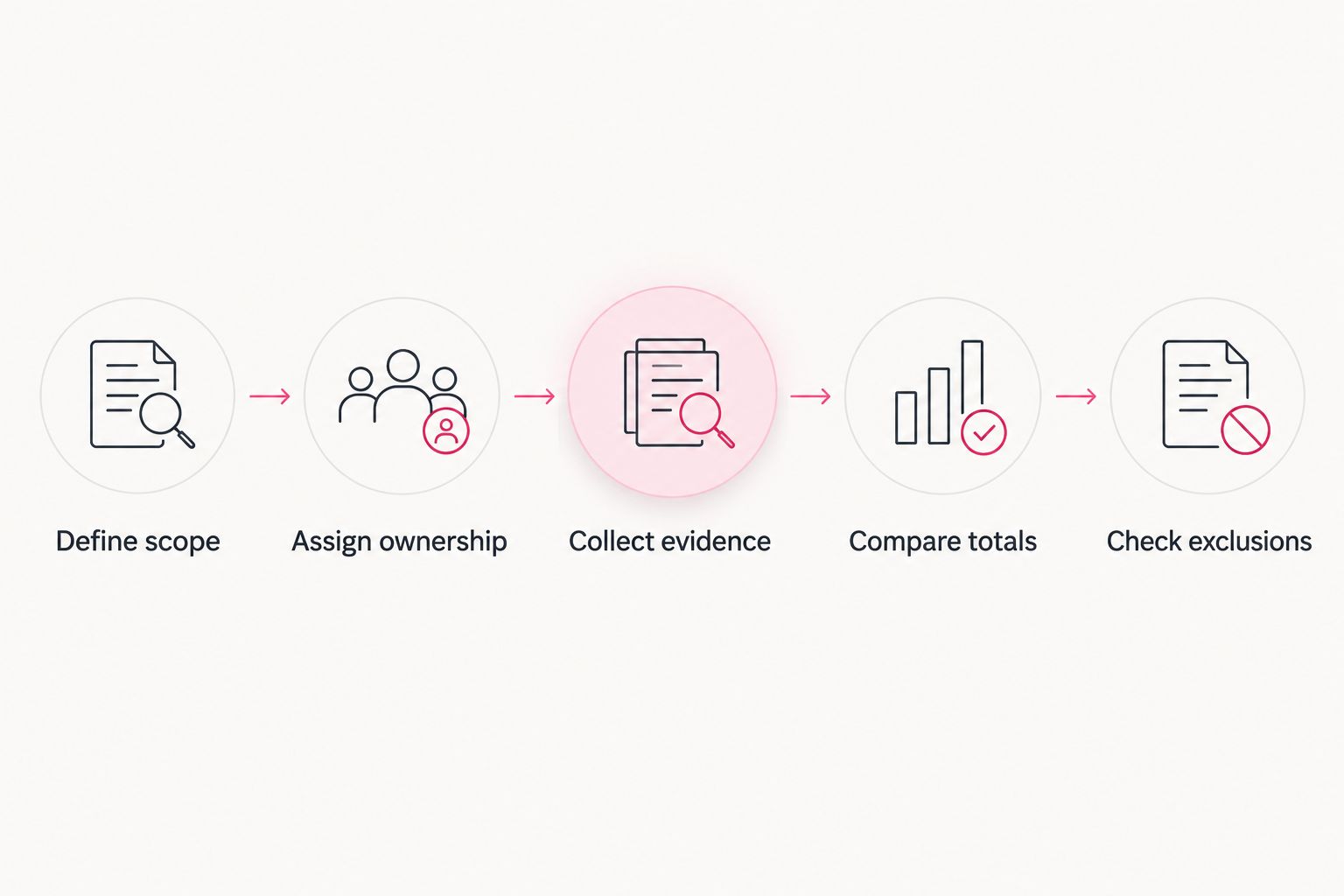
Use this process for a 2026 decision. Complete the requirements before asking anyone to recommend a staffing model.
- Define scope. List required services, supported systems, locations, and coverage hours. Identify work that is mandatory versus work you can defer.
- Assign ownership. Name the responsible party for each task under outsourcing, in-house IT, and co-managed IT. Mark anything without an owner.
- Collect evidence. Gather employment expenses, current software costs, written service proposals, and project estimates. Replace assumptions with documented terms.
- Compare totals. Use the same 12-month period, separate transition expenses, and account for retained internal work. Check shared expenses for double counting.
- Check exclusions. Resolve uncovered tasks, duplicated tools, and unclear responsibilities before selecting the lower-cost acceptable option.
The sequence matters. Pricing first encourages you to adjust the requirements around an attractive proposal rather than compare proposals against what your business actually needs.
After the comparison, ask each shortlisted provider or hiring manager to explain unresolved responsibilities. A blank ownership field is a decision blocker, not an administrative detail.
Where TeraCloud fits in the decision
TeraCloud managed IT services are for small and midsize businesses seeking external support, cybersecurity, and cloud management. Its stated services include data management and practical automation, with 24/7 support provided across Texas, Florida, Wyoming, and nationwide.
Evaluate TeraCloud against the same requirements you use for an internal team. The relevant advantage is its stated service scope across these functions. The limitation is that a service description does not establish your contract’s inclusions, response commitments, or total expense; obtain those in writing.
Can outsourcing replace every internal IT responsibility?
Outsourcing operational work does not remove the need for internal business ownership. Your company still needs someone to approve spending, authorize access, set priorities, and decide which interruptions are most urgent.
Assign that role explicitly. Include its workload in the comparison rather than assuming all IT-related management disappears with an external agreement.
Is co-managed IT cheaper if you already employ IT staff?
Co-managed IT is cheaper only when its combined expense is below another acceptable arrangement. Keeping existing employees and adding services does not automatically reduce spending.
Identify what the external agreement replaces or adds. Compare the resulting coverage and cost before treating either additional capacity or reduced workload as a financial saving.
Should you include downtime in the calculation?
Include documented downtime effects when your records support them. Separate observed losses from assumptions about future incidents.
Do not assign a projected outage saving to either model without evidence. A provider’s service description or an employee’s experience alone does not establish a measurable reduction in your business losses.
FAQ
Is outsourcing IT cheaper than hiring in-house in 2026?
Outsourcing IT is cheaper only when its complete cost is lower for equivalent responsibilities and coverage. Compare service charges, transition work, and retained internal duties against the complete employment and operating costs of an internal team.
What expenses should I include beyond an IT employee’s salary?
Include employer payroll expenses, benefits, recruitment, training, tools, management time, and any required external support. Include shared software expenses consistently across every option.
Does managed IT include every technology project?
Include a project in your comparison only when the written agreement includes it. Confirm the treatment of migrations, major changes, and work involving specialist application vendors.
What’s the best way to compare an IT proposal with hiring?
Compare both options against the same written requirements over a 12-month period. Separate transition expenses and identify the owner of every required task.
Is co-managed IT better than replacing our IT staff?
Co-managed IT fits businesses that want to retain internal staff and assign specific responsibilities externally. Compare its combined expense and coverage with replacement before deciding.
Does 24/7 support mean every issue is resolved immediately?
24/7 support alone does not establish an immediate resolution commitment. Ask for written terms covering response, escalation, supported systems, and the handling of urgent incidents.
Who approves spending when IT is outsourced?
Your business must assign an internal owner for spending approvals and business priorities. Include that person’s coordination duties in the operating model.
One last thing
The easiest expense to miss is work that changes hands without disappearing. Access approvals, business priorities, and coordination still need owners after outsourcing. Ask each option to account for the same work before accepting its total.
Related guides
- Can co-managed IT work alongside existing IT staff?
- Can managed IT replace an in-house IT department?
- How long does onboarding a managed IT provider take?
Your next step: build a responsibility-by-responsibility cost sheet and request a written proposal against that exact scope.