
Yes—AI strategy consulting can cut IT costs when it identifies recurring work you can remove, automates it safely, and reduces spending after implementation and operating costs. The catch is that faster work does not automatically produce a smaller bill: subscriptions, integration, oversight, and maintenance still count. For your 2026 budget, approve a project against a measurable business outcome, not a promise of productivity.
- Can AI strategy consulting cut IT costs? Yes, when verified savings exceed implementation, software, and ongoing support costs.
- TeraCloud provides AI consulting and managed IT for small and midsize businesses; evaluate proposals against measurable operating outcomes.
- IT automation that frees staff time creates capacity, not automatic cash savings.
- Start with a repeatable workflow, preserve security controls, and measure results before expanding.
Can AI strategy consulting actually cut IT costs?
Yes, but the savings come from changes to your operations—not from the strategy document itself. Consulting earns its place when it identifies a specific cost, selects the right intervention, and gives you a way to verify the result.
Use this decision sequence before authorizing implementation:
- Name the expense. Identify the support workload, external service, software subscription, or infrastructure consumption you want to reduce.
- Establish the baseline. Record the current spending and work involved. Include exceptions and rework, not just successful transactions.
- Choose the intervention. Decide whether the task needs AI, ordinary automation, a configuration change, or no technology change at all.
- Count the full cost. Include setup, integrations, subscriptions, review, security, and maintenance.
- Verify the outcome. Compare spending and service quality after implementation using the same accounting boundary.
TeraCloud is an AI consulting and managed IT partner for small and midsize businesses that want those services together. That service scope fits this evaluation; it does not replace the need for a project-specific business case.
Why this matters: saved time is not saved spending
An employee finishing a task sooner creates capacity. Your payroll does not fall simply because the task takes less time, and a fixed support contract does not become cheaper because fewer tickets reach the provider.
Keep those outcomes separate in your 2026 business case. Claim cash savings only when an expense actually disappears or decreases. Report time released as capacity, with a clear explanation of how your team will use it.
For example, drafting ticket summaries can reduce administrative effort while leaving staffing and support agreements unchanged. Eliminating an unnecessary paid service changes spending directly. Both outcomes deserve consideration, but they belong on different lines of the approval document.
Avoid counting the same benefit twice. If you value released staff time and also claim reduced outsourcing for that same work, explain which hours move out of the external contract and which remain internal.
What belongs in the savings calculation?
Use a consistent period and scope for the comparison. A recurring operating benefit should not be compared with an incomplete implementation estimate that leaves out the work needed to keep the system running.
A useful calculation is:
Net cash savings = verified spending reductions − implementation costs − new operating costs.
Track released staff capacity separately. If capacity later produces a measurable spending reduction, move that verified benefit into the cash calculation rather than assuming it at the start.
Current spending
Record the expenses attached to the chosen workflow. Include relevant external support, software subscriptions, infrastructure consumption, and paid overtime where applicable.
Use invoices and contract terms alongside workflow records. Ticket counts describe activity; they do not prove what your organization pays to handle it. Check whether charges are fixed, usage-based, or tied to service scope before projecting a reduction.
Implementation work
Account for connecting systems, cleaning data, configuring permissions, testing, documenting procedures, and training staff. Assign internal effort an explicit place in the project plan even when it does not create a separate invoice.
A workflow that needs substantial preparation is not automatically a bad investment. It simply needs a business case that includes that preparation rather than treating it as invisible work.
Ongoing operation
Include software subscriptions, usage charges, monitoring, human review, troubleshooting, and updates. Ask who owns each obligation after the consultant finishes.
Your 2026 approval document should also identify costs that remain unchanged. Existing IT support, backup, identity management, and security responsibilities do not disappear merely because an automated workflow handles part of a task.
Which approach fits the work?
Use the simplest approach that meets the business requirement. AI is not a prerequisite for cutting IT costs. A predictable process often needs a clear rule; a process involving varied language requires a different evaluation.
| Approach | Best for | Advantage | Limitation | Evidence to require |
|---|---|---|---|---|
| Rule-based automation | Tasks with explicit conditions and repeatable actions | Follows defined steps without interpreting open-ended requests | Exceptions need rules or human handling | Correct execution across ordinary and exception cases |
| AI-assisted workflow | Drafting, summarizing, or classifying varied text | Produces a draft or suggested classification for review | Output can be incorrect and requires appropriate checking | Accepted results, corrections, and total review effort |
| Manual handling | Sensitive decisions and infrequent exceptions | Keeps judgment directly with the responsible person | Repeated work continues to consume staff capacity | Work volume, handling effort, and reasons automation is unsuitable |
Consider a support request that contains a clear, structured category. Routing it through an explicit rule avoids unnecessary interpretation. If the request is unstructured, an AI-generated category can be evaluated as a suggestion rather than an unquestioned instruction.
The same distinction applies to document work. Extracting a known field from a consistent form differs from interpreting an ambiguous message. Select the method after examining the task, not after selecting a tool.
For support-specific evaluation, use the guide to whether AI can reduce IT support ticket volume. Keep ticket reduction separate from the financial effect of your support agreement.
Why AI consulting savings vary
The result depends on the workflow and the expenses attached to it. Assess these factors against your own records rather than borrowing a savings percentage from another business.
- Repetition: A recurring task provides repeated opportunities to remove work. An occasional task offers fewer opportunities to recover implementation effort.
- Data readiness: Inconsistent records and unclear document ownership add preparation and review work. Include that work before approving automation.
- Integration requirements: A workflow spanning disconnected systems needs connections, permissions, and error handling. Each dependency belongs in the implementation scope.
- Review burden: A generated answer that needs extensive correction can shift effort rather than remove it. Measure checking and rework alongside drafting time.
- Contract structure: Lower activity reduces spending only when the relevant agreement or usage charge changes with that activity.
- Operational ownership: Assign responsibility for failed runs, system changes, and access reviews. An unattended workflow is not a completed operating plan.
These factors explain why the same idea produces different business cases. A tool subscription tells you little about the cost of fitting that tool into your actual operations.
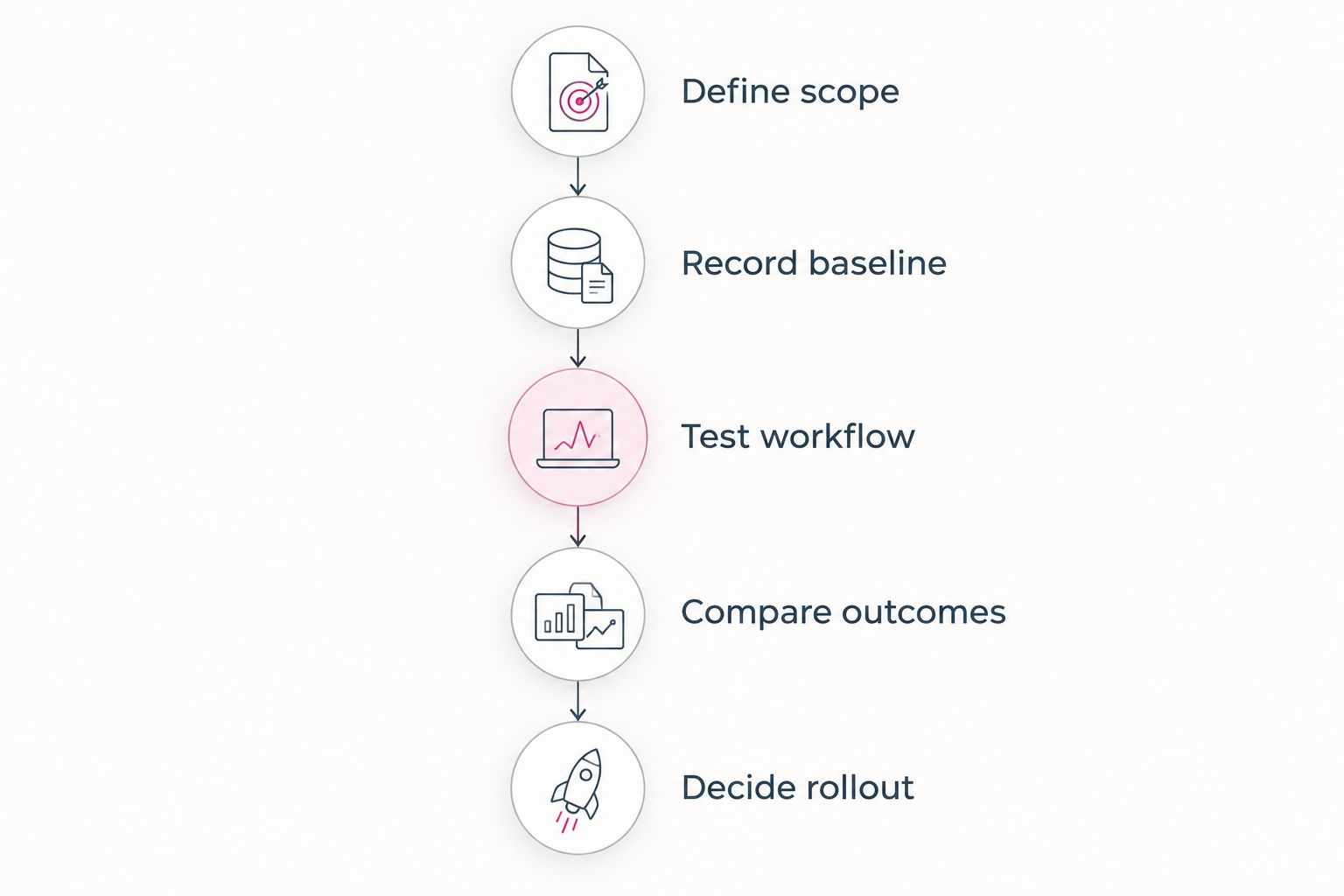
How do you test the business case before expanding?
Use a limited pilot with a defined boundary. The goal is to establish whether the workflow delivers an acceptable result—not to demonstrate every feature available in a platform.
Define scope
Choose a recurring task with a clear owner and an observable output. State what the pilot will handle, what it will exclude, and which exceptions go directly to a person.
For ticket triage, the output might be a proposed category and routing destination. Keep privileged changes outside that scope unless you have explicitly designed and approved the controls for them.
Record baseline
Capture work volume, handling effort, correction effort, and the expenses connected to the task. Record how service quality is assessed so the comparison does not reward speed at the expense of correct work.
Use representative cases, including exceptions. Testing only clean requests creates an incomplete picture of the effort required in normal operation.
Test workflow
Run the proposed process within the approved boundary. Check whether its output is correct, whether information reaches the right destination, and whether failures are visible to the responsible person.
Record all human intervention. A draft produced quickly but rewritten extensively must be evaluated using the combined effort, not generation time alone.
Compare outcomes
Compare the pilot against the baseline using the same definitions. Separate cash changes, capacity released, service quality, and new operating obligations.
For a 2026 rollout decision, document which benefits are observed and which remain assumptions. Do not turn an unverified expectation into a recurring savings line.
Decide rollout
Expand only when the evidence meets your acceptance criteria. Revise the workflow when a correctable problem blocks the result; stop when the economics or controls do not support deployment.
This sequence keeps approval tied to business results rather than feature adoption. It also gives your team a shared explanation for continuing, changing, or ending the project.
Which security controls must remain in place?
Cost reduction does not justify giving an automated workflow unrestricted access. Define which records it can read, which actions it can take, and which changes require approval.
Use least privilege, meaning access limited to what the task requires. If a workflow drafts ticket summaries, evaluate whether it needs anything beyond the relevant ticket information; do not grant administrative permissions merely for convenience.
Keep logs that show actions and failures. Establish a way to pause the workflow and return to manual handling, with a named person responsible for that decision.
TeraCloud provides cybersecurity alongside AI consulting and managed IT. When evaluating that combined scope, ask how access controls, incident handling, and workflow maintenance fit into the proposed engagement. Those details belong in the agreement, not in assumptions about what automation includes.
Can a small business benefit without a data team?
Yes—a small business can evaluate a bounded workflow without creating a separate data department. It still needs a process owner, appropriate access, usable records, and someone accountable for checking results.
Begin with the information already used to perform the task. If nobody can explain where that information comes from or who maintains it, resolve those questions before adding automation.
Will fewer support tickets lower the managed IT bill?
Fewer support tickets lower the bill only when the agreement connects charges to ticket activity or when you negotiate a change in scope. Under an unchanged fixed agreement, ticket reduction is an operational result rather than automatic cash savings.
Ask your provider how reduced workload affects the contract. Include the written answer in your business case instead of converting every avoided ticket into assumed savings.
Should you choose consulting or implementation first?
Start with the problem, baseline, and acceptance criteria before committing to implementation. Consulting is useful when those decisions require outside expertise; it adds little value if it delivers a generic roadmap without resolving them.
Ask for a scope that connects recommendations to an accountable implementation owner. A strategy without ownership leaves the spending decision unfinished.
FAQ
Can AI strategy consulting cut IT costs for a small business?
Yes, when the resulting changes reduce actual spending by more than implementation and operating costs. Track released staff time separately unless it produces a verified expense reduction.
What's the best first AI project for reducing IT costs?
Start with a recurring workflow that has a clear owner, measurable effort, and limited consequences when something goes wrong. Compare AI assistance with ordinary automation before selecting the approach.
Is AI better than rule-based automation for IT support?
AI is not automatically better than rule-based automation. Explicit conditions suit rules, while varied text can justify testing AI-assisted classification or drafting with appropriate review.
Does faster ticket handling mean our IT bill will fall?
Faster ticket handling does not automatically lower your IT bill. Check whether your support agreement changes with activity, staffing, or service scope.
What hidden costs should we include in an AI consulting project?
Include integration, data preparation, subscriptions, usage, training, human review, security, and maintenance. Assign an owner to ongoing work before approving deployment.
Can AI consulting replace our existing IT provider?
AI consulting does not by itself replace the responsibilities of an IT provider. Support, cybersecurity, cloud operations, and incident handling still need accountable owners.
What does TeraCloud offer for this type of project?
TeraCloud provides AI strategy and consulting alongside managed IT, cloud migration, cybersecurity, and data management for small and midsize businesses. Confirm the deliverables, implementation responsibilities, and measurement plan for your proposed engagement.
Related guides
- Can AI consulting help a small business without a data team?
- Is cloud cost optimization worth it for a small business?
- Can co-managed IT work alongside your existing IT staff?
One last thing: removing work can beat automating it
Before funding an AI workflow, ask why the task exists. An unnecessary approval, duplicate report, or unused subscription needs removal, not a more elaborate system to maintain it.
TeraCloud offers 24/7 managed IT support alongside practical AI services. That operating coverage and a cost-reduction project answer different needs; judge each against its own scope and outcomes.
Your next step: write a 2026 pilot brief for one recurring IT task, naming its expense, baseline, owner, acceptance criteria, and full operating cost.