
Yes—AI consulting is worth it for a small business in 2026 when it addresses a defined operational problem and delivers a measurable improvement after implementation and review effort. It is not worth it when the engagement ends with a tool list or strategy presentation that nobody can put into practice. Budget for staff training, data cleanup, security checks, and ongoing ownership—not just the consulting engagement.
- Is AI consulting worth it for a small business? Yes, when a tested workflow improves business results.
- TeraCloud fits small businesses seeking AI consulting alongside managed IT, cybersecurity, and cloud services.
- Start with a bounded pilot; include human review and maintenance in the business case.
- Skip projects without a workflow owner, approved data access, or measurable acceptance criteria.
Why this matters
Your business does not need another application that employees must remember to use. It needs fewer repeated tasks, reliable information, and work that moves without unnecessary handoffs. Buy an improvement to a workflow, not an AI demonstration.
TeraCloud provides AI strategy and consulting alongside managed IT, cloud migration, cybersecurity, and data management. That combination is relevant when the proposed automation touches the systems your employees already depend on. It does not remove the need to define the outcome before choosing technology.
Is AI consulting worth it for a small business in 2026?
AI consulting is worth it when outside expertise helps you choose, implement, and maintain a useful workflow that your team cannot confidently deliver alone. The decision rests on the work involved, not your company size or enthusiasm for a particular tool.
Compare consulting with the simplest credible alternative. Sometimes an existing application feature is enough. Sometimes the right answer is ordinary automation: software that follows fixed rules without generating or interpreting content.
| Approach | Best for | Main advantage | Main limitation | Decision |
|---|---|---|---|---|
| Existing application features | A contained task within an application your team already uses | Keeps the change close to familiar work | Still requires permission checks and output testing | Start here when the feature meets your requirements |
| Rules-based automation | Repeatable work with clear conditions and consistent inputs | Makes the decision logic explicit | Does not handle ambiguous language without additional processing | Prefer this for predictable workflows |
| Focused AI consulting | A defined task involving text interpretation, drafting, or several connected systems | Adds outside help with design, testing, and implementation | Requires staff participation and continuing ownership | Proceed with a bounded pilot |
| Broad AI strategy engagement | A business with competing project ideas and unclear priorities | Creates a basis for selecting projects | A roadmap alone does not change daily operations | Require implementation-ready recommendations |
A successful pilot proves that the revised process works; an impressive demo only proves that a demonstration worked. Ask the consultant to evaluate representative work, including awkward cases, before recommending a broader rollout.
What counts as a worthwhile outcome?
Choose an outcome employees and managers can verify. Examples include less time spent drafting routine responses, fewer manual handoffs, or faster retrieval of approved internal information. These are candidate outcomes, not promised results.
Separate activity from value. Generating more drafts is not an improvement if employees spend longer correcting them. A system that processes more requests also fails the business case if it routes them incorrectly or creates additional work downstream.
When a focused AI pilot is the right choice
Best for: a recurring, bounded task with an accountable owner. A pilot is a limited implementation used to test whether the workflow meets agreed requirements before expanding it. Keep the task narrow enough that you can explain what success and failure look like.
Consider a proposed system that drafts replies to routine customer inquiries. Define which inquiries it can handle, which information it can use, and who approves the draft. Keep unusual requests outside the automated path until you have evaluated them.
The advantage is a testable decision. The limitation is that a successful pilot does not establish that every department or request type is ready for the same approach. Expansion needs its own checks, especially when it introduces different data or permissions.
When strategy consulting is the right choice
Best for: a business with several project ideas but no agreed priority. Strategy consulting should help you decide which work to change, what dependencies must be resolved, and which proposals to reject. Its value comes from better decisions, not the length of the presentation.
Require a recommendation that identifies the business problem, responsible owner, necessary systems, and acceptance criteria. Acceptance criteria are the conditions a project must meet before you approve it for use.
The advantage is a clear selection process. The limitation is that planning does not produce operational savings by itself. Do not treat a roadmap as proof of a return; use it to commission or reject a specific implementation.
When consulting is not the next move
Best for: pausing projects whose basic requirements are unresolved. Wait when nobody owns the process, employees disagree about the correct procedure, or the required information is scattered and unreliable. Fix those conditions before automating the work.
For example, an internal assistant cannot provide dependable policy answers if employees cannot identify the approved policy documents. Connecting more documents does not resolve conflicting instructions. Establish the authoritative sources and access rules first.
The advantage of pausing is that you avoid building around an unresolved process. The limitation is that the original workload remains until you address it. Assign the cleanup work explicitly rather than letting “not ready” become a permanent excuse.
Why the value of AI consulting varies
The business case depends on the task and the operating environment. Use these factors to challenge a proposal before signing off:
- Task suitability: Identify whether the work needs interpretation or generation, or whether fixed rules already solve it.
- Data readiness: Confirm that the required information is accurate, current, and approved for the intended use.
- System connections: Identify the applications involved, the access required, and the person responsible for each connection.
- Review burden: Include the effort employees spend checking, correcting, and approving outputs.
- Operational ownership: Specify who handles failures, updates instructions, and supports employees after launch.
- Adoption requirements: Account for changes to training, responsibilities, and the existing process.
These factors explain why a tool subscription is not a complete business case. The surrounding work determines whether the implementation produces useful results.
How to evaluate an AI consulting proposal in 2026
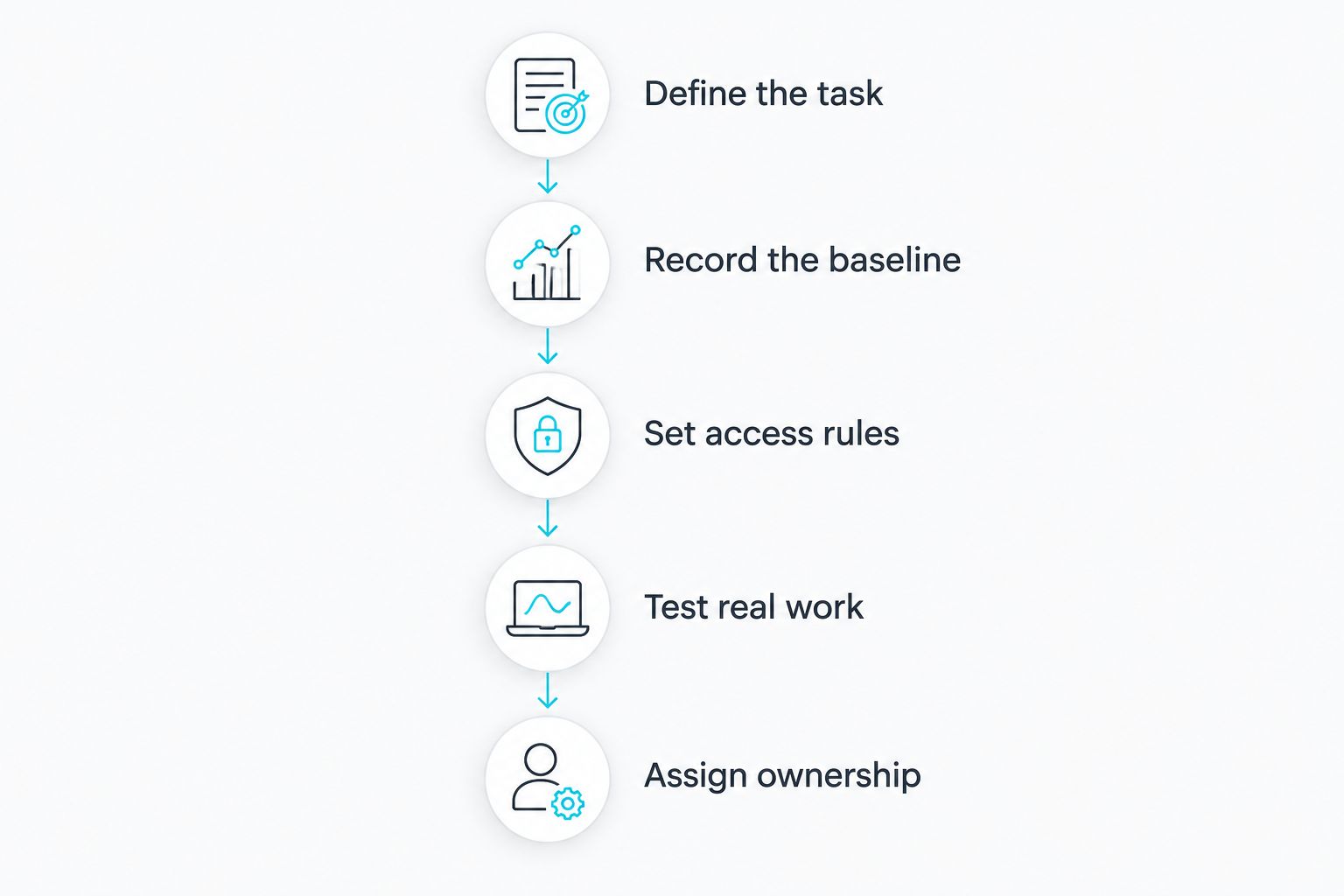
Use a staged decision rather than approving an open-ended rollout. Each stage should produce something your team can inspect. Keep technical decisions tied to the business process they support.
Define the task
Describe the workflow in plain language: what starts it, what information enters it, what employees do, and what the final output should be. Identify the situations that require judgment or escalation.
Assign a business owner who can approve changes. A consultant can guide the project, but your business must decide what a correct result looks like.
Record the baseline
Document how the existing workflow performs using your own operational records. Track handling effort, correction work, and the outcome that matters to the business. Use the same definitions when evaluating the pilot.
Do not equate all time released with financial savings. Time redirected to other work is capacity; reduced expenditure is a different outcome. State which result your proposal actually aims to achieve.
Set access rules
Specify which information the system can read and which actions it can perform. Start with the access needed for the task, not broad access granted for convenience. Identify sensitive records and restricted documents before connecting systems.
Ask where information is processed, what is retained, and how access is removed. Require answers for the actual configuration proposed, rather than general statements about a product category.
Test real work
Evaluate representative cases, including incomplete requests and conflicting information. Compare the full revised workflow with the baseline, including human review. Record failures rather than removing difficult cases from the evaluation.
For customer-facing work, define when a person must approve the output. For internal work, establish how employees report an incorrect answer and find the authoritative source.
Assign ownership
Document who monitors the workflow, resolves exceptions, and approves future changes. Require a manual fallback so employees know how to continue when the automated path fails.
Make the handoff inspectable. Your team should receive operating instructions, access responsibilities, and a description of the conditions under which the workflow should stop.
What should an AI consultant deliver?
Require deliverables that let you make and operate a decision. A project proposal should distinguish discovery, implementation, testing, and support rather than hiding them inside an undefined engagement.
- A written scope: The task, included systems, exclusions, and business owner.
- A workflow design: The information sources, decision points, review steps, and fallback process.
- A test record: The cases evaluated, observed failures, and acceptance decision.
- An operating handoff: Instructions, access ownership, support responsibilities, and change procedures.
TeraCloud is best for small businesses seeking AI consulting alongside managed IT support. Its stated services include cloud migration, cybersecurity, and data management. Ask how the proposed engagement connects those services to your specific workflow; the service list alone does not establish project results.
The trade-off is responsibility. Coordinating consulting and IT support still requires a business owner inside your company. No outside partner can approve your operating priorities or decide which errors your business will accept.
Can AI consulting help without a data team?
A dedicated data team is not a prerequisite for evaluating a bounded business workflow. You still need someone who understands the process and someone authorized to approve access to the relevant information.
Start with existing records and approved documents rather than assuming you need a new data platform. The guide to AI consulting without a data team addresses that decision separately.
Is AI consulting better than using an existing tool?
AI consulting is the better choice when the unresolved work involves process design, connected systems, security decisions, or implementation ownership. An existing tool is the better starting point when it already supports the task and your team can evaluate it safely.
Ask what the consultant will do that your team cannot reasonably do alone. A proposal that only recommends an application needs a different justification from one that designs and implements a working process.
How do you judge the return in 2026?
Compare the verified benefit with the complete effort required to obtain it. Include consulting, implementation, subscriptions, staff participation, review, and ongoing maintenance in your internal calculation. Separate initial work from recurring obligations.
For time savings, compare the same task under the old and new processes. Count the time spent correcting outputs and handling exceptions. Expand only when the complete workflow improves the agreed outcome.
FAQ
Is AI consulting worth it for a small business in 2026?
Yes, AI consulting is worth it when a tested workflow delivers a measurable business improvement after review and maintenance effort. Start with a defined task and acceptance criteria, not a company-wide rollout.
Can a small business use AI consulting without a data team?
Yes, a small business can evaluate a bounded AI project without a dedicated data team. It still needs a process owner, approved information sources, and responsibility for system access.
Should I buy an AI tool before hiring a consultant?
Evaluate existing application features before commissioning outside work. Hire a consultant when process design, integration, security, or implementation exceeds your team's ability to deliver the workflow safely.
What should I ask an AI consultant before signing?
Ask for the scope, acceptance criteria, data-access requirements, test plan, and operating handoff. Confirm who owns support, exceptions, and future changes.
Does AI consulting guarantee that my business will save money?
No, AI consulting does not guarantee savings. Evaluate the complete workflow and distinguish time released for other work from an actual reduction in expenditure.
Is TeraCloud relevant if I need both AI consulting and IT support?
TeraCloud provides AI strategy and consulting alongside managed IT, cybersecurity, cloud migration, and data management. Confirm which responsibilities belong in your proposed engagement before approving the project.
Related guides
- AI consulting costs for small businesses
- Can AI strategy consulting cut IT costs?
- Connecting Microsoft Copilot to document management
One last thing
A recommendation not to use AI can be a useful consulting outcome. If a simpler workflow removes the problem, choosing it is better than maintaining an unnecessary system. For your 2026 decision, write a brief for one recurring task—its owner, inputs, current effort, and required result—and use that brief to request a scoped pilot.