
Co-managed IT is not automatically cheaper than fully outsourced IT in 2026; it is cheaper only when retained staff and outside support together cost less than outsourcing equivalent work. A smaller provider invoice does not establish savings because you still carry internal payroll, management time, and any tools or projects outside the agreement. Compare total operating costs against the same responsibilities, security requirements, and support coverage before choosing.
- Is co-managed IT cheaper than fully outsourced IT? Only when combined internal and external costs are lower for equivalent coverage.
- Co-managed IT best suits businesses retaining capable IT staff and buying support for clearly defined gaps.
- Fully outsourced IT best suits businesses assigning most daily IT operations to an outside provider.
- TeraCloud provides managed IT, cybersecurity, and cloud services for small and midsize businesses; compare the proposed scope before choosing.
Why this matters
Compare the whole operating model, not just the provider invoice. Co-managed IT leaves work with your employees. Fully outsourced IT transfers more operational work outside the business, but you still need someone to approve priorities, spending, and access.
TeraCloud managed IT is best suited to small and midsize businesses seeking outside IT, cybersecurity, and cloud support. The right arrangement depends on what your business retains internally—not the label on the proposal.
Is co-managed IT cheaper than fully outsourced IT?
There is no universal cheaper option. For your 2026 decision, put both proposals beside your current staffing costs and require an equivalent description of the work covered. A narrow support agreement and a broad operational agreement are not interchangeable purchases.
| Decision point | Co-managed IT | Fully outsourced IT |
|---|---|---|
| Best for | Businesses retaining IT staff with clear responsibilities | Businesses assigning most daily IT operations externally |
| Internal staffing | Retained staff perform agreed tasks | Internal technical staffing depends on work retained |
| Main advantage | Preserves internal knowledge while adding outside support | Places more operational responsibility with a provider |
| Main limitation | Requires clear handoffs between employees and provider | Requires clear oversight of provider delivery |
| Cost comparison | Include retained payroll and external support | Include provider scope and remaining internal work |
| Critical check | Who handles work between the teams? | What remains outside the agreement? |
The table describes operating models, not standardized service packages. Each agreement determines the actual responsibilities.
For example, suppose your IT employee manages business applications while a provider handles agreed security and infrastructure tasks. That is a co-managed division of work. If your alternative proposal covers application administration too, you must account for that difference before comparing the totals.
A smaller scope is not evidence of a more efficient service. First establish who performs each task. Then compare what your business pays to get that work completed.
When co-managed IT is the better fit
Best for: businesses with capable internal IT staff whose work remains necessary. Co-managed IT lets you retain those employees while assigning defined responsibilities to an outside provider. It is an operating choice, not an automatic cost reduction.
Start with the work your employees actually perform. Business-specific application knowledge, internal project coordination, and hands-on tasks should appear in the responsibility list if you intend to retain them. Do not assume that buying outside support removes those obligations.
The advantage is continuity: your internal team keeps its business knowledge and agreed responsibilities. The limitation is coordination. If employees and the provider both expect the other party to handle an alert, an unresolved handoff leaves the task incomplete.
Ask which retained tasks require technical expertise and which require business approval. This separates necessary internal work from work that the proposed provider would also perform. Paying for overlapping responsibilities without a reason makes the comparison harder to justify.
Before choosing, read the guide to working alongside existing IT staff. Your decision should specify what stays internal, what moves outside, and who owns escalation when the initial response does not resolve the issue.
When fully outsourced IT is the better fit
Best for: businesses assigning most daily IT operations to an external provider. Fully outsourced IT fits that objective only when the agreement covers the work you intend to transfer. The phrase does not guarantee every application, project, location, or security responsibility is included.
The advantage is a clearer external owner for the contracted operational work. The limitation is that your business still needs oversight and must handle exclusions. Outsourcing technical execution does not outsource your authority to approve spending or decide who should access business information.
Check specialized applications explicitly. A provider supporting devices and infrastructure is not necessarily responsible for configuring an accounting workflow or resolving a vendor-specific application problem. Those responsibilities belong in the scope rather than in assumptions.
Also distinguish transferring work from eliminating jobs. Do not record a payroll saving unless your staffing plan actually changes. If you retain an employee for application ownership, vendor coordination, or project work, that employee remains part of the outsourced model's total cost.
Choose fully outsourced IT for the responsibilities it accepts—not because its name suggests complete coverage. A documented exception is manageable. An undisclosed expectation is not a usable basis for budgeting.
How to compare total IT costs in 2026
Use a common 12-month comparison period. That is a budgeting method, not a claim about contract length or typical savings. Keep recurring operations separate from transition work so you can see both the initial commitment and the ongoing arrangement.
Include retained staff costs
For co-managed IT, include the employees who remain responsible for IT work. Use your actual payroll, benefits, and other applicable employment costs. Include the time business leaders spend overseeing the arrangement when you have records that support it.
Apply the same treatment to fully outsourced IT. A manager approving changes or an employee administering a specialist application is still contributing internal work. Do not assign invented hourly values to that time; use your own records or show the responsibility separately.
Match the recurring scope
Request a written description of included support, security operations, cloud administration, backup responsibilities, and reporting where those services are relevant. Compare like with like. Mark an excluded service as excluded rather than treating it as covered.
Separate software ownership from software administration. Paying for a license does not establish who configures it, monitors it, or resolves access problems. Your comparison should identify both the tool and the work needed to operate it.
Separate transition and project work
Document onboarding, account transfers, documentation, and any remediation required before routine support begins. A change of provider can involve work that is separate from ongoing operations; the proposal must state how that work is handled.
Keep migration and other defined projects visible too. If your 2026 plan includes a cloud move, ask whether that project sits inside the proposed agreement or needs a separate scope. Do not bury it inside an assumed operating total.
Record exclusions and remaining responsibilities
List work that neither proposal accepts. Assign an owner before making the decision. Otherwise, you are comparing agreements while leaving part of your actual requirement outside both of them.
Your final worksheet should show retained staffing, contracted services, tools, transition work, projects, and exclusions. Only claim savings when the completed comparison supports them. A projected reduction and a verified reduction are different conclusions.
Why co-managed and fully outsourced IT costs vary
The work you assign matters more than the service label. Use these factors to structure the comparison; each comes from a responsibility your business must place somewhere.
- Retained workload: Identify the tasks your employees continue performing. Their costs remain in the model even when an outside provider takes over other work.
- Support coverage: Specify when support is required and what happens outside normal business hours. Continuous monitoring and an agreed response are separate responsibilities.
- Security scope: State who manages access, investigates security alerts, and coordinates incident handling. Do not infer those duties from a general cybersecurity heading.
- Cloud and application responsibilities: Identify which systems the provider administers and which remain with employees or application vendors.
- Transition requirements: Record the work needed to hand over accounts, documentation, tools, and unresolved issues.
- Project boundaries: Distinguish routine operations from migrations and other planned changes so the comparison reflects your actual requirements.
None of these factors establishes that one model is always cheaper. They establish what you are buying and what your business still has to deliver.
How do I compare the proposals fairly?
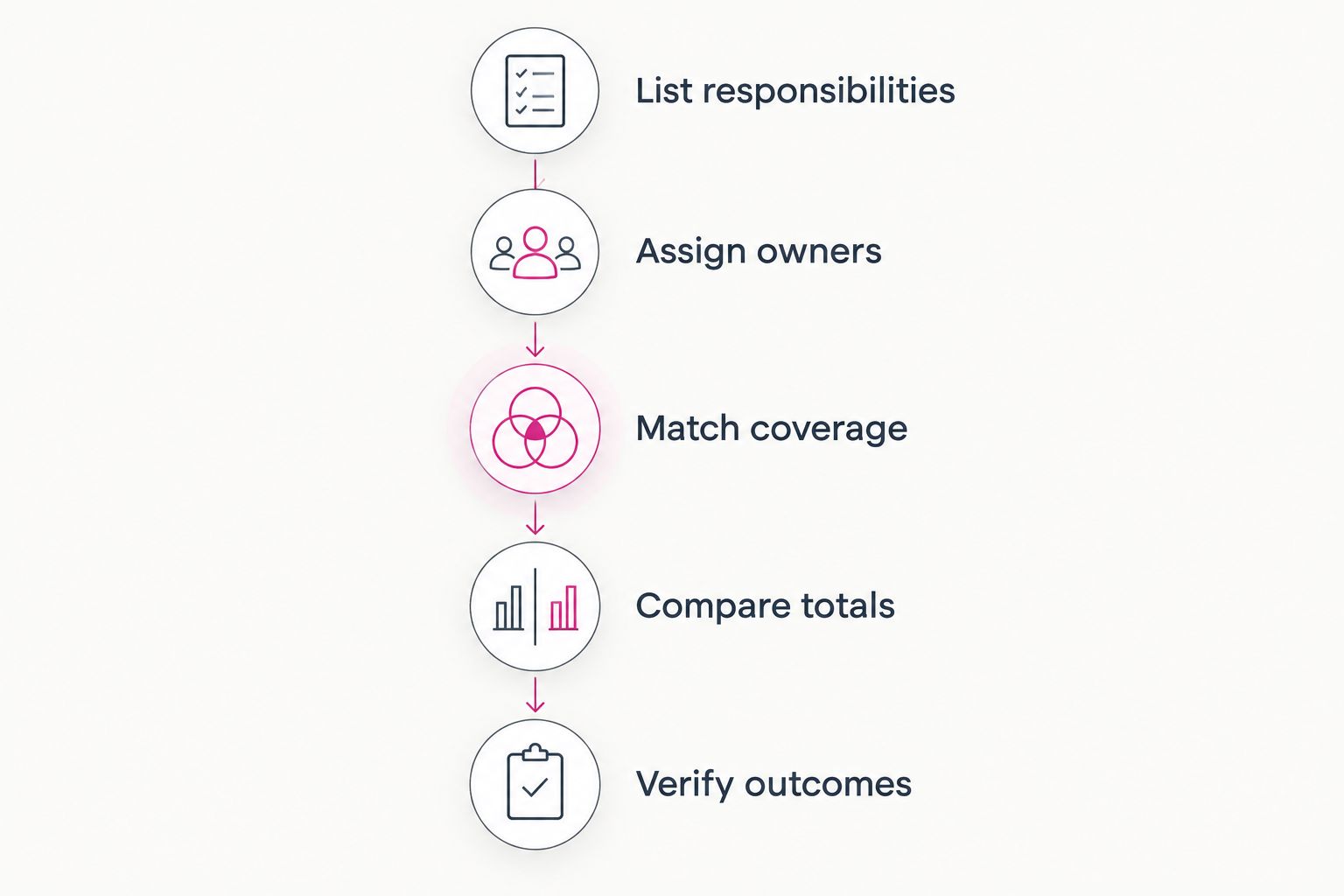
Use this sequence before approving either arrangement. Each step resolves a different source of ambiguity, from unassigned work to unsupported savings.
- List responsibilities. Write down support, security, cloud administration, backups, business applications, and planned projects that your business actually needs. Include existing unresolved work so it does not disappear during the comparison.
- Assign owners. Name the employee, provider, or application vendor responsible for each task. Specify who approves changes and who receives an escalation when the first owner cannot resolve the issue.
- Match coverage. Align systems, support hours, locations, and exclusions. If the proposals differ, ask for a revised scope or keep the difference explicit rather than treating the totals as directly comparable.
- Compare totals. Combine your actual retained staffing costs with each proposal's contracted work, tools, and transition requirements. Keep assumptions visible and distinguish ongoing operations from the initial handover.
- Verify outcomes. Define what successful delivery means: documented ownership, completed tasks, and evidence that agreed responsibilities are being performed. Make reporting part of the decision rather than an afterthought.
The order matters. Adding totals before matching coverage creates a precise-looking comparison of different services. Your worksheet should make scope differences visible enough that another decision-maker can understand them without a sales presentation.
Ask both providers to walk through the same operational example. An employee cannot access a business application: who receives the request, who investigates, who contacts the application vendor, and who confirms resolution? Written answers reveal scope differences that a service summary leaves unclear.
Can co-managed IT save money if I already have IT staff?
Co-managed IT reduces total spending only when the combined arrangement costs less than your equivalent alternative. Existing staff are not free simply because they are already employed. Their retained responsibilities and employment costs belong in the calculation.
Identify the exact spending the new arrangement would replace. That might be an existing service or a planned purchase in your own budget; it must be documented, not assumed. If the arrangement improves coverage without reducing spending, describe it as added coverage rather than savings.
Does fully outsourced IT eliminate internal IT work?
Fully outsourced IT does not eliminate your need for business ownership. You still approve priorities, authorize access, and decide which operational changes the business accepts. Technical execution and business accountability are different roles.
The agreement determines how much technical work remains internal. Name those remaining tasks before approving the proposal. An arrangement that depends on undocumented employee effort is not fully explained, regardless of its label.
Is around-the-clock support included in either model?
Support coverage depends on the agreement, not on whether the model is co-managed or fully outsourced. For your 2026 comparison, distinguish receiving requests, monitoring systems, investigating incidents, and performing remediation. Ask which activities are covered and who owns each one.
TeraCloud offers 24/7 support for small and midsize businesses. When evaluating a proposal, confirm how that support applies to your systems and retained team; do not assume it establishes a specific response deadline or project inclusion.
Where TeraCloud fits in the decision
TeraCloud provides managed IT, cybersecurity, cloud migration, Microsoft 365, and data management services. Those categories are relevant when your comparison includes external operational support and cloud administration. They do not, by themselves, establish which arrangement has the lower total cost.
The benefit is access to outside support across those stated service areas. The limitation for this decision is straightforward: service categories are not a substitute for a written division of responsibilities. Ask for a proposal tied to the tasks you intend to transfer, then compare it against retained staffing and the alternative scope.
FAQ
Is co-managed IT cheaper than fully outsourced IT in 2026?
Co-managed IT is cheaper only when retained staffing and outside support together cost less than equivalent fully outsourced coverage. Compare total operating costs, not provider invoices alone.
What's the best IT model if I already have an IT manager?
Co-managed IT fits when your IT manager retains necessary responsibilities and outside support fills defined gaps. Fully outsourced IT fits when you intend to transfer most daily operations, subject to the proposed scope.
Do I count existing employee salaries when comparing IT options?
Yes, include the employment costs of staff retained in each arrangement. Existing payroll remains part of the operating model even when a provider accepts other responsibilities.
Can I assume cybersecurity is included in outsourced IT?
No, the agreement must specify the cybersecurity responsibilities included. Identify who manages access, investigates alerts, and coordinates incident handling.
Does fully outsourced IT mean I no longer need an internal owner?
No, your business still needs an owner for priorities, approvals, and provider oversight. Outsourcing technical work does not transfer your business decisions to the provider.
Does TeraCloud offer around-the-clock IT support?
TeraCloud offers 24/7 support for small and midsize businesses. Confirm the responsibilities and coverage applicable to your proposed agreement.
How long should my IT cost comparison cover?
Use a common 12-month period as a budgeting method for both proposals. Separate recurring operations from transition and project work so the comparison stays clear.
Related guides
- Is co-managed IT worth it with in-house staff?
- Is outsourcing IT cheaper than hiring internally?
- Can managed IT replace an in-house department?
One last thing
A provider invoice tells you what the provider charges for its agreed work. It does not tell you what your complete IT operation costs. That distinction is the reason a narrower agreement can look cheaper without establishing any total saving.
Before renewing or replacing your IT arrangement in 2026, send both providers the same responsibility list and request proposals against it. Make that your next step. Decide between co-managed and fully outsourced IT only after the proposals show equivalent work, clear owners, and the costs your business actually retains.